
 Incredible facts
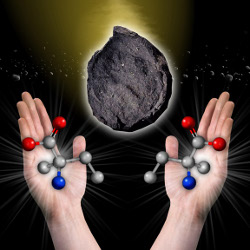
In 1995, a meteorite hit Earth, giving a new impetus to the development of the theory of panspermia, according to which life was brought to our planet from other planets. Grave Nunataks 95229, named after the crash site, proves the extraterrestrial origin of life on the planet.
For the study, scientists took only 4 grams of meteorite powder. The results of the chemical analysis were impressive: the substance contained a fairly large amount of ammonia, hydrocarbons, and, most importantly, nitrogen, which is part of proteins and DNA, which are the basis of all living organisms.
According to Professor Sandra Pizzarello, the results of the study show that asteroid fragments — meteorites — reach Earth, bringing with them substances (including ammonia), which wasn't enough on an emerging planet. It was these meteorites that brought nitrogen to Earth in the form in which it is necessary for the birth of primitive life forms.
Life between Mars and Jupiter
The very hypothesis about the extraterrestrial origin of life on Earth is based on the fact that when the planet was formed, it did not have enough simple molecules necessary for its origin primitive life. According to theory, the place from which the seeds of life were brought to Earth is the Asteroid Belt between Mars and Jupiter. At the initial stages of the formation of the Solar System, they were located in a zone where the heat and pressure from the ongoing processes were not so strong. When asteroids collided, meteors were formed in the belt that moved throughout the solar system. They probably brought the necessary materials to Earth.
Dr. Caroline Smith, a meteorite expert, says that the detection of nitrogen is the most important result of the study, but she would like to see it found in other meteorites as well. She acknowledges that nitrogen, which was scarce on an emerging planet, is essential for life to start. The question remains: Where did this nitrogen come from?
It is found on meteorites, but it is still unclear how, under what conditions and when the first living organisms appeared. Professor Pizzarello suggests that the substance has interacted with volcanoes and tidal waters, but again this is only a guess.
Murchison is too good
In 1969, a meteorite called Murchison fell on Australia. The space object turned out to be a real storehouse of organic substances, which proved the extraterrestrial origin of life. However, Professor Pizzarello says that Murchison contains hydrocarbon molecules that are characteristic not for the initial stage of life on Earth, but for subsequent periods. She adds that the composition of these random molecules is very complex, and it is unlikely that they played an important role in the origin of life on Earth.