
 Unbelievable facts
Contents:
What affects a child's growth
Methods for predicting a child's future growth
When Does the baby stop growing?
Child growth rate table by age
How to measure height
Even before a baby was born, you might have wondered what his height, hair and eye color would be like.
While we can't know everything in advance, there are a few clues that can help you know how tall your child is going to be.
What affects a child's growth
There are several factors that determine how tall or short your child will be, including:
1. Paul
Boys are generally taller than girls. By the end of puberty, they experience stunted growth. This delay gives them a 2-year advantage before the final growth spurt.
Read also: How to determine the sex of an unborn child?
Until the age of 12-13, boys and girls have approximately the same height, but after crossing this threshold, the growth of girls equalizes, and boys continue to grow until 17-18 years old.
In some cases, girls grow taller than boys, depending on hereditary factors.

© Sergey Novikov
2. Heredity
A person's height is usually inherited. Many members of the same family grow at the same rate and have similar heights. However, this does not mean that short parents can't have a very tall child.
3. Health status
If a child has some medical conditions, this can affect his growth, as in Marfan syndrome, a genetic disorder in which a person grows up to be unusually tall.
Diseases that can cause short stature in children include arthritis, celiac disease, and certain types of cancer. Also, children who have taken certain medications, such as corticosteroids for a long period, may not grow tall enough.
4. Meals
Growth takes a lot of energy. Overweight children are often taller than others, but staying in shape is essential for children's development.
A balanced diet helps the child achieve maximum growth. At the same time, if the diet lacks important nutrients, this can delay the child's growth.
5. Physical activity
Exercise is important for staying fit and healthy. In addition, physical activity helps the child's growth and development, and lack of physical activity slows down growth due to weak bone structure.
Overall, about 60-80% of a person's height is determined by heredity. The role of external factors, especially nutrition, is about 20-40%.
Methods for predicting a child's growth in the future

© Photo Images
There are several methods for predicting a child's growth, and although they are not completely accurate, these scientific methods can give you a clearer picture of your child's future growth:
1. Growth at an early age
To calculate a boy's adult height, multiply his height at the age of 2 by 2.
For girls, multiply her height at 18 months by 2.
For example, for a girl 78 cm tall at the age of 18 months, the future growth will be: 78* 2 = 156 cm
2. Average parental height calculator
This formula is one of the easiest ways to calculate a child's height by knowing the parents' height. The method was developed in 1948 by Horace Gray based on the average height of parents.
1. Let's calculate the height of the parents.
(mother's height+father's height)
2. To find out the girl's future height, you need to subtract 13 cm from her parents' height.
The girl's height = the height of the parents is 13 cm
3. To find out the boy's future height, you need to add 13 cm to the parents' height.
Boy's height = parents' height +13 cm
4. Divide the sum by 2.
For example, the boy's mother is 167 cm tall and the father is 182 cm tall.
167 + 182 = 349
349+ 13 = 362
362/2 = 181 cm
The error of this method is +/- 10 cm.
3. Khamis-Roche formula
The Khamis-Rosh method was developed in 1994 at Wright State University in the United States by Dr. Harry Khamis and Alex Roche. This formula is suitable for children over 4 years of age.
This formula is suitable for children over 4 years of age.
Boy's height = 22.7 + 1.37* height at the age of 2
Girl's height = 25+ 1.17* height at the age of 2
If you don't want to test your math skills, you can use an online calculator to determine your child's height.
This is a more accurate method for predicting a child's growth without determining the age of the skeleton. For boys, the error is about 5.3 cm, and for girls it is 4.3 cm.
4. Bone age X-ray
This method was developed in 1959 and is considered to be the most accurate. It includes an X-ray examination of the child's hand, fingers, and wrist.
The X-ray shows the growth of the child's bone growth plates. As they mature, the growth plates become thinner, and when growth is complete, they disappear.
The doctor can use bone age to determine how tall a child will grow.
When does a baby stop growing?
Girls and boys are most likely to experience a growth spurt during adolescence. This happens at different ages depending on gender.
Girls' growth is fastest during childhood and accelerates rapidly when they reach adolescence. On average, girls reach adulthood at the age of 14-15 years, or several years after their first menstrual period.
Boys enter adolescence later than girls at about 12-15 years of age, and the greatest growth occurs 2 years later than girls. The growth rate of most boys slows down by age 16, but often continues to increase until age 18.
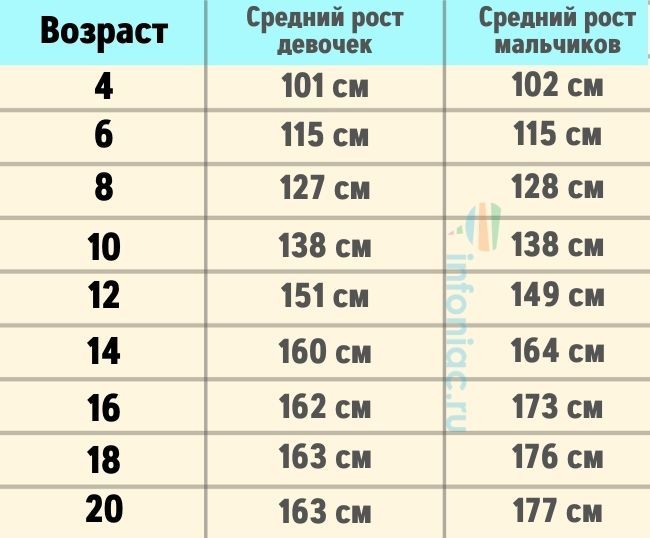
Table of child growth rates by age
Growth rate tables are an important tool used by doctors to determine whether a child is growing properly. They are based on regular measurements of the child's height, weight, head size and body mass index.
In the table below you can find the average height for different ages.
How to measure height
1. Stand with your back against the wall. Take off your shoes and hats and try to stand with your back straight.
2. Your head, shoulders, back and heels should touch the wall.
3. Place a book or box above your head so that it forms a right angle against the wall.
4. Mark with a pencil or sticker where the bottom of the book is in contact with the wall.
5. Measure your height from mark to floor.