
 Ecology
Circular spiders know how to avoid getting caught in their own sticky webs: to do this, they move in a special way, as recent studies have shown. For the first time, naturalists solved the riddle about the movement of spiders on their webs a century ago. Then scientists suggested that the spider's paws have a special coating that does not stick to the net.
Using modern image processing technologies, scientists from Costa Rica made video recordings that helped explain the spider's ability not to stick to its own web.
Circular spiders can be found in large numbers around the world, but their ability to avoid getting caught in their own nets has puzzled scientists for a long time, said one of the study's authors Dr. William Eberhard (William Eberhard).
Features of round-worm spiders:
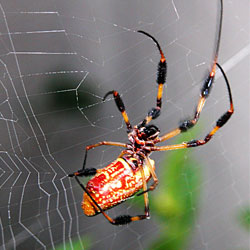
— The Nepila clavipes spider (pictured) can be found in South and North America.
— About 3,500 species of round-worm spiders are known, including the common cross spider that lives in the US and Europe.
— Sometimes these spiders are called goldworms
Researchers who observed spiders in the early 20th century assumed that spiders covered their legs with oily liquid, but this remained just a theory. Recent studies have shown that spiders “tiptoe” on their web, touching it with thin hairs, thus avoiding too close contact with the sticky surface of the web.
However, while making their web, spiders forcefully kick the net, but still somehow they manage to avoid sticking to it.
To solve the riddle, Dr. Eberhard and his team of scientists used a camera and a microscope, which helped to examine how the spider works in detail.
Scientists have identified three factors that allow the spider not to stick: hairs on the legs, which reduce the area of contact with the surface, the chemical coating of the hairs, which reduces stickiness, and there are also special movements of spiders with their legs.
Under the microscope, scientists noticed that when a spider touches the web with its paw, sticky droplets come into contact with the hairs. As soon as a spider lifts its leg from the web, droplets slip off its non-sticky hairs. In the same way, water droplets slip off the leaves of tropical plants.