
 Ecology
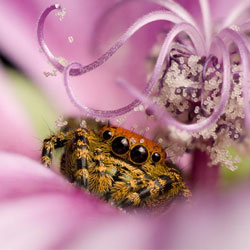
Horse spiders, which hunt by cleverly grabbing their prey into their arms, measure the distance to their potential victims in a unique way that is not typical for any other animal the world, as new research has shown. Scientists believe that their unique ability is due to the fact that spiders see green.
There are several vision systems that organisms use to accurately assess distance and depth. A person, for example, has binocular stereoscopic vision. Because our eyes are spaced apart, they receive visual information from different angles, and our brain uses it to automatically reproduce 3D image. Other living things, such as insects, adjust the focal length of the lenses in their eyes or move their heads from side to side to create an effect called motion parallax — more Close objects will move faster in view than distant ones.
Horse spiders (Hasarius adansoni) do not have such customizable vision systems, their eyes are too close together for binocular stereoscopic vision, and they do not use motion parallax during hunting. How can these creatures perceive depth?
Researchers in Japan have recently discovered that arachnids sense distances very accurately by comparing unclear image outlines with clear ones, this method of assessing distance is called image defocusing.
Horse spiders have four eyes located next to each other in a row: two large main eyes and two additional ones on each side. Spiders use small side eyes to see the movement of an object, such as a fly, which is then targeted by the main pair of eyes, said study author Akihisa Terakita , a biologist from Osaka University, Japan.
Instead of a single layer of visual receptor cells, the retina of the spider's main eyes has 4 different layers of visual receptor cells. When Terakita and his colleagues studied the spider's main eyes in more detail, they found that two layers closer to the surface contained UV-sensitive pigments, while deeper layers contain pigments that are sensitive to green color.
Due to the corresponding distances of the layers from the lenses of the eye, incoming green light is captured only by the deep layer, while the other retinal layer sensitive to green receives defocused or blurred images. The researchers hypothesized that spiders measure depth based on the level of image blur on this layer. This level of blur differs depending on the distance from the subject.
To test this, scientists placed a spider and 3 to 6 fruit flies in a cylindrical plastic chamber that was inserted into a white foam box. Then they began to send light of different colors to the insects. If green light defocus is so important to spiders, they won't be able to estimate the distance correctly in the absence of green light.
As it turned out, in green light, spiders easily saw and grabbed prey, but could not find their way around in the red rays at all. Scientists believe that green light, and not light from a different wavelength, is needed to defocuse the image correctly and necessary for spiders to estimate distances.
Scientists do not yet know for sure whether other living creatures use this technique of depth perception. In the future, these discoveries may be used for the design of visual systems in robots.