
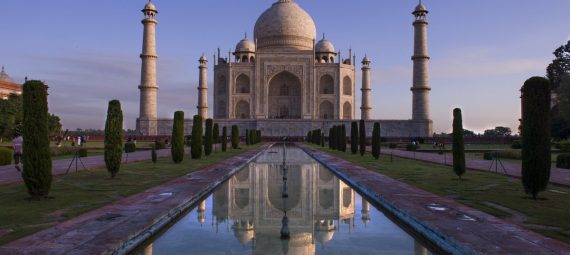
1. Taj Mahal
The Taj Mahal, a miracle on marble, was built by Mughal Emperor Shah Jahan in memory of his beloved wife, Empress Mumtaz Mahal. Shah Jahan married Arjumand Bano Begum (Mumtaz Mahal), the granddaughter of Itimad-Ud-Daul, the wazir (Prime Minister) of Emperor Jahangir in 1612 AD.
Mumtaz Mahal died in 1631 AD at the birth of the 14th child. The grief-stricken emperor made every effort to build a tomb in her memory, which is universally recognized as one of the seven wonders of the world and the main attraction of India.
Artisans were requisitioned from all over the empire, including Central Asia and Iran. And the bricks for the inner frame were made on the spot. The white marble for the exterior surfaces was imported from Makrana, Rajasthan. The inscription on the northern facade indicates the year 1057 AH. (1647 AD) as the completion date after 17 years.
The Taj Mahal plan demonstrates strict bilateral symmetry. The central point is the tomb (rauza) and its four minarets, surrounded by a mosque and an assembly hall (Mehman Khan). The Taj Mahal is exactly the same width as the height (55 meters). The highlight of the monument is the elaborately carved pietra dura, inlaid with semi-precious stones.
The color of the translucent marble is constantly changing from dawn to midnight, giving it a magical aura in accordance with Shah Jahan’s vision that the tomb and garden should represent paradise on earth. This is a unique man-made manifestation of the glorious era of the Mughals and a wonder of the world.
After his death in 1666 AD, Shah Jahan was buried next to his beloved wife in the Taj Mahal.
Official website: www.tajmahal.gov.in
2. Varanasi
Varanasi, a sacred city in India, is also known as Kashi and Benares. Varanasi is the most popular place of pilgrimage for Hindus, the city is sacred to Hindus and Jains, one of the seven sacred cities of India. It is believed that this is where the abode of Shiva is located, Varanasi is located on the banks of the Ganges River, in which, according to Hindus, you can wash away all your sins.
Varanasi is considered the oldest city in the world, it is more than 3000 years old. Varanasi or Kashi is also known as the city of temples, temples are here at every turn. The most famous temple in Varanasi is the Golden Temple, restored in 1776, which is dedicated to the god Shiva.
3. Ajanta Caves
Ajanta Caves are Buddhist monuments in rock caves dating back to the 2nd century BC, which are masterpieces of Buddhist religious art. The magical caves of Ajanta were abandoned around 650 AD, and everyone forgot about them until 1819, when the British did not stumble upon them while hunting. Their isolation contributed to the fact that they were perfectly preserved.
The caves are located 100 km northeast of Ellora, 104 km from Aurangabad and 52 km from Jalgaone Railway Station. They crash into the volcanic lava of the Deccan in the forest gorges of the Sahardi Hills in the picturesque surroundings. Ajanta Caves contain drawings and sculptures that depict the life of the Buddha.
4. Jaisalmer
Jaisalmer or “Golden City”, is a city in the Indian state of Rajasthan. It is located 575 kilometers west of the state capital Jaipur, near the border of Pakistan. Jaisalmer stands on a ridge of yellowish sandstone, in the middle of the great Indian desert or Thar Desert. The city is crowned with a fort, which houses a palace and temples.
Jaisalmer was founded at the crossroads of camel caravans traveling through the desert, with exotic spices and precious silks. This strategic location of Jaisalmer made it possible to remove tribute from merchants, as the main caravan routes connecting India with Persia and Egypt passed through it.
5. Harmandir Sahib
Harmandir Sahib (ਹਰਿਮੰਦਰ ਸਾਹਿਬ) or Darbar Sahib, also known as the Golden Temple of Amritsar, is the central holy place in the Sikh religion. Keeping the most sacred scripture of the Sikh faith, Guru Granth Sahib, in the temple grants Harmandir Sahib the highest blessing. The fourth guru of Sikhism, Guru Ram Das, dug a reservoir in 1577 AD, building a temple in it. The gilded temple located in the tank created an impressive effect. The reservoir was named “Amritsar”, which means “The Nectar Pool of Immortality”. The city that grew up around the holy temple received the same name. Harmandir Sahib means “House of God”. So, the full meaning of this word is “The House of God sitting in a pool with the Nectar of Immortality.”
Harmandir Sahib is located in the center of the old part of the city of Amritsar, Punjab province in India. The golden temple sits on a rectangular platform, surrounded by a pool of water. The temple building has four entrances, instead of the usual one. It is a symbol of the openness of Sikhism and indicates that followers of all faiths can enter it. The walls of the temple are decorated with carved wooden panels and intricate inlay in silver and gold. The Golden Temple is open to everyone. Pilgrims and visitors to the Golden Temple should take off their shoes and cover their heads before entering.
Harmandir Sahib became a place of grief and loss in the 1980s — many people died here. After the proclamation of the state of Khalistan, Sikh extremists hid inside the Golden Temple, 400 soldiers and 2,000 Sikhs died when the Indian army stormed the temple in 1984. In response to these atrocities, Prime Minister Indira Gandhi was assassinated by her own Sikh bodyguards a few months later.
6. Kanha National Park
Kanha National Park is located in the state of Madhya Pradesh, in the heart of India. Kanha National Park is one of the tiger reserves. Kanha is considered one of the best wildlife areas in the world.
Kanha is definitely a paradise for wild animal species that live in a natural habitat. It was Kanha who became the source of inspiration for Rudyard Kipling to write his famous novel The Jungle Book.
Official website: www.kanhatigerreserve.com
7. Palolem (Palolem)
Palolem is undoubtedly one of the most open ideal beaches of Goa, palm trees, gentle sand and a calm bay, it is an ideal place for a beach holiday. It is considered an ideal place for a family holiday in a tropical paradise with a turquoise sea.
8. Virupaksha Temple
The Virupakshi Temple is located in Hampi, 350 km from Bangalore, in the state of Karnataka in southern India. Hampi was once the seat of the Vijayanagara Empire and the Virupaksha Temple is part of a group of monuments built in 1336-1570 AD. The Virupakshi Temple is dedicated to the god Shiva and is known as one of the most sacred temples in Karnataka.
9. Lake Palace
Built between 1743 and 1746 on a small island near the Jagmandir Palace on Lake Pichola, the palace is a wonderful sight. The walls of black and white marble are decorated with semi-precious stones and ornamented niches. Gardens, fountains, terraces with columns and columns decorate courtyards. In the 20th century, the palace was transformed into a hotel for millionaires.
10. Agra
Agra is an ancient city on the banks of the Yamuna River. It is mentioned in the Mahabharata (ancient Indian epic), but gained global significance as the capital of the Mughal Empire from 1556 to 1658. Agra is located on the tourist route of the Golden Triangle with Delhi and Jaipur. The city is known for its Mughal architecture and the fact that one of the seven wonders of the world, the Taj Mahal, is located here – a monument of incredible elegance and architectural perfection. Agra has many other famous archaeological sites, it is famous for its marble inlay and its leather industry, which produces shoes for the best shoe companies in the world.
11. Mattancherry Palace
Mattancherry Palace, reminiscent of the influence of the Portuguese and Dutch, is today one of the best museums in India both from a historical and architectural point of view. Over the years, it has become one of the most famous tourist destinations in India, attracting both local and foreign tourists all year round.
Portuguese explorer Vasco da Gama was warmly welcomed by the rulers of Kochi when he landed in India in 1498. The Portuguese were allowed to build factories. The palace was built by the Portuguese in the middle of the 16th century, around 1555, and presented as a generous gift to the King of Cochin – Raja Veera Kerala Varma. In 1663, the Dutch seized power. They carried out some expansion and major repairs in the palace. Subsequently, the Rajas also carried out repairs that gave it a more Hindu texture, which over the centuries turned the Palace into one of the most significant places illustrating the primitive art of Hindu temples.