
 Ecology
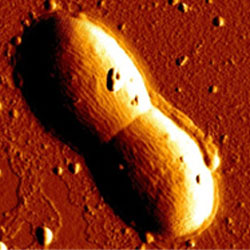
Scientists have recently discovered a deep-sea bacterium at the bottom of the Pacific Ocean that can survive without food for a long time. These bacteria are doing quite well despite being fed at a minimum of 86 million years.
The bacterium was found under a layer of soft red silt at the bottom of the Pacific Ocean, where there is an underwater current. In this area of the ocean, almost nothing can sink to the bottom. Most of the dying plankton dissolves in water and is carried away before any parts of it can even reach the bottom. It is very rare for a single particle to reach the bottom.
“If you imagine a grain of sediment falling to the surface, it will take at least a thousand years before another grain of sand falls next to it,” says Hans Roy of Aarus University in Denmark.
Roy was one of the members of a team that recovered in 2009 for samples of ancient rainfall and found living bacteria hiding in the mud that were completely unafraid of what they had in these places there are practically no nutrients.
Sediments form on the ocean floor at a rate of about 1 millimeter in 1,000 years. Therefore, when researchers found that the sediment was about 27 meters thick, it became clear that this silt was several tens of millions of years old.
“These bacteria left the surface, taking lunch 86 million years ago, and are still using this “ration,” the scientists say. “It looks like they have temporarily stopped their lives features. It seems like they split the cake first by half, then half, then again and again, but no one gets the last slice. This is just amazing.”
Roy and colleagues believe that these bacteria have the slowest metabolism in the world, receiving minimal amounts of oxygen and nutrients that allow them to survive.
“I weigh 65 kilograms and eat about 1 kilogram of food a day, so it'll take me about 2 months to eat foods that are equal in weight,” Roy says. “Imagine these organisms It will take a thousand years to eat food that is equal in weight to them. It looks like a slowdown in vital functions.”
Roy can't say exactly how old these bacteria are. They seem to have been breeding quite slowly since the time of dinosaurs. Or some representatives may be about a million years old and are able to recover well and quickly to cope with age-related injuries.
In any case, these microorganisms have a very unusual life cycle that we can hardly imagine. “For example, we know that a tree is growing and changing, but if we look across and look at it, we won't notice any changes. In this case, we need a completely different timeline,” Roy says.