
 Ecology
It is very rare to see eyes, guts and gills preserved in fossils. Bacteria, which are found almost everywhere, are so voracious that they eat all the soft tissues of living organisms before they settle down and gradually turn into stones. Usually, shells, bones and teeth reach us from ancient times.
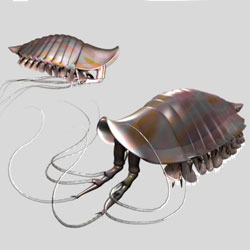
Nevertheless, paleontologists have discovered amazing fossils that preserved the soft bodies of animals — the four-eyed arthropod species Leanchoilia (pictured), which lived on the planet half a billion years ago. How is this possible?
It turned out that the ocean's chemical composition half a billion years ago was not at all the same as it is today. At that time, extreme conditions in the ocean inhibited the appetites of hungry bacteria, which prevented living beings from decomposing. This helped humanity look at the development stages of our distant ancestors, otherwise many things would be lost to us forever.
Leanchoilia is one of dozens of interesting creatures from the point of view of science. It did not have a skeleton or other solid parts of the body and appeared during the Cambrian Explosion, when complex life forms began to develop from unicellular cells very quickly.
More than a hundred years since Leanchoilia and other soft-bodied creatures were discovered in the famous Burges-Shale formation in British Columbia, Canada, scientists have not been able to understand how these soft animal fossils have been able to survive and reach us. This phenomenon was explained by the unusual conditions that were observed at that time.
Recently, a team of researchers led by paleontologist Robert Gaines from Pomona College, California, was able to determine the chemical composition of seawater, which helped explain how this is how Leanchoilia and her contemporaries were able to avoid decay after death.
In the journal Proceedings of the National Academies of Science, scientists presented 3 factors that helped contain bacteria: lack of oxygen, small amounts of sulfates, and excess carbonate calcium.
1) Lack of oxygen
The first condition that allowed Leanchoilia's corpses to remain in excellent condition was that there was not enough dissolved oxygen in the ocean, so storms and avalanches are fast enough they buried dead animals in soft mud, but they did not have time to decompose. At that time, oxygen-loving bacteria posed no threat when they are present in the ocean today and are rapidly breaking down organic objects.
2) A small amount of sulfates
Another advantage for preserving Leanchoilia's bodies is the obvious lack of sulfates in seawater. These specific chemicals are also essential for bacteria to function.
Gaines and colleagues discovered this factor when they analyzed the presence of sulfur in Burges-Sheil-type sediments from 6 different parts of the world. This discovery was very important. A huge number of bacteria would like to use sulphates instead of oxygen to take energy for their dirty work. Scientists have noted that sulphates are now a common component of seawater. In many marine conditions, bacteria that use sulphates act in the same way as oxygen-loving species. At the time of Leanchoilia, both of these types of bacteria seemed to be struggling.
Even very small amounts of sulphates in sediments could cause animal bodies to decompose before they became fossils. And a small amount of sulfates was still available, according to scientists. So they suggested that there should be another factor that would make an impact.
3) Excess calcium carbonate
Shortly after Leanchoilia's accidental burial, a thin layer of calcium carbonate formed on the seabed, which helped to “prime” the animal's grave. This layer kept bacteria from reaching his body. In other words, the cement barrier cut off hungry microorganisms, dependent on sulfates, from mining and from a single source of energy.
Previous studies have shown that seawater contained more calcium carbonate during the Cambrian period than it is today. Gaines's team was the first to provide direct evidence of the presence of carbonate layers in fossil sediments. They found these layers in two rock samples taken from sediments in China.