
 Ecology
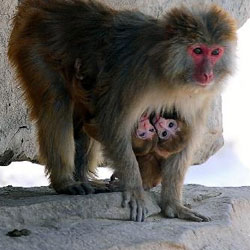
For the first time, twins were recorded in wild Tibetan macaques. In many primate species, twins are rarely able to survive, so the mother's involvement in caring for them is most important.
Perhaps only the best mothers in the animal world, as well as in the human world, can raise and raise twins. In the wild, twins often die right after birth, or only one becomes an adult.
The Tibetan macaque, the mother of twins described in the latest issue of Primates magazine, is undoubtedly doing its job well. “She looked pretty healthy,” says research author Megan Matheson, professor of psychology at Central Washington University. “I was impressed when I first saw her I watched her in August 2010 when she was running with two, now pretty big babies hanging on her!”
The last time Matheson saw them, the kids were alive. They have not yet reached the age of 2, but we can say that they were still in their childhood. Both twins turned out to be boys. But they won't be really adults until they're 7 years old.
Matheson and her colleagues found a mother with twins among a group of free Tibetan macaques in Huangshan, China. They observed the mother for 5 months after giving birth, comparing her behavior to that of other females who have one baby or are childless.
The researchers found that the twins' mother spent more time looking for food and relaxing, but her social interaction was no different from other female macaques in the group.
She seemed to love showing her twins to others, and her relatives showed a lot of interest in her offspring. For some reason, she tried to show one twin more often than her brother. Scientists don't really know why this happened yet. Perhaps it was because the monkey was right-handed and one of the children was on the right side, so she showed it, or she simply preferred him more.
The males of these primate species, like many others, do not share parental responsibilities. Female Tibetan macaques mate with many males during the mating season. “Dominant males are more successful, but lower males also manage to find partners,” Matheson said. As a result, paternity is difficult to define.
Although uncertainty about paternity is normal in these animals, adult males protect all young in the group if they are in danger, but they do not necessarily pay attention to one person.
In some primates, females can help each other raise their young, but this behavior is not common for Tibetan macaques. Matheson suspects this is happening because “females are not very good at protecting their young and give them too much freedom as soon as they begin to move on their own.” Even if the mother is still feeding the young, she can leave them and go looking for food, while her children will be left to themselves.
Due care for twins in primates is rare, except for one family of South American monkeys called “marmosets”, which includes species such as tamarins and marmosets. Females of these monkey species tend to bring twins, while males help them raise babies. Sometimes the mothers and fathers of these monkeys also raise triplets.
Research has shown that in humans, women who give birth to twins live longer, have more children than they expect, become pregnant at shorter intervals and at an older age they give birth to their last child.
Shannen Robson, a professor of anthropology at the University of Utah, who studied twin mothers, said that more resilient women are more likely to naturally give birth to two at once kids.
“Having twins before won't make you stronger and healthier, but stronger and healthier women are more likely to have twins,” she explained.
Naturally, it is quite difficult to bear two fetuses at once, even visually the abdomen is much larger if a woman is pregnant with twins. However, evidence shows that twin mothers live longer and are more fertile.
As for the Chinese macaque, she is quite energetic and even knows how to save her time. For example, she insists that children be fed at the same time. For example, if one of the twins wanted to eat lunch, she wouldn't let him get close to the pacifier until her brother also came running for food.
This monkey gave birth to twins when she was quite young, and it is possible that she will be able to give birth to more twins in the future.