
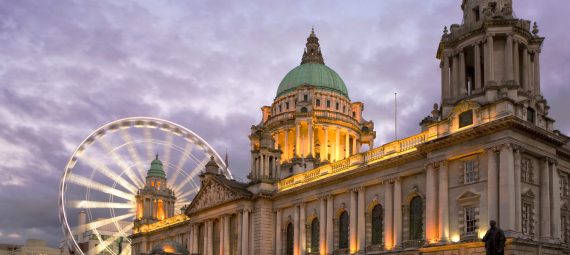
Town Hall
The monumental building of the city council was built at the beginning of the 20th century in a mixture of architectural styles. Classicism prevails, diluted with elements of Baroque and Victorian architecture. Stairs, gates and facade are decorated with several types of marble, stained glass arched windows of the second floor depict important events from the history of the city, an impressive 50-meter dome and corner towers of the same height harmoniously complete the image of the structure.
The Town Hall is a functioning administrative building, where meetings of the local administration are held. Tourists can only go inside with a guide.
Address: Donegall Square N, Belfast BT1 5GS.
Belfast Castle
Built in the 19th century, Belfast Castle became the successor of the Norman fortress, which was destroyed by time and endless wars. The structure of light sandstone was erected in the baronial style with imitation of medieval architectural elements: knight (gun) towers and a crenellated roof with a stepped pediment. Not without the influence of Neo-Gothic. The castle is surrounded by an English garden with alleys, fountains and perfectly aligned flower beds.
There is a souvenir shop in the basement — a real antique shop with unique things.
Address: Antrim Rd, Antrim Rd, Belfast BT15 5GR.
Royal University
The university is one of the top 20 educational institutions in the UK, as well as many prestigious European associations. The complex occupies 7 city blocks. From an architectural point of view, the main red brick building, designed by Charles Lanyon in a mixture of styles, is of interest. The tone of the whole structure is set by Gothic and modern. Huge stained glass windows with complex frames and towers with battlements make it look like a castle, and the intricate facade decor evokes associations with mansions in the manner of Portuguese Manuelino.
Address: University Rd, Belfast, BT7 1NN.
Titanic-Belfast
On the shore of Belfast Lough, on the territory of the former shipyard of the Harland & Wolfe company, there is a huge museum dedicated to the history of the sunken Titanic and its more successful brothers – the transatlantic liners Olympic and Britannica. The complex was built in 2012 on the site of abandoned docks that no one needed after the decline of the shipbuilding industry in Belfast. The museum building was built using advanced technologies of modern architecture, it looks very well against the background of the port landscapes.
The exhibition is located in 9 galleries. She tells about the construction of three giant ships, the wreck of the Titanic, the consequences of the disaster and about the numerous myths and legends associated with this event.
Address: 1 Olympic Way, Queen’s Road, Belfast BT3 9EP.
Cathedral of St. Anna
Belfast Cathedral was built for a long time and thoroughly. The result was a majestic building in the Romanesque style in its Irish execution. The appearance of the temple is slightly oppressive with its massiveness, but decorative balustrades and multi-level arches of the entrance and windows soften the first impression. Filigree stained glass windows and light details of the facade add grace to the structure. The interior is solemn and simple — stone walls, mosaic marble floor and rows of wooden benches. In the cathedral there is an organ of the early 20th century, its divine sounds can be heard during services.
Address: Donegall Street, Belfast, BT1 2 HB.