
Nijo Castle
The national treasure of Japan, the UNESCO World Heritage Site, one of the most beautiful castle complexes of the “land of the rising sun” — all this is about the amazingly powerful and at the same time elegant Nijo Castle (Nijo-jō), located in the “heart” of the city of Kyoto.
Arashiyama
Mount Arashiyama on the outskirts of Kyoto has long been famous for the beauty of its landscapes, it was here in the 10th century that the traditions of admiring the blooming spring sakura and red autumn maples were born. These days, crowds of Japanese and tourists wander along the paths, but in summer there are few people here.
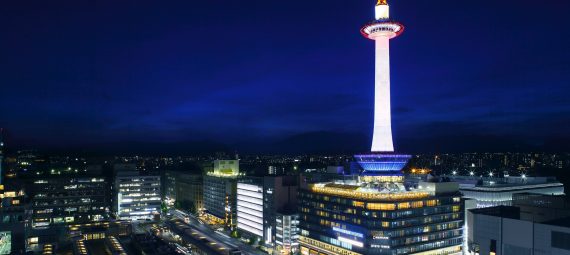
Kyoto Tower
This steel tower is the tallest building in Kyoto. Its observation deck is located at an altitude of 100 m, and together with the spire, the height of the tower reaches 131 m. The tower weighs 800 tons and is installed on the roof of a nine-storey building, which houses a 3-star hotel and several shops.
Fushimi Castle
Once one of the most refined and amazingly decorated castles in Japan, today, alas, tourists will be pleased only with a perfectly restored facade. All the luxurious “stuffing” that Fushimi had has not survived to this day.
Kiyomizu-dera
Kiyomizu-dera is a Buddhist temple famous throughout Japan, founded, according to legend, in 778 at a waterfall on the slope of Mount Otowa. It was like this: one wandering monk Entin was given a dry tree by another hermit named Geei (these are the gifts the monks have, what they are rich in, as they say).
Kyoto University
Kyoto University is the second most prestigious university in Japan after the University of Tokyo. Kyoto University was founded at the end of the 19th century and for a long time had the status of an imperial university, now it is considered a national university, and therefore it is very honorable to study here.
Enryaku-ji Monastery
Enryaku-ji Monastery, located on Mount Hiei, in the east of the mountain range near Kyoto, is one of the most important Buddhist monasteries in Japan. Founded in the 8th century, it once controlled about 3,000 temples across the country and even had its own army of warrior monks.
Ryukoku Museum
The Ryukoku Museum is open in one of the most striking buildings of the ancient Japanese capital. Behind the ultramodern facades there is an extensive collection of religious artifacts demonstrating the development of Buddhism from its birth to the present day.
Kyoto National Museum
The museum, which was then called the Kyoto Imperial Museum, was founded simultaneously with the Imperial Museums in Tokyo and Nara, in 1889. The construction of the majestic building was completed in 1895, and 2 years later the museum opened its doors to visitors. The museum received its current name in 1952 .
Gion District in Kyoto
This area of Kyoto began to be built up in the Middle Ages and was located opposite Yasaka Temple. The Gion was built in order to meet the needs of travelers and pilgrims arriving at the temple. But as a result, it has become one of the most exclusive and popular geisha quarters.