
 Unbelievable facts
Scientists have revived a number of ancient viruses found in Siberian permafrost. Although the study carries some risks, viruses need to be studied due to the growing danger of permafrost melting caused by climate change.
An international team of researchers from Russia, France and Germany has discovered and revived 13 ancient viruses from samples collected in icy areas of the Russian Far East.
Among them was a virus that is estimated to be 48,500 years old.
Scientists hope that the study will reveal how humans and animals coped with these viruses.
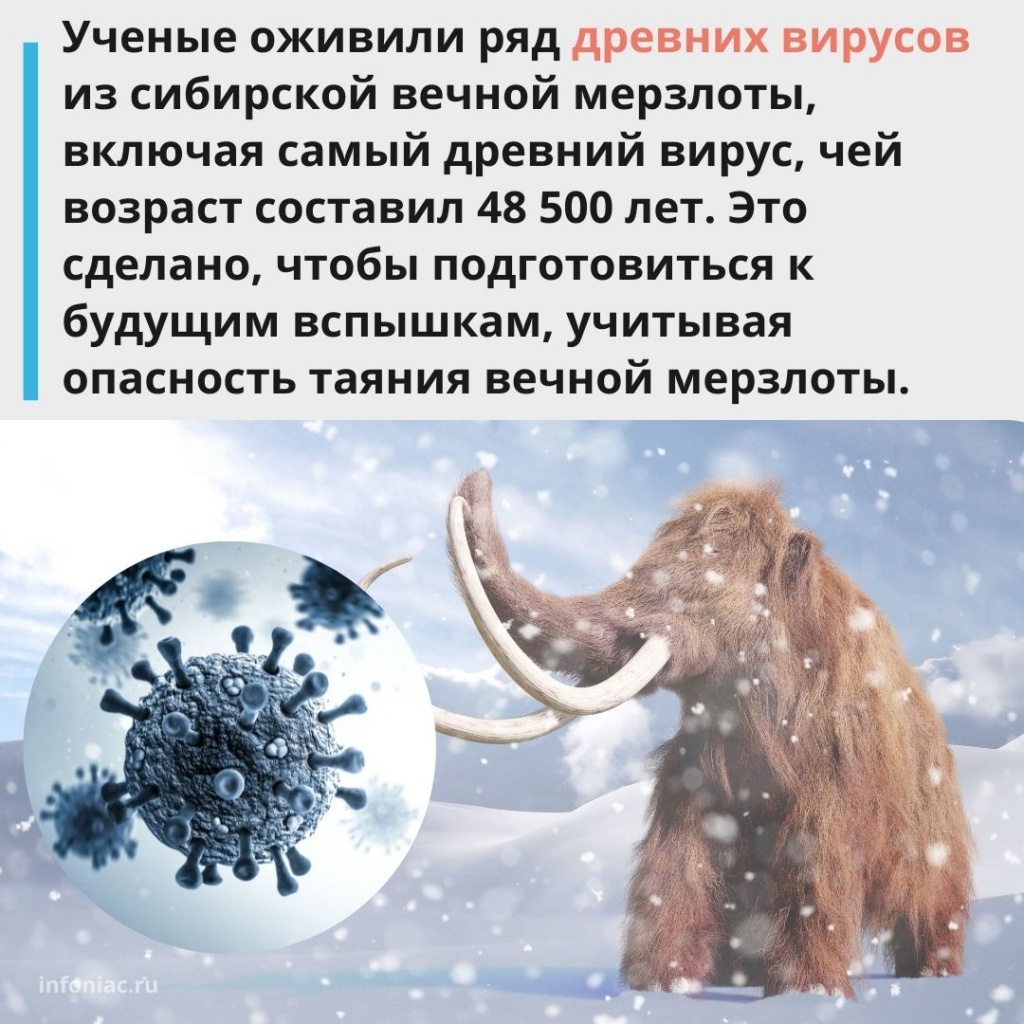
Three of the newly discovered viruses were taken from a sample of 27,000 years old mammoth excrement and icy permafrost with mammoth hair. They were named Pithovirus mammoth, Pandoravirus mammoth and Megavirus mammoth, respectively.
In addition, 2 new viruses, Pacmanvirus lupus and Pandoravirus lupus, were derived from Siberian wolf stomach contents.
All living viruses belong to the pandoravirus type, a group of giant viruses that infect amoebas. However, experiments show that they are still able to enter cells and multiply, which means they can be pathogens.
Read also: The world's largest virus has been discovered
This means that other permafrost viruses can pose a potential threat to plants, animals, or even humans.
The researchers explained that climate change may lead to the revival of many ancient viruses, but it is not yet possible to accurately determine their level of danger. They intend to study viruses in order to develop new vaccines and antiviral drugs.