
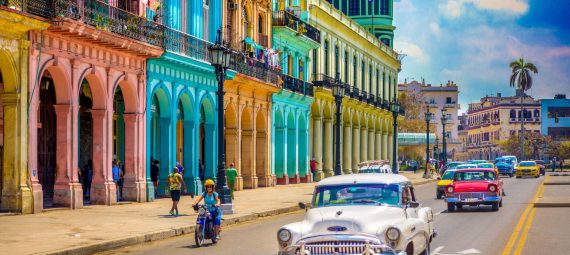
The historical center of the city, Old Havana, was included in the UNESCO World Heritage List of Humanity in its entirety in 1984, along with buildings, squares and historical monuments. The total list of attractions included almost 1000 objects. Naturally, this part of the capital is the most famous and most popular among tourists. The vast majority of Havana’s must-visit places are located here.
Strictly speaking, Old Havana can only be called the part of the city near the bay, which was once surrounded by a fortress wall. What begins next, in the Capitol area, is a later development that began in the 18th century. But now it is already called Old Havana, and everything else that cannot be definitely attributed to any of the neighboring districts – for example, the fashionable Vedado.
On the water side, Old Havana is bounded by the Malecon Embankment, a seven-kilometer promenade full of monuments and historical buildings. From it, the Prado Boulevard, the central city avenue, the core of Old Havana and the center of urban life goes deep into the city. A few steps away from it is the stunning building of the former presidential Palace, where the Museum of the Revolution is now located. Moving along the boulevard further, you can get to the Grand Theater of Havana and the Havana Capitol — perhaps the main architectural landmark of the city. The second most important architectural and historical monument of Old Havana is the Cathedral on Cienaga Square, near La Fuerza. Nearby is the central Plaza de Armas. The ancient Iglesia de Nuestra Church, Revolution Square with the Jose Marti monument and the famous Colon Cemetery with its sculptures are located on the other side of the Prado and quite far away.
In general, the capital of Cuba is not a small city, and Old Havana is no match for European medieval towns that can be bypassed in half an hour. Of course, it is most pleasant to walk along the small streets near the port. The old pharmacies still have century-old cash registers, the floors in the shops are lined with ancient marble mosaics, the door and window openings are very high. Classic tourist routes usually run from square to square: Arms Square, San Francisco Square, Old and Cathedral Squares. Nevertheless, sometimes it’s worth getting off the beaten track: even in the historical part of Havana, you can take only a couple of steps away from the trodden path and see the real life of Cubans: almost slum quarters, houses in almost disrepair, colorful locals.