
 Science
Ever since humans went to outer space, we've been looking for signs of life in space.
So far, the search for extraterrestrial civilization has not yielded the desired results. But why?
Here you can learn about the most popular theories that try to answer this question.
Where are extraterrestrial civilizations
Theory 1.

Simply put, we are unique. The unique Earth hypothesis suggests that planets like Earth (which have complex organisms) are incredibly rare, so the existence of extraterrestrial intelligent life is unlikely, which means that we are unique in our appearance.
Alien creatures
Theory 2.
They didn't survive. Aditya Chopra and Charlie Lineweaver hypothesized that life on other planets did not last long, and aliens died out very quickly. Life on “habitable” planets has not developed fast enough to stabilize the planet and give birth to new life.
Read also: Seven misconceptions people have about aliens
Where are the aliens
Theory 3.
The Earth fell under the Great Filter — five cases of mass extinction — but, nevertheless, was able to enable the development of complex organisms. What if all “inhabited” planets were hit by asteroids, burned by solar flares, torn apart by geological upheavals, roasted by supernova explosions or gamma-ray radiation, and only Earth were you able to cope with the difficulties?
About space and aliens
Theory 4.
Unfortunately, we don't deserve this. The Great Silence hypothesis suggests that advanced type III civilizations on the Kardashev Scale (a way to measure the technological development of a civilization) that are able to curb the energy of their galaxy, they simply do not want to contact people who mainly use the resources of their planet.
3 types of civilization according to the Kardashev Scale:
Type I – uses only the resources of the home planet
Type II — uses all of the energy from a nearby star
Type III – uses all of its galaxy's energy.
Read also: 10,000-year-old paintings depicting UFOs and aliens were found in India
Where are the aliens
Theory 5.

Earth had a good run. In his study, Dr. Peter Behroozi of the Space Telescope Science Institute (STSCl) in Baltimore, USA, said that Earth formed quite early when compared to planets in A universe that has yet to evolve. The last star will burn out in just 100 trillion years, and 92% of the planets are yet to be born. We're the first, but we may not be the last.
What extraterrestrials look like
Theory 6.
We've been wrong all along. An extraterrestrial civilization might not be biological like us. According to cosmologist Martin John Rees, these may be machines, not organic creatures. Instead of waiting for a radio signal, we should look for people who use the star's energy, structures that don't contain carbon.
Read also: What should aliens look like from the point of view of science?
Alien life
Theory 7.
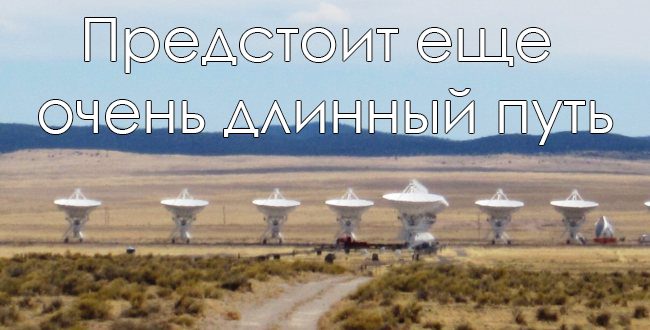
We still have a long way to go, and there are many more searches to do. We've scanned a very small part of the universe, and there are still a lot of unexplored places to explore. The important thing is not to lose hope.
Theory 8.

The edge of the visible universe is 46.5 billion light years away (that's so far away!). While searching for an extraterrestrial civilization, we were able to scan everything about 40,000 light years from Earth. We haven't even gone beyond our galaxy, which is 100,000 light years across. Extraterrestrial civilizations may simply be too far away for our current technology to reach them.