
 Incredible facts
Watch the video, If you're too lazy to read
Watch the video, If you're too lazy to read
These interesting facts about penguins can surprise not only children but also adults.
Interesting facts about penguins
1. Penguins belong to the group of waterfowl, flightless birds.
2. Scientists don't know exactly how many penguin species live on Earth.
The number of surviving penguin species is still under discussion. Due to the strong similarities between some species, penguin biodiversity ranges from 17 to 20 species.
3. Almost all penguins live in the southern hemisphere.
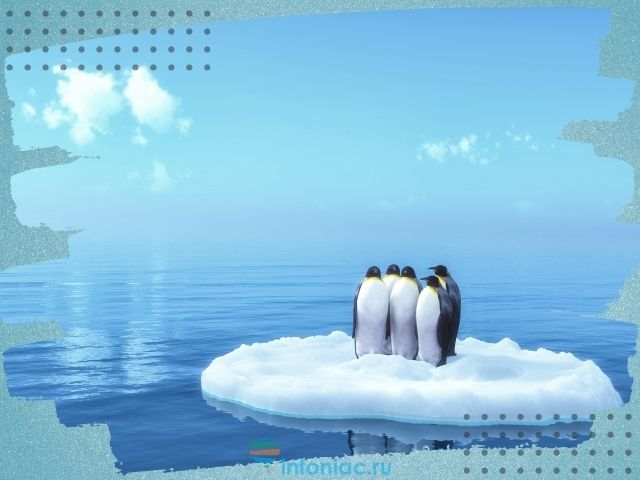
The exception is the Galapagos penguins, who live on the Galapagos Islands, just north of the equator, making them the only penguin species living in the northern hemisphere.
4. The habitat of penguins depends very much on the species we are talking about
Some of them are able to live in some of the coldest parts of the world, while others live in warmer places, all the way to the equator.
5. Large penguin populations are found in Antarctica, Argentina, Australia, Chile, New Zealand, and South Africa
6. The life span of penguins varies from 6 to 27 years.
However, most species live between 15 and 20 years.
7. Emperor penguins are considered the largest.
They are 122 centimeters tall and weigh between 22 and 45 kilograms.
8. The smallest penguins are blue penguins.
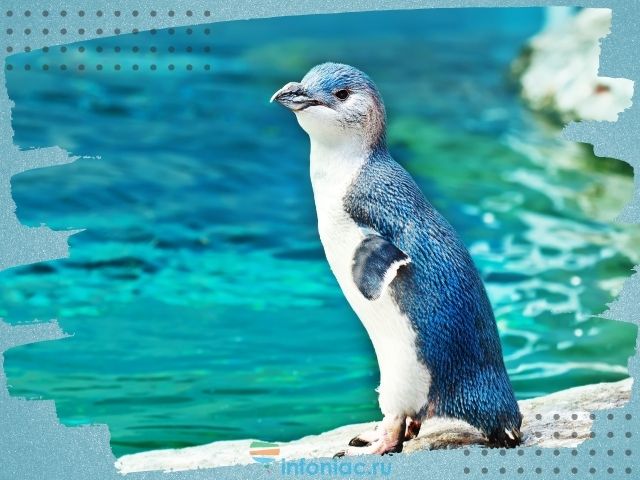
They are also called baby penguins and are between 30 and 40 centimeters tall and weigh up to 1.5 kilograms.
9. All penguins live as close to water bodies as possible, as this is their only source of food.
10. Penguins' basic diet includes fish, squid, and shrimp.
Penguins that live closer to the equator consume large amounts of fish, while penguins living in the Arctic region rely on shrimp and squid.
11. Penguins spend about 75% of their lives in water.
12. Penguins' bodies are designed specifically to drown.
While most birds have hollow bones inside to help them fly, penguin bones are very dense and this makes it easier for them to dive underwater. Penguins also originally had regular wings, but over time they evolved into flippers, which now allow them to swim underwater at incredible speeds.
13. Penguins jump into the air before diving into the water, allowing them to swim faster.
This technique releases air bubbles sandwiched between the feathers and increases swimming speed by 2-3 times. When returning to land, small penguins can jump from the water to a height of 2 to 3 meters.
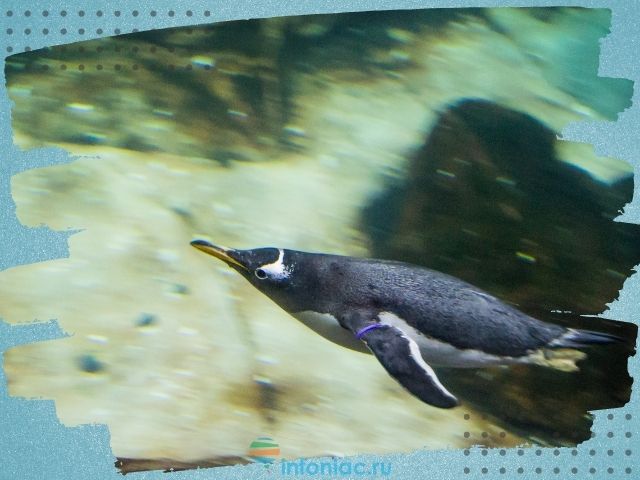
14. Penguins dive deeper and swim much faster than any other bird.
Penguins can dive to a depth of more than 250 meters, while emperor penguins can dive deeper than 550 meters. Diving to this depth requires a large volume of lungs; the longest dive lasted 22 minutes.
15. Penguins can swim at speeds exceeding 15 km/h.
Most penguins swim between 7 and 11 kilometers per hour, and the subantarctic penguin can reach 35 kilometers per hour, but the walking speed of all penguins varies from 2.7 to 3.8 kilometers per hour.
16. Penguins can't breathe underwater.
However, almost all species are able to hold their breath for at least 15 minutes.
17. Emperor penguins are the undisputed champions of penguin diving.
They are able to travel more than 500 meters below the surface and stay under water for more than 20 minutes.
18. Penguin “costumes” are disguises.
The black plumage on the back is very difficult to see from above, and the white plumage on the abdomen, from below, looks like the reflection of the sun on the water surface. This not only helps them hide from predators, but also makes it easier for them to catch prey.
19. Penguins' vision is much better than one might think.
Penguins can see clearly both underwater and on land, and are also able to distinguish colors and are particularly sensitive to violet, blue and green colors, and possibly to ultraviolet waves. In addition to sight, penguins have a well-developed sense of smell.
20. Penguins can drink seawater.
Although penguins can drink fresh water from local streams, their hunting lifestyle requires such an adaptation. They have a gland located above the eyes that extracts excess salt from the blood and removes it through the nasal canals when they sneeze.
21. Penguins are waterproof.
The oil gland in penguins releases water-repellent oil that penguins apply to their feathers for better glide in the water.
22. Penguins molt every year.
While other birds change their feathers in parts, penguins molt completely and sit on land for 2-3 weeks and wait for all the feathers to grow back.
23. Penguins usually sleep lying or standing, and can also lie on the water while resting.
While sleeping, they hide their heads under their wings.
24. Penguins can control blood flow in their bodies
They do this sufficiently so as not to overcool and protect the limbs from freezing.
25. Penguins live in groups and even when hunting they tend to swim and feed together.
Penguin colonies can range in size from 100 to 1,000 pairs, but there are also several species that prefer to live isolated from their relatives.
26. Some penguins build nests out of rocks.
Ghentu penguin nests consist of small pebbles, moss and feathers.
27. Penguins only mate during the mating season
At the same time, it is quite common for old couples to reunite in the new mating season. Most penguins lay 2 eggs per season, with the exception of emperor penguins and king penguins, who lay only one egg each.
28. Fat penguins are better parents.
Since penguins take turns incubating an egg while their partner feeds at sea and such shifts last from several days to several weeks, penguins are trying to find a fuller partner, who can't eat for weeks while it's his turn to hatch an egg.
29. The hatching process can take up to 3 days
When penguin chicks are ready to hatch, they begin to pierce the egg shell from the inside using their beak, a process that can take 3 days.
30. The chick is completely dependent on its parents until it grows waterproof feathers.
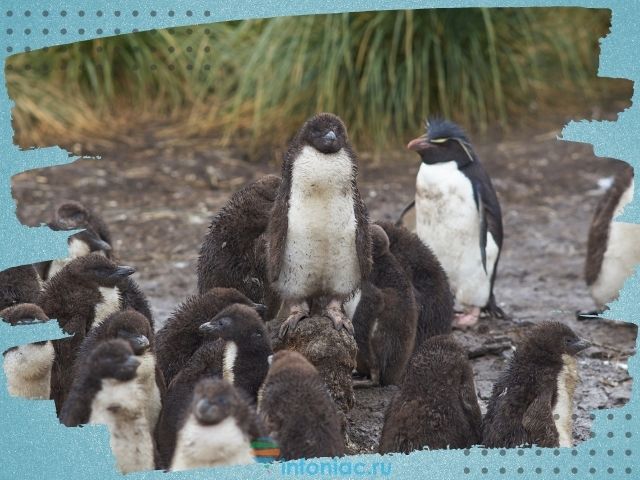
This period lasts from 7 to 9 weeks for Adelie penguins and up to 13 months for king penguins.
31. Penguins' cheers vary and allow them to differentiate between each other and their chicks.
Their sounds are unique and allow them to find each other among thousands of other similar-looking penguins.
32. About 1 in 50,000 penguins are born with brown feathers instead of black.
These penguins are called Isabellines and differ from albinos, but like albinos, they live shorter lives due to the lack of camouflage.
33. The main enemies of penguins on earth are lizards, snakes, other birds and ferrets.
Orcas, seals and sharks are dangerous in the water.
34. The first traces of penguin's existence are 61.6 million years old.
35. Penguins are very friendly to people.
Most of the natural enemies of penguins live in water or fly through the air, which makes them feel safe on land and are almost unafraid of explorers and tourists.
36. The discoverers of penguins called them “strange geese”.
This is how Antonio Pigafetta called the penguins he saw during Ferdinand Magellan's first trip around the world. It was later revealed that he was talking about penguins seen in the Falkland Islands, now known as Magellanic Penguins.
37. Some extinct penguins grew over 150 centimeters.
Recently discovered fossils have shown that the ancient penguin species was taller than the average modern human, whose height exceeded 178 centimeters. For about 60 million years, Kumimanu biceae weighed almost 100 kilograms.
38. Penguins don't have teeth
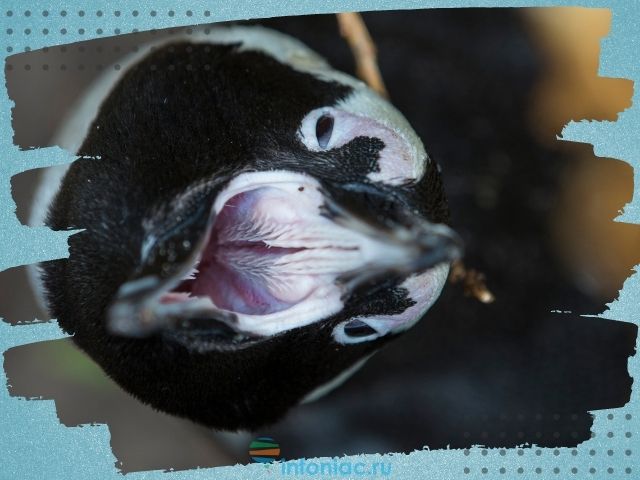
The fleshy thorns in their mouths help penguins swallow fish. Their protrusions, directed in the opposite direction, help direct prey down the throat.
39. Emperor penguins hatch eggs on their paws.
Penguins keep the egg warm by using a hanging skin fold. They can stay in this position for several weeks until the chick hatches, and during this time they will never move, even to eat.
40. Blue penguins dig holes.
Blue penguins dig small tunnels in the sand dunes as a way to the main nest. Both partners take turns incubating eggs and feeding their chicks until they are 8 or 9 weeks old.
41. Penguins cuddle to keep warm.
Emperor penguins have learned not only to huddle up and warm themselves, but also to wait for the penguins in the center to get too warm to stand outside the circle and let in those who were before cold on the edge.
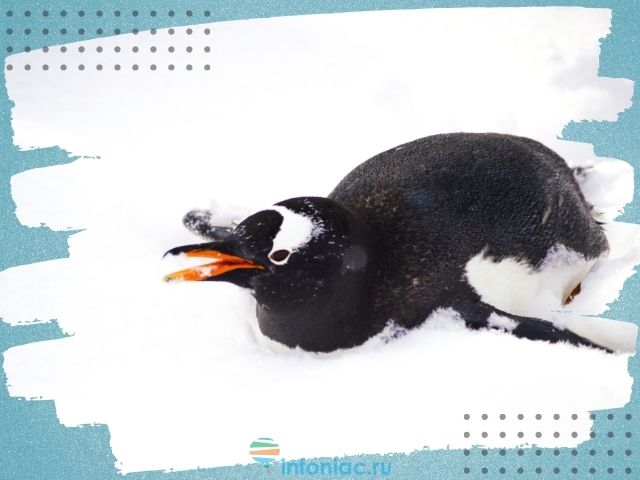
42. Penguins love sledding.
Instead of walking on ice, they often lie on their stomachs and push their feet away. This method of transportation is much faster than the standard one.