
 Incredible facts
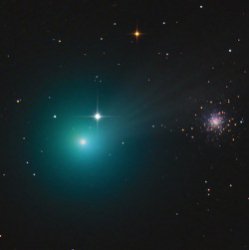
The newly discovered Comet Lovejoy will be visible in the sky in early 2015.
Comet C/2014 Q2 Lovejoy, which appeared before the New Year and will stay with us for most of January, can be seen through small telescopes and binoculars, and with the naked eye on the dark night sky without light pollution.
Its next appearance in our night sky will not take place until 8,000 years from now.
Comet C/2014 Q2 Lovejoy (photos)
The comet will be closest to Earth on January 7, 2015, at a distance of 70.2 million kilometers, and will therefore be brightest at this time and for the next two weeks.
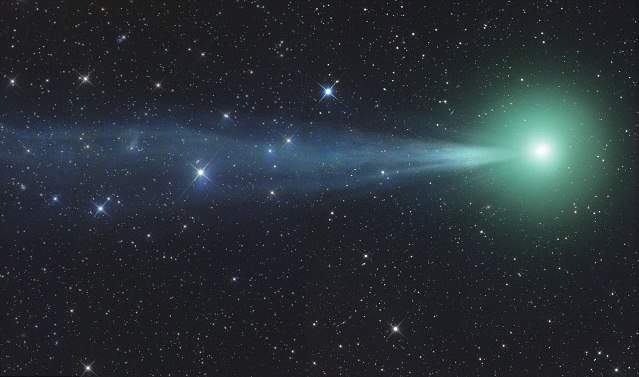
Amateur astronomer Terry Lovejoy first discovered the comet on August 17, 2014 using the Celestron C-8 telescope at the Birkdale Observatory, Australia.
Comet Lovejoy is rapidly getting brighter as it moves from the southern hemisphere of the sky to the northern hemisphere.
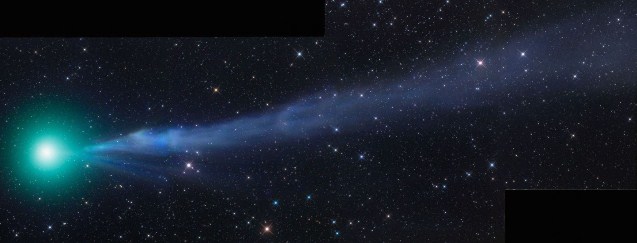
Astronomers measure the brightness of objects in the sky using an apparent magnitude scale. The brighter the object, the lower the number.
In November 2014, the comet had a magnitude of 9.2, at the end of December it was 5.3, and from January 7 to the middle of this month it will reach a brightness of 4.1, making it visible to the naked eye.
Read also: Calendar of important astronomical events in 2015
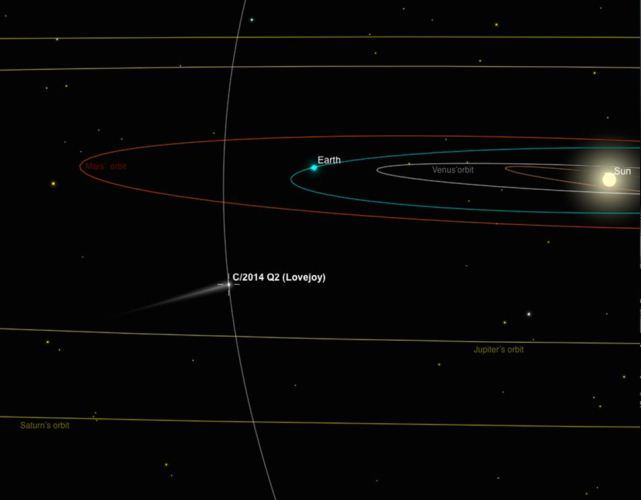
The diagram shows the orbit and location of Comet Lovejoy in relation to the orbit of Earth and neighboring planets.
Comet C/2014 Q2 Lovejoy orbit
Comet C/2014 Q2 Lovejoy will be clearly visible in the northern hemisphere of the sky for most of January 2015. In the first week of January, it passes through the constellation Hare (near the Orion constellation) to the constellation Eridanus and will approach the Taurus constellation by January 9.
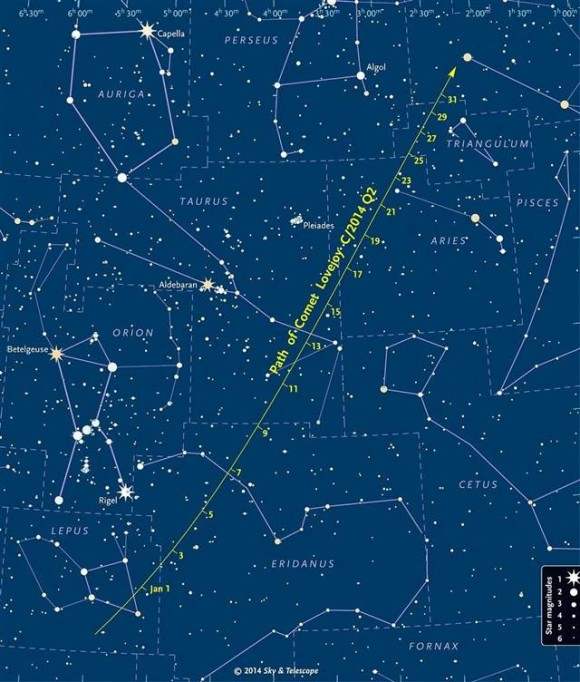
The map shows where the comet will be in January 2015. The yellow line shows the comet's path, and the numbers show the date.
C/2014 Q2 Lovejoy is a long-period comet with an orbital period of about 11,500 years. The gravity of the planets in our Solar System slightly changed the comet's orbit, and it will next return in about 8,000 years in 10,015.
Read also: The Philae probe discovered organic molecules on the surface of the comet
While the comet will be bright enough to be seen by the naked eye, it's best to observe it with binoculars or a telescope. It is visible smoky and looks green thanks to molecules that glow when they collide with the solar wind.