
 Events
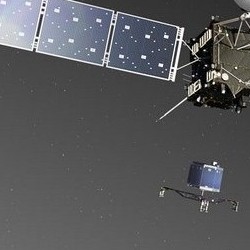
According to CNN: fantasy became a reality on Wednesday, November 12, when a mechanical space traveler called the “Philae probe” landed on a predetermined target – a comet with a much less romantic one called 67P, which is about 310 million km from Earth.
Scientists and European Space Agency (ESA) executives jumped and hugged each other for joy when the landing was confirmed. Spaceships have previously crashed into comets, but this is the first soft and controlled landing in history.
Read also: Rosetta's journey in documentary photos
This comet has low gravity, but Philae still managed to land on it using anchor harpoons, albeit on the second attempt. Scientists have not yet fully analyzed the data obtained, what will happen in the coming days.
The historical mission of “Philae”
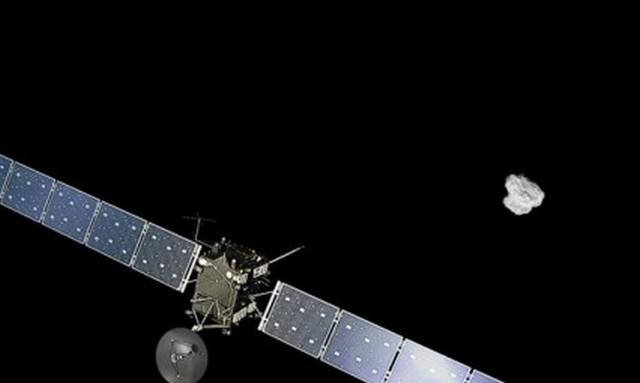
The ambitious mission, named Rosetta, like the orbiter itself, has secured a place in history books. This made it possible not only to enter the comet's orbit for the first time, but also to deliver a lander to the comet's surface for the first time.
The Rosetta mission will try to answer very important questions about the history of our solar system: what were the initial conditions, how exactly the solar system developed, what role in comets and other issues played the development.
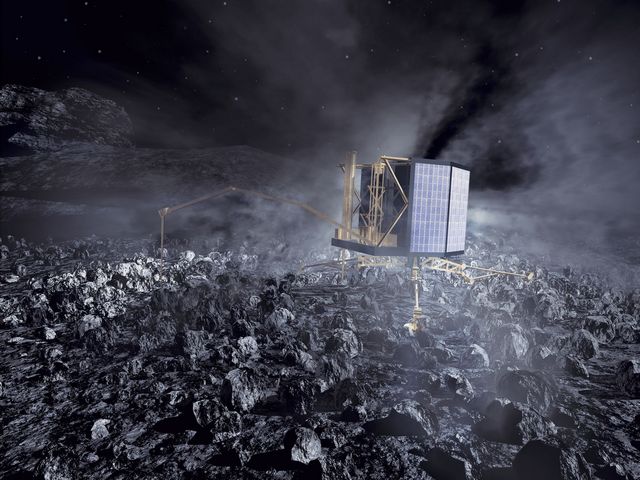
In addition, this mission may well bring humanity closer to answering the question “Are we alone?”
The probe was launched from Earth 10 years ago and approached 67P's orbit in early August.
The principle was this: the Philae lander separates from the orbital lander and lands 7 hours later on the comet.
The Rosetta spacecraft had to be in the right position in orbit to ensure that the probe descended on the correct trajectory. In addition, the probe does not have engines for self-landing.
Read also: The most interesting facts about the Pan-STARRS comet
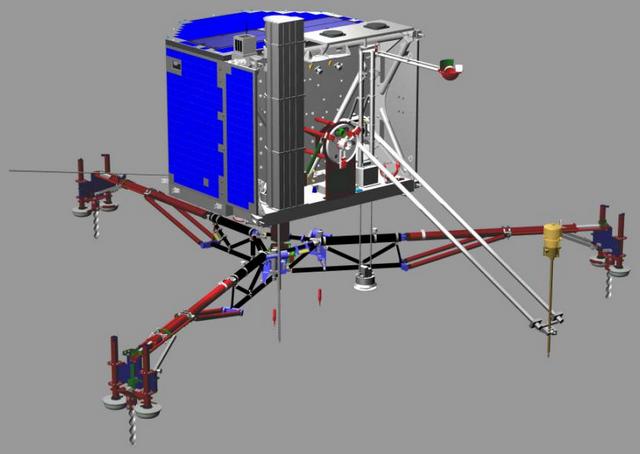
The descending machine weighs about 220 kg, and its size is comparable to a household washing machine. The target comet is only 4 km in diameter.
First news from Rosetta
Shortly after landing, the probe sent a report: “It landed at its new address.” Later, he wrote again: “I'm on the surface, but my harpoons didn't work.”
The spacecraft is named after Rosetta Stone, a piece of volcanic rock found in Egypt in 1799. This discovery allowed scientists to decipher hieroglyphics and thus understand ancient Egyptian culture.
Well, as for the Philae lander, it is named after the island in the Nile River where the obelisk was found, the inscriptions on which helped decipher the same Rosetta stone.
Functions of the “File” probe
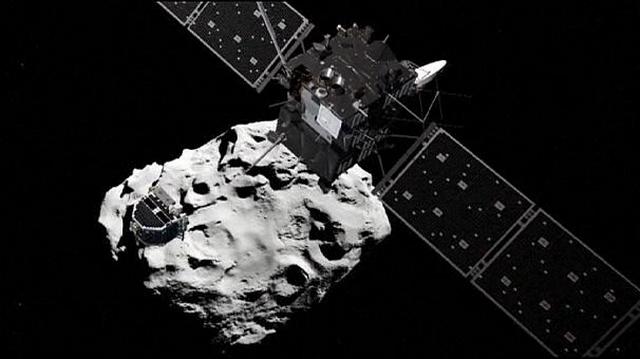
Philae is equipped with equipment for various functions, including photographing the comet's surface. In addition, scientists have high hopes that the probe will find out what happens when the burning effect of the sun drives away gas and dust.
The Philae landing, planned by a European consortium led by the German Institute for Aerospace Research, should carry out nine experiments.
According to information on the ESA website:
Sensors on the descending vehicle will measure the density and thermal properties of the surface.
Gas analyzers will help detect and identify any complex organic and chemical substances.
Other tests by the space probe will measure the magnetic field and the interaction between the comet and the solar wind.
Philae also has a built-in drill with a 20 centimeter drill that will take soil on the comet and supply it to onboard furnaces for testing.
Scientists are pleased with the mission's progress and are amazed at what has been achieved so far.
The orbiter will remain close to the comet for more than a year until it approaches the sun at a distance of 180 million km.
In addition to amazing scientific results, the very challenge and ambitions of such a mission are outstanding and show how far our achievements in space exploration and, in particular, the Solar System have progressed. This gives us hope for success in future missions.
This spacecraft symbolically flew past Earth, Mars and two asteroids. No one has ever landed on the surface of a comet or received data like Rosetta did.
The search for extraterrestrial life using the Philae probe
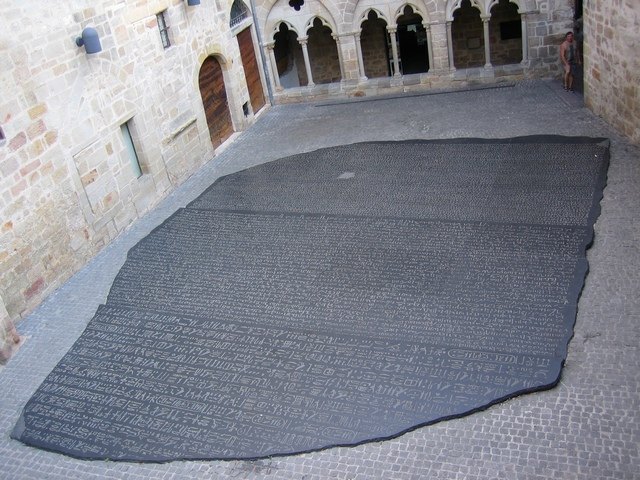
Just as the Rosetta rock once helped solve Egypt's mysteries, the mission of the same name can, through research into the structures of soil, ice, and other components of the comet, understand the key components of the comet moments in shaping life outside our planet.
Scientists also hope that the mission will help portray Earth's early existence. After all, it is quite possible that our Earth is grateful to such comets that carry water and organic molecules.
The word “life” for researchers in outer space can mean from a single-celled organism to a technological form of life much more advanced than that of humans.
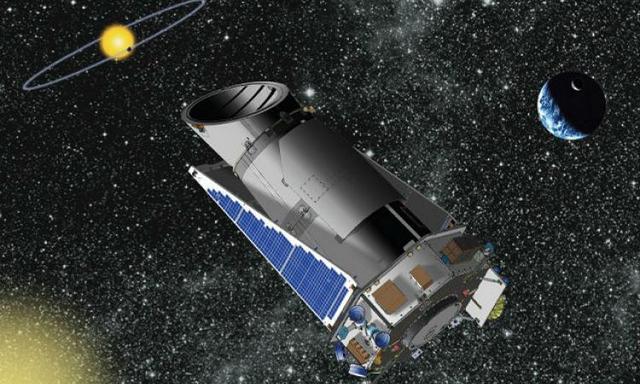
It will even be enough to find remains that prove the existence of once-technological civilizations. Undoubtedly, such a find will be encouraging and inspiring for humanity.
While the search for signs of intelligent life has been going on for more than three decades without results, Philae is only a little closer to this dream.
We know of several hundred billion stars in our galaxy and about the same number of galaxies in the known universe. Recent results from the Kepler mission have shown that between 10% and 20% of the stars in our galaxy may be habitable.
Today, the best scientists are looking for intelligent life, which can be compared to finding a handful of sand on all the world's beaches. However, we should not be upset about this. We just have to dig deeper and more thoroughly.

However, researchers are looking for more than just signs of intelligent life. They are also working to fill in all the gaps in the history of life's origin, origins and evolution.
While finding intelligent life on other planets in the universe is like the ending of a well-written novel, understanding this ending has a significant effect if you've read the other chapters in book.
For example, to “read” these chapters, researchers study extremophiles, life forms on Earth that live in Antarctica's ice-covered lakes, Yellowstone hot springs in the US, and in the highlands the deserts of Chile.
Read also: 10 amazing satellites of the Solar System
These studies will tell us that similar life is likely to occur on other, less favorable planets. Scientists are also exploring how strange life might be on other nearby worlds. Imagine finding biology on Saturn's moon Titan, with its methane lakes.
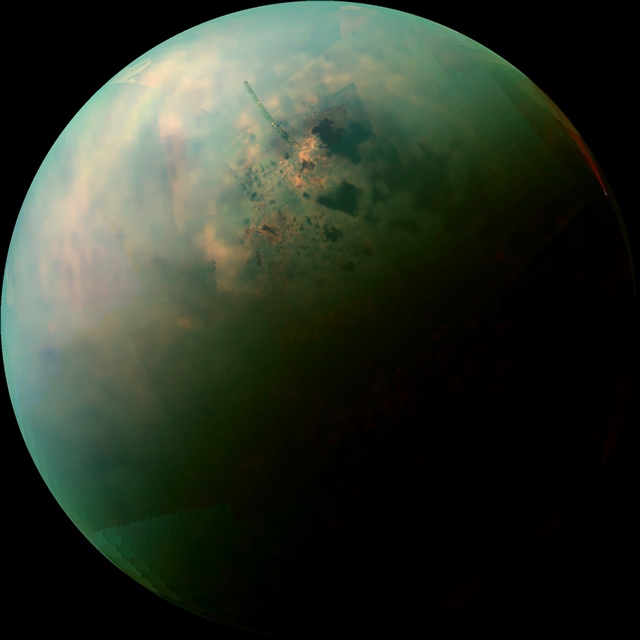
This kind of life is really going to be very different from what we're used to seeing. Such a discovery could open a window of understanding of biological creatures on other planets.
After all, with the help of some evidence, it can be argued that the main organic building cells appeared on our planet several billion years ago, and more intelligent life originated in the following years.
It should be noted that researchers at the SETI Institute (acronym translation: search for extraterrestrial intelligence) are studying intelligent life on Earth, except for humans, which communicates between its species, hoping to capture the main elements of communication. This is done so that we can find common ground, if necessary, with extraterrestrial intelligence.
We're just beginning to understand and appreciate the levels and diversity of intelligence that exist on this planet and the many ways in which different animals can communicate. SETI scientists have a key role in these areas. They seek to understand terrestrial evolution and the complexity of communication beyond Earth.
However, state funding for scientific educational programs, despite the importance of the project, is insufficient. State funding for space research is also currently in jeopardy.
It is attracting science teachers, showing manned space missions on TV and other events that inspire young people to learn about the universe around us.
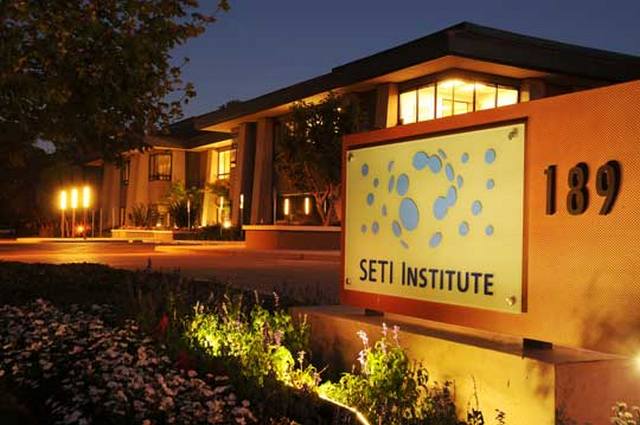
Thus, one of the main tasks of the SETI Institute is to help educate the public and instill interest in space knowledge and exploration. Inspiring the next generation of scientific thinkers and researchers is of paramount importance to the Institute.
Not only will the Rosetta mission help us understand where we came from and what our story was, but it will also be helped by inspiring a new generation to follow in the footsteps of astronomers Carl Sagan and Frank Drake.
Just as all scientists are now celebrating the success of the Rosetta mission, future generations will continue to celebrate understanding the origin of life on this planet and finding evidence of life in other worlds.