
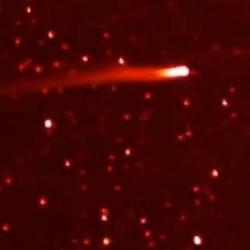
 Events
Comet ISON, called the “comet of the century”, was badly damaged when it met close to the Sun and was mostly destroyed. However, there is still hope that some part of her survived.
The telescopes recorded a huge ball of ice and dust that disappeared behind the star, but only a faint ribbon appeared afterwards.
Astronomers continued to search for the object, but most likely the comet fell to pieces due to the incredible heat and tidal forces close to the Sun.
Experts from the European Space Agency, who observed via the Soho satellite, announced the death of Comet ISON at 21:30 GMT. However, they later said that a small part of the comet may have remained intact.
The appearance of comet ISON 2013
Comet ISON has attracted global attention ever since it was discovered by Russian astronomers Vitaly Nevsky and Artem Novichok in 2012.
The 2 km wide object flew to the inner solar system from an area far beyond the planet Neptune.
As the comet got closer to the Sun, its ice began to evaporate, releasing its glowing tail from the dust.
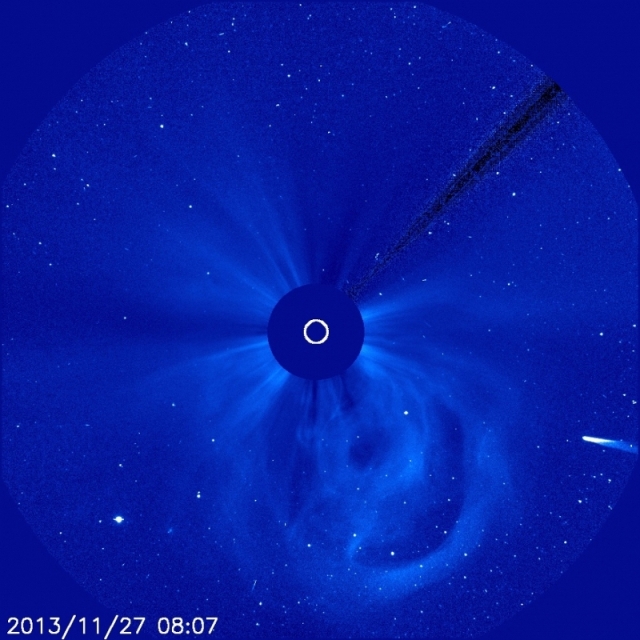
Soho image of comet ISON as it approaches the Sun
It circled the Sun at a distance of just 1.2 million kilometers at 18:35 GMT (10:35 p.m. Moscow time) on Thursday, November 28.
Soho followed Comet ISON as it orbited the Sun, but then failed to detect a clear object when it was supposed to appear. The strip in the picture was the last piece of debris.
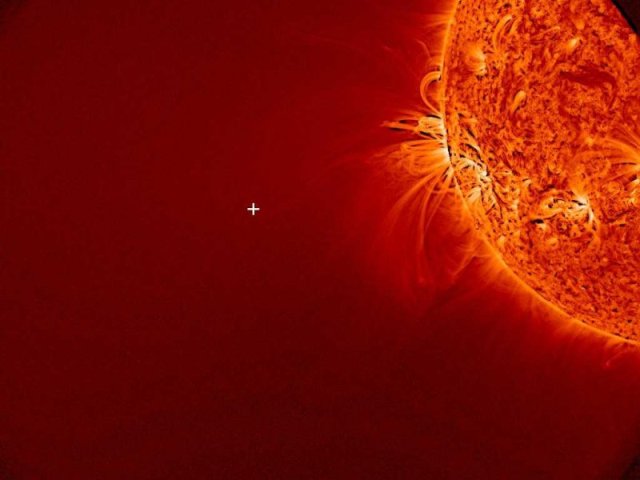
The NASA Solar Dynamics Observatory image did not detect Comet ISON. The white cross shows where it should have appeared.
NASA's Solar Dynamics Observatory telescopes also found no clear signs of the comet's nucleus.
As it passed around the Sun, the comet was exposed to temperatures of more than 2,000 degrees Celsius. The star's incredible gravity pulled and squeezed the object, hurling it from side to side. So far, all the evidence suggests that the comet's nucleus was torn apart.
However, scientists later said that some part of the comet may have survived.
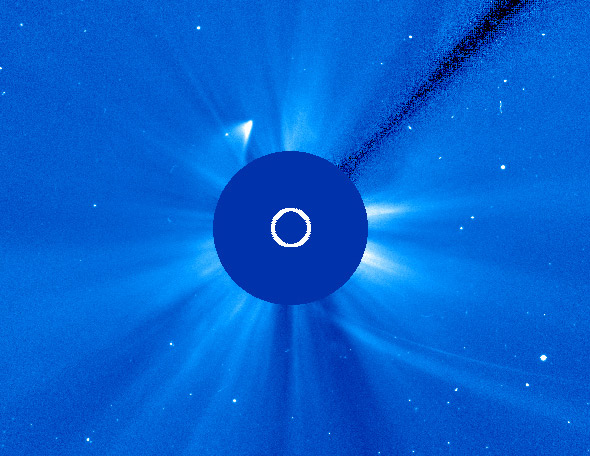
The Soho image shows that part of the comet did appear
Recent images show an increase in the brightness of a small fragment of the comet. Astronomers are surprised, but say that in the coming hours or days it will become more clear about the fate of Comet ISON. Its remains may remain bright or completely crumble.
“It seems that a small part of ISON has stayed and is actively releasing material,” Karl Bantam said on the NASA Solar Dynamics Observatory blog. “It is too early to say whether it will be visible in the night sky”
Comet ISON video