
 Ecology
Corals were suffering from human activities even before carbon dioxide emissions into the atmosphere began to acidify the oceans, which in turn led to global warming. A team of oceanologists has found that deforestation off Panama's coast and overfishing in the Caribbean Sea have been causing changes in coral reef ecosystems since the 1900s.
The destruction of trees causes more rainwater to drain into the sea, taking with it the soil and more pollutants that end up in the ocean. As a result, this leads to changes in the composition of living organisms in the coral reef ecosystem.
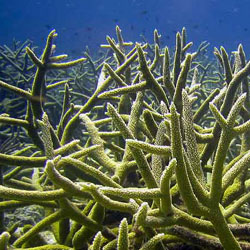
Overfishing leads to a decrease in the number of marine herbivores, so algae begin to grow strongly. Over time, branched corals are replaced by other species that have no branches and grow more slowly. This means that marine animals have fewer hidden places to hide from enemies.
Also, when forests are cut down, bivalves, such as oysters and clams, begin to shrink in size. The populations of two dominant species — Acropora cervicornis horn-shaped corals (pictured) and oysters — have fallen dramatically over the past century.
To determine when changes in the reef ecosystem began to occur, oceanographers began to study coral skeletons and shells and use the radiocarbon method to determine their age. They then compared data on coral changes with archived records of deforestation.