
Caves exist everywhere in the world, many of them have been used by man as dwellings or places of worship. Often they had a connection with structures on the surface of the earth. But when people stopped settling in caves, the surface structures also turned out to be abandoned, then collapsed, leaving only caves. But this fate has not befallen all cave settlements. In some places in the north of China, people are still settling in caves, and we are talking not about thousands, but about 40 million people!
1. Uchisar
In the center of the historical area of Cappadocia in Turkey is the cave city of Uchhisar. This compact settlement is located in the center of the triangle formed by the cities of Goreme, Nevsehir and Urgul, and its name Uchisar (or Uchhisar) means “three fortresses”.
The most important attraction of this area is the fortress of the same name carved into the rock, located on top of the cliff. There are towers topped with spires in this cave settlement. Tourists discover the external similarity of the settlement with a piece of Swiss cheese – the entire rock in the area of the fortress is dotted with tunnels, labyrinths and rooms cut down in it. But after the increased danger caused by erosion, people left these caves, the last ones left here in the 50s of the last century.
From the top of the cliff, the entire valley is perfectly visible, almost the whole of Cappadocia is visible here at a glance. In addition, the Valley of Love is also visible, about which many legends have been invented. Now a number of caves are being rebuilt, but for use only as sheds or barns. Several modern buildings are attached close to the caves. The main purpose of this mountain village is now to attract tourists.
2. Ortahisar
This Turkish fortress is also carved into a rock monolith. It has 10 levels with a total height of 86 m. Even in ancient times, this rock served as a fortress. The Seljuks called it Ortakhisar, that is, “The Middle fortress”. Under them, it served as one of the three strategic Cappadocian points, which also included the fortresses of Uchkhisar and Bashkhisar.
Currently, the fortress has collapsed in a number of places or is on the verge of collapse, so it is almost completely closed to visitors. The entire rock here is also heavily incised by a network of caves. At one time, it served not only for defense, but also for living. The interiors of the fortress are partially visible through the collapses. After a recent restoration, you can climb the steps to the top of the cliff.
3. Candovan
In the north-west of Iran, in the province of East Azerbaijan, in the wilderness there is a unique settlement of Kandovan. People here cut down their homes in volcanic rock, and their city from afar resembles a huge termite mound. According to the stories of local residents, their ancestors began to settle in the rocks about seven centuries ago under the onslaught of the Mongol hordes. Since then, they have not dared to come down from there. They can be understood – living in caves is quite comfortable: in summer it is cool here, and in winter it is warm.
Over the centuries, the inhabitants of the settlement have significantly expanded the network of premises, so many here have 2-3-storey “apartments”, and even with outbuildings. In the usual 4-level dwelling here, livestock is kept on the first tier, the next two levels are residential premises, and stocks are stored on the upper one. The strong material of the walls serves as an excellent insulator, so it’s cool inside in summer and warm in winter.
4. Vardzia
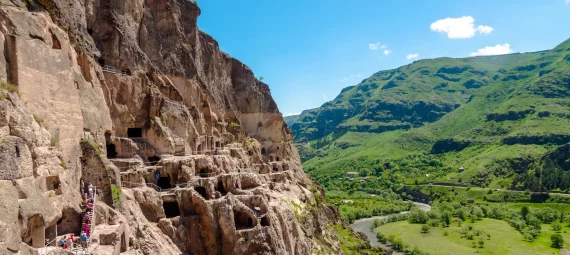
One of the biggest Georgian attractions is Vardzia, a high rock towering over a steep wall dotted with dozens of caves, both natural and man–made. From the river bank, you can see dozens of holes in the rock, although in fact there are hundreds of them – there are about 600 rooms in the rock settlement. Along the river, this rocky city stretches for about a kilometer.
People began to inhabit these caves in the time of Queen Tamara to hide from the raids of the Mongol-Tatars. Nature presented a pleasant surprise to the locals in the form of a largely ready-made fortress, which they only had to put in order and settle in. In fact, people settled in those natural caves back in prehistoric times, and during the reign of Tamara, the arrangement of the Vardzia fortress was taken up on a state scale: many rooms were expanded, they were landscaped, the Assumption Church was built inside, which later grew to the famous rock monastery of Vardzia. For 20 years, about a dozen temples, baths, a library were cut down in the rock, secret passages were lengthened and even a sewage system was laid. As a result, now you can see how some caves have gone dozens of meters deep into the bowels of the rock, and they are located on 8 tiers.
During its heyday, Vardzia was famous as an “invisible city” – what can now be observed from the shore of the Kura was hidden in the past by an external rock wall, which collapsed during a strong earthquake and exposed the previously hidden premises of the famous cave city. Currently, a small group of monks lives in Vardzia, which monitors the caves and charges a small fee from visitors who want to look at this miracle.
5. Bandiagara
Bandiagara is a steep sandstone plateau, on which there are unique ancient structures: rock dwellings, sanctuaries, altars, granaries, places for public gatherings. UNESCO has included the entire architectural complex spread out in Mali in its World Heritage List.
Here, a steep rocky ledge, stretching for 150 kilometers, rises 500 m above the plain. Dogons currently live in the rocky rooms of the southern slope, and thelems and toli used to live in them. The tribes of the Tellems settled in the slopes of the cliffs since ancient times, until they were displaced by the Dogons in the XIV century. This tribe cut down rooms in the rocky slope in order to bury their dead there, so that they would not be disturbed by the severe floods typical of this area. As a result, dozens of villages appeared above the caves along the rocks.