
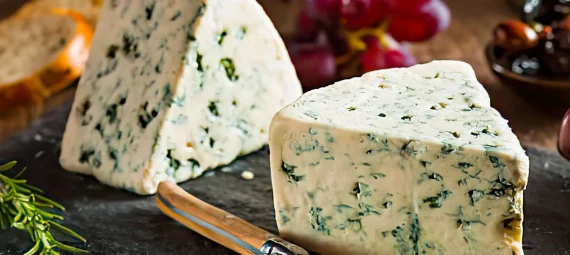
5. Roquefort: classic green mold
Roquefort is one of the most famous blue cheeses: its white crumbly flesh is decorated with a pattern of mold that gives it a specific taste and smell. In each piece, a sweet buttery taste and the aroma of haze are clearly felt, and the veins of mold add spice. The real Roquefort is considered only the one that is produced in the historical region of Rouergue in the south of France, where the technology of its manufacture was born. Sheep’s cheese matures in limestone caves, thanks to which mold forms in it. A kilogram of the finished product costs about 50 EUR.
4. Fetid Bishop: the subtle scent of socks
English cheese with a telling name is one of the oldest in the world: Cistercian monks made it from the milk of Gloucester cows back in the 10th century.
Oddly enough, he owes his pungent smell, reminiscent of the fragrance of stale socks, to pears of the “fetid bishop” variety. When ripe, the cheese is dipped in pear cider from time to time, which makes it orange, sticky and smelly.
However, it is not difficult to get rid of the unpleasant aroma — it is enough to remove the crust from the cheese: then you can appreciate its delicate sweet taste. The fetid bishop goes well with red wines and fruits, and it costs about 25 GBP.
3. Milbenkese: tart aftertaste and live mites
In the German village of Wurchwitz, tick cheese has been made for 300 years — this is how the word milbenkese is translated into Russian. Instead of lactic acid bacteria, cheese mites are used in its production, whose enzymes ensure the maturation of the product. The formed cheese is put in a wooden box and literally sprinkled with ticks: about half a million of these 0.3 mm arthropods settle in each cheese head. When maturing, milbenkase acquires a dark color, a bitter aftertaste and the smell of ammonia. Cheese is eaten together with live ticks.
By the end of the 20th century, the tradition of production was almost lost, but it was successfully revived, and a marble monument to a cheese tick was even erected in Wurchwitz — a very frightening kind.
2. Vieux Boulogne: exquisite notes of rotten meat
The title of cheese with the strongest and most disgusting smell in the world has rightfully earned the French variety Vieux Boulogne. This soft cheese comes from the town of Boulogne-sur-Mer exudes a complex bouquet of rotten vegetables, rotten fish, dampness and manure, and all because it is aged in damp cellars and washed with beer during maturation. Despite the unpleasant ambergris, gourmets appreciate Vieux Boulogne for its mild taste with a mushroom tint. It is advised to use it with bread or cookies, washed down with beer, champagne or red wine.
1. Kasu martsu: national treasure
Everything is fine in it: a putrid smell, jumping worms and a price of 200 EUR per kilo. You can’t find kazoo marz in stores — only at the market or at local cheese makers. It is listed in the Guinness Book of Records as the most dangerous cheese in the world, and until 2010 its sale in Italy was banned. However, then the ban was lifted, recognizing the “rotten cheese” as a cultural heritage of Sardinia.
The repulsive aroma and burning taste are the result of the decomposition of pecorino cheese, which is accelerated by the larvae of the cheese fly. It is believed that kazu martz needs to eat while the larvae are still alive: dying, they make an already dubious product frankly toxic.