
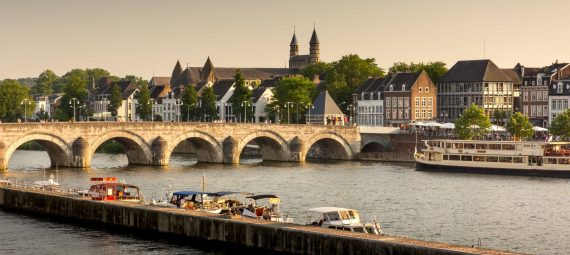
The Meuse River Embankment
The embankment of the left bank of the Meuse River is not an attraction in itself. However, here, in the area between the bridges of St. Servatius and John F. Kennedy, there are so many noteworthy objects that it is better not to pass by.
On the streets adjacent to the embankment, there are smoothly flowing into each other “City Park”, “Monsignor-Nolenspark” and “Albenhofpark”, where you can walk or ride a bike, the very ancient Basilica of the Virgin Mary, the medieval Gates of Hell, a monument to the spirit of the inhabitants of Maastricht (Mestrichter Geis). The Hoge pedestrian bridge is thrown across the river.
Freithof Square
The name of the central square of the city of Freithof (or Vreithof) is translated by some as “the courtyard in front of the church”. By “church” we mean the main city cathedral — St. Peter’s. Servatia, he serves as the architectural dominant of the square. Besides it, there are several old buildings of traditional Dutch architecture: St. Peter’s Cathedral St. John’s Monastery.
In winter, the square hosts a Christmas market, in summer concerts and dance evenings. Cafes and restaurants are open at any time of the year.
One of the Maastricht theaters and a museum are named after the square (they are located here). The latter exhibits costumes, interior items, paintings, but more often photographs.
St. Peter’s Cathedral Servatia
The main temple of Maastricht has the status of a papal basilica and is considered the oldest sanctuary in the Netherlands. It was built on the grave of Saint Servatius — the patron saint of the country, the first bishop of Maastricht — around the 5th century. The building acquired a modern look by the end of the 20th century.
The temple is made in Romanesque style, complemented by Gothic chapels and carved Gothic portals. Sculptures of Servatius himself and two local bishops are installed on the territory near the basilica. The largest bell in the Netherlands hangs on the bell tower of the cathedral. The previous one was removed and placed in the courtyard. Historical murals and stained glass windows, an organ, carved wooden and stone sculptures, ceiling decorations, and paintings have been preserved in the altar part. Dishes, church items, busts, and jewelry are on display in the cathedral’s treasury. Its greatest value is a 12th—century golden reliquary with the relics of Saint Servatius.
Basilica of the Virgin Mary
The second of the oldest sanctuaries in the Netherlands has an unusual appearance. If you look at the basilica from the west side, you will see the fortress, from the east — the church itself, which will resemble the architecture of St. Peter’s Cathedral. Servatia. The construction of the building began in the 10th century, and was completed in the 20th century. Moreover, it was built, presumably, on the site of an ancient Roman settlement, which, in turn, was founded on the site of a pagan sanctuary.
Different parts of the basilica date back to different centuries: the crypt was equipped in the 10th century, the Gothic nave was built in the 13th, the choir was restored in the 19th and 20th. The church is famous for the most beautiful stained glass windows of the 19th and 20th centuries, an organ of the 17th century and a collection of antiquities: antique books, sculptures, embroidered robes. The main value stored here is the belt of the Mother of God, an important relic for Christians.
The basilica hosts guided tours and concerts.
St. Peter’s Bridge Servatia
This bridge is sometimes called the Old Roman Bridge, because the Romans were the first to build such a structure here. Their creation collapsed in the 13th century, when a solemn procession was passing over the bridge. The replacement of the bridge also appeared in the 13th century, since the 17th century the structure has been renovated almost every 100 years.
The bridge is pedestrian, it has 7 stone arches and a lifting part. The width is 9 m, the length is 160 m. There is a statue of Saint Servatius on the bridge.
The Gates of Hell
An impressive building with a frightening name appeared in Maastricht in the 13th century. It is part of the medieval fortifications built to protect the city from enemies. Actually, the Gates of Hell are the Small gates of the fortress, through which they entered Maastricht from the river. They are two tall round towers connected by a covered gallery decorated with a bright red balcony.
The Gate got its name due to the fact that gunpowder was stored in them.
The building is one of the symbols of Maastricht, it was reconstructed in the 19th century, completing the fortress walls. There is a museum on the second floor of the building, where you can get acquainted with the history of the city. Not far from the walls there is a monument to the real D’Artagnan, who died in these places, defending the city.