
 Unbelievable facts
The human eye can adapt to the dark, and we begin to see some objects in dim light. This is one of the most amazing results of evolution.
But there are animals that can boast an incredible ability to see perfectly in pitch darkness – their night vision is hundreds of times better than human vision.
For further comparison, it is better to understand what “luxury” is.
The number of lumens per square meter (or simply lux) reflects the light spectrum that animals see. People, for example, can see in 1 lux light.
Cat
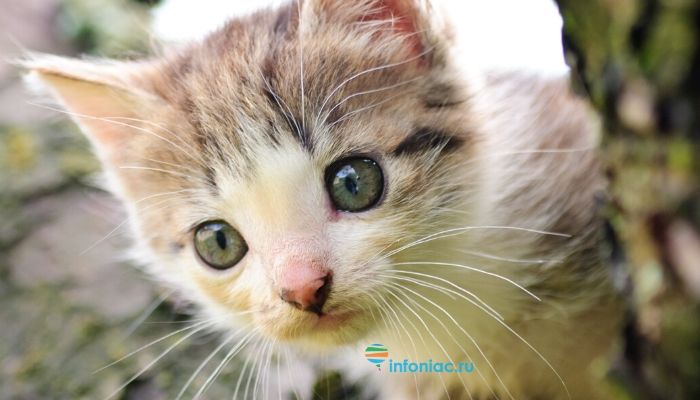
Cats can see several times better than humans. Their eye is seven times more light sensitive than that of humans. The elliptical pupil of these animals narrows significantly during daylight and dilates at night to better capture light. A cat's eyes glow at night, as light travels through the retina and is reflected back, affecting it twice, allowing receptors to re-absorb it.
Two types of light-sensitive cells can be found in the retina of cats: cones, which make it possible to distinguish colors but function only under normal light, and rods that do not they perceive color, but are able to function in the dark. Although we have quite a few cones, cats have a lot more. There are 350,000 rods per 1 square mm of retina..
An interesting fact: cats also have one drawback to such an amazing night vision — in the daytime they see much like a person suffering from red-green color blindness. Although they are able to distinguish blue from the rest, cats cannot tell the difference between red, brown and green.
Read also: How do cats see the world?
How cats see (video)
Tarsiers
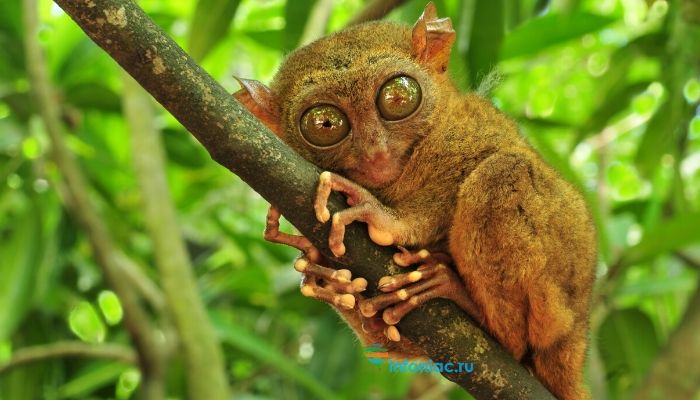
These animals live in trees in Southeast Asia. They have larger eyes that “absorb” more light, and the pupil regulates the amount of light that enters the eye. This allows them to see at only 0.001 lux of light.
An interesting fact: thanks to their eyesight, tarsiers can hunt early in the morning and at night. Their vision and ability to deftly jump from branch to branch allows tarsiers to catch small prey, even if they are disguised among trees.
The large lens in each eye with more than 300,000 sticks per square mm – just like a cat's – allows you to see perfectly in the dark. The biggest disadvantage is that tarsiers can't move their eyes. However, they can twist their necks 180 degrees.
Also read: 15 common misconceptions about vision
An unusual little killer
Dung beetle
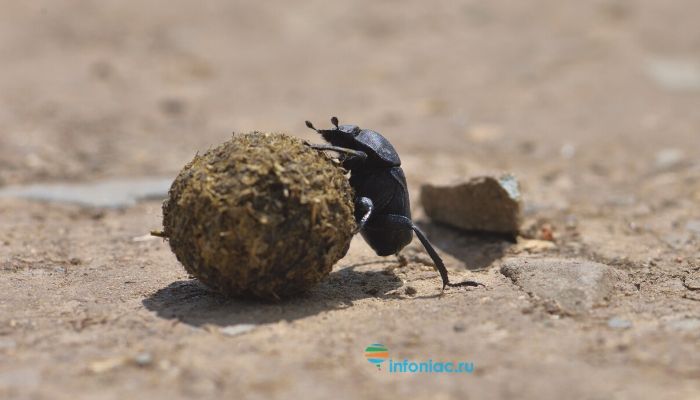
These insects can go looking for manure at any time of the day or night, as their eyesight allows them to see clearly in the dark. Beetles that fly more often at night see 85 times better than daytime beetles. They can see at light levels up to 0.0001 lux.
An interesting fact: the eyes of daytime beetles consist of a large number of ommatidia (a structural and functional part of the facet eye of insects), which are found in pigment membranes that do not the insect will become blind in the bright sun. But night beetles do not have pigment membranes, so their light sensitivity is much higher.
Read also: Animals with incredible eyes
Stargazer beetle
Halictid bees
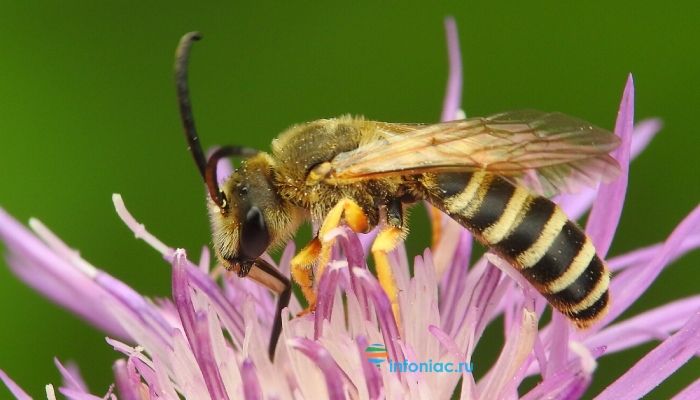
They can fly in the dark and can see perfectly at a light level of 0.00063 lux. Swedish scientists have found that some bees have pigment membranes in their eyes that prevent the insect from becoming blind during the day when the Sun is shining brightly, but they can see everything perfectly at night and they get their own food.
For example, halictid bees can navigate in extremely low light, which is 20 times less intense than the light emitted by stars. Simply put, these bees can see so well at night that they can easily collect nectar and pollen from night flowers and find their way home.
Fun fact: Their retina is designed in such a way that when light falls on it, data is transmitted through nerves to the brain, where the signals are summed up to produce a brighter picture, even if it is not too clear. Night flowers for bees are a source of nectar and pollen, and they do not need to worry about predators and parasites at night.
The bee collects pollen
Carpenter bee
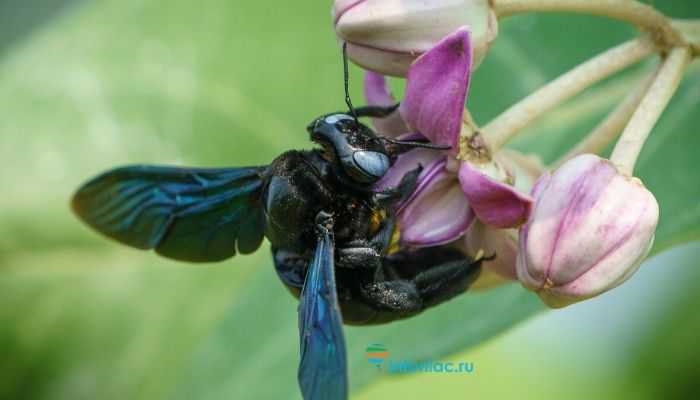
Native to Western Ghat, India, the carpenter bee is able to see the smallest details in only 0.000063 lux.
These bees boast lenses that are quite large for insects, which allow them to catch more light.
An interesting fact is that these bees are not able to process a lot of light, so if you dazzle them with direct light, they may fall, but they recover after a while.
Carpenter bee: villain or friend?
American cockroach
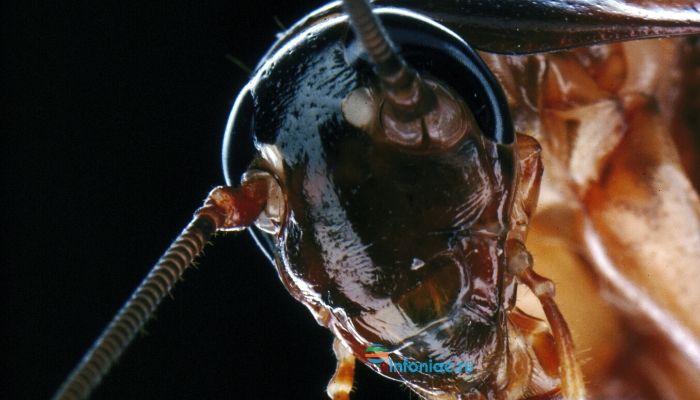
To be seen at night, this cockroach reacts to photons. His eyes are very sensitive.
Everyone knows that light is made up of photons. So, the eyes of an American cockroach are equipped with receptors that can respond to movement even if each cell receives 1 photon every few seconds. For comparison, in order for a person to see an object, it takes 100 photons to reach that object at a time.
These insects have no analogues, their vision is unique. However, in the dark they can't fly like bees.
American cockroach (video)
Owl
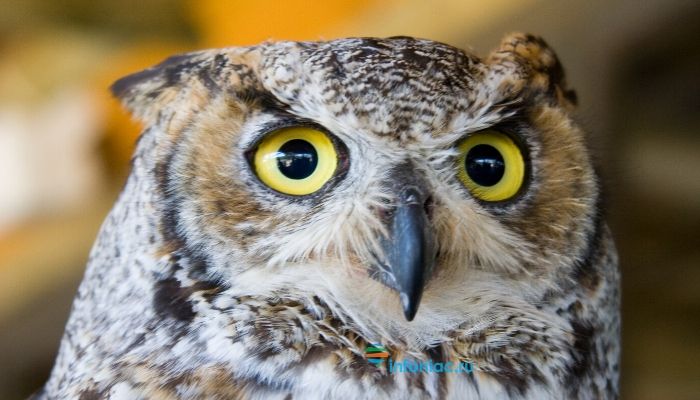
Many people think they don't see well during the day, but this is a myth. They have good eyesight, but at night it's 100 times better. On a dark night, even when there is no moonlight, an owl can notice a mouse in the grass or a squirrel on a branch.
Most owls are nocturnal animals, meaning they are active at night. An owl has almost a million rods per square mm on its retina. Humans have 200,000 per square mm. This feature allows owls to see perfectly in the dark.
They also have an “eye glow”, and this is due to the tapetum, a special layer of the choroid that reflects visible light. This makes the pictures even brighter.
Owl senses