
Cantacuzino Palace in Bucharest
On one of the ancient streets of central Bucharest, surrounded by a luxurious well-kept park, there is the Cantacuzino Palace, built in 1903 by the project of the honored Romanian architect Johan Berindame. Combining the features of French academicism and Rococo elements in its architectural appearance.
Kotrochen Palace
In the southwestern part of Bucharest, on top of the Cotroceni Hill, there is the Cotroceni Country Palace, a striking example of 19th-century architecture. Thousands of tourists come here every year to see the luxurious residence of Prince Ferdinand and Princess Maria, who later became King and Queen of Romania.
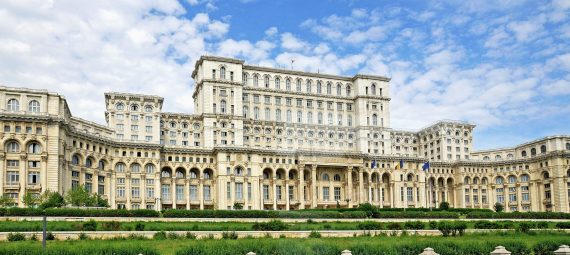
The Palace of Parliament in Bucharest
Bucharest’s business card, its main asset and pride, the world’s largest and heaviest civil structure, as well as a controversial symbol of dictatorship and oppression — all this is the Parliament Palace, the famous architectural monument of Romania.
Peles Castle
Peles is one of the most beautiful castles in Romania. The architecture of the building is eclectic, there is a lot of everything mixed in: Rococo, Baroque, and Renaissance. There are columns and fountains on the terraces, and several towers on the roof.
Pelishor Castle
King Carol I built a Pelisor for his nephew Ferdinand I. Pelishor is a summer residence for the heir to the throne. The construction took place in 1899-1903. Pelishor is not a single building, but a complex of several: a central castle and small terraces.
Romanian Athenaeum
The Romanian Athenaeum Concert Hall is a truly outstanding landmark. This is not just another concert venue, but a real temple of art, a symbol of the spiritual tradition of the Romanian people. Its construction in the golden age of the Romanian state was an initiative of the cultural elite of the nation.
Bucharest Botanical Garden
The history of the Bucharest Botanical Garden is not simple and interesting. It was founded in 1860 and was located near the Medical Faculty of the University of Bucharest, occupying a small area of about seven hectares in those years. But he did not exist there for long, in 1874 the garden moved to a new location.