
The Catacombs of the Capuchins
Somewhere outside the historical center of Palermo, under the Capuchin monastery, there is one of the most extraordinary museums of our time — the “Catacombs of the Capuchins”. Today, this “mass” tomb is one of the most famous exhibitions of mummies. This place is not for the faint of heart, but for extreme people who love the extraordinary.
La Martorana
The most popular church among the newlyweds of Palermo is La Martorana, one of the main medieval attractions of the capital of Sicily, an example of the harmonious neighborhood of the Arab-Norman style and Baroque.
Palazzo Normanni
Perhaps the most famous and significant landmark of Palermo in Sicily is the Palazzo dei Normanni, or the Royal Norman Palace with the Palatine Chapel located in it. It is the former residence of the Kings and Viceroys of Sicily in Freedom Square.
Palermo Cathedral
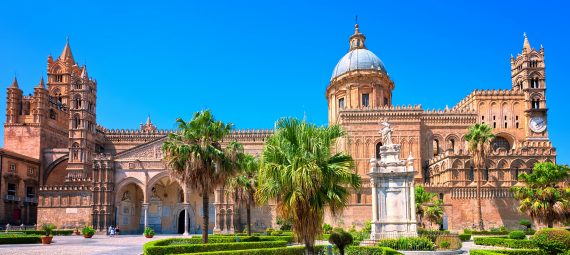
The Cathedral in Palermo does not boast the harmony and academic beauty inherent in most of the main temples of Italian cities. The huge structure on Vittorio Emanuele Street looks more like a castle or a luxurious royal palace.
Palatine Chapel
The Palatine Chapel is one of the oldest chapels in Palermo, once it served as a house church for the Sicilian rulers. This monument of the Arab-Norman architectural style is described in Guy de Maupassant’s novel The Wandering Life.
San Giuseppe dei Teatini
The masterpiece of the Italian Baroque — the church of San Giuseppe dei Teatini of the 17th century — is located in the center of Sicilian Palermo, next to the Quattro Canti Square (Four Corners), and forms part of its architectural ensemble. The temple was acquired and restored by the Order of the Theatines and bears the name of St. Joseph.
Sicilian Biopark
The Sicilian Biopark is not just an animal exhibit. This is a modern interpretation of the zoo, where animals are kept in conditions as close to natural as possible. In total, more than 60 species live here.
Massimo Theatre
The most famous opera house in Sicilian Palermo is called Massimo, which means “the greatest”. It is indeed the largest in Italy and one of the largest in Europe. The architectural ensemble was designed in 1868 by the famous architect J. Basile, and the architect’s son completed it 22 years later.