
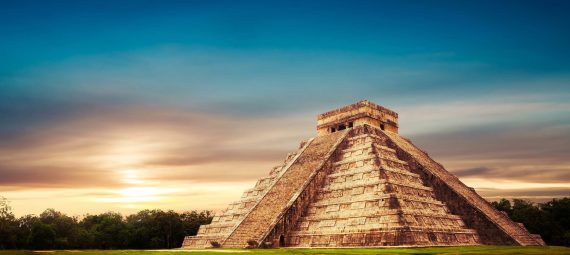
Long before the continent was discovered, Mexico wasted no time and created its own masterpieces, some of which. unfortunately, it is no longer available for tourists to see due to significant destruction or complete disappearance. However, even today there are some relics worthy of the attention of travelers. First of all, we are talking about the pyramids, which symbolized the worship of local people to the gods and forces of nature, representatives of the animal world.
Pyramid of niches in El-Tahin
On the coast of the Gulf of Mexico is the ancient ruined city of El Tahin, founded before our era. It was here that a large ritual center of local Indians was located until it was burned by the Toltecs. The sanctuary of El-Tahin literally translates as the place of thunder and it is dedicated to the rain god. The structures are scattered across a large fertile valley and mountain slopes that protect it from the destructive wind. The Pyramid of Niches is the largest monument located here. It consists of a system of ledges and tiers, as a result of which a semblance of niches was formed, from which the pyramid got its name.
The height of the structure reaches eighteen meters, the structure is made of limestone. Huge blocks were hewn, and once upon a time they also had another color – red interspersed with black. In ancient times, niches contained figurines of idols worshipped by local tribes. 364 steps lead to the top by the number of days, and the last step is considered the 365th. It was at the top, on the platform, that the sacrifices to the rain god were held. An interesting fact is that 18 stadiums were found near the ritual structure, and Indian ball games are depicted on the walls.
The Great Pyramid in Kalakmul
The Kalakmul Biosphere Reserve has several major attractions, but first of all it is the Great Pyramid that is offered to see here. The base of the building occupies two hectares of land, this is a fairly large area for a pyramid, and it goes 53 meters high. Due to its parameters, the pyramid received the status of the largest on the Yucatan Peninsula. Climbing to the top is not easy and many tourists say that they get tired during the hike, however, after climbing up, they exhale and exclaim that the process was worth it. Tourists can see the neighboring section of El Mirador with all its natural beauties. Scientists have discovered four tombs inside the pyramid, presumably titled persons were buried there. After exploring the pyramid itself, travelers can admire tropical birds, spiders and howler monkeys.
Pyramid of Nohoch Mul
The pyramid in Koba Nohoch Mul is one of the most popular among tourists. The height of the pyramid is 42 meters, and a temple has been erected on top. Tourists are led up by narrow stone stairs, but each step is quite high, which makes the ascent not so easy. In order to overcome the pyramid, you will need to climb 120 steps. Climbing up here, tourists can admire the incredible scenery opening onto the Riviera Maya.
The pyramid itself is empty inside. The platform at the top was traditionally used for sacrifices. The structure in Cabo has seven levels, the corners there are rounded, similar to the pyramids of Uxmal and Chichen Itza. Arriving to see the pyramid of Nohoch Mul, be sure to walk around the city itself and get acquainted with it. This is one of the most ancient centers of the Maya civilization, where you can walk along sixteen breathtaking white paths. The town of Koba is full of its secrets and riddles that scientists have not been able to solve for centuries.
Pyramid of the Magician in Uxmal
The word Uxmal translates literally as thrice built. It really displays several styles that are represented in this area. The settlement is quite ancient, but in the 10th century it turned into an abandoned location when the Toltec spread began here. Before the arrival of the Spaniards, there was a desert here. The greatest attraction of the region is the pyramid of the Magician, or the House of the Dwarf. Why such an interesting name? Locals believe that the pyramid was built by a dwarf overnight, and his mother, who was a witch, helped him. It perfectly demonstrates the knowledge of the Maya in astronomy. For example, the pyramid itself is oriented to Venus, and the staircase is perfectly aligned with the rays of the setting sun.
Pyramid of the Moon in Teotihuacan
The city of the gods Teotihuacan was founded many years ago and there are two most important pyramids for tourists that cannot be bypassed when arriving in Mexico — the pyramid of the Sun and the pyramid of the Moon. The name of these objects was given by the Aztecs. The Pyramid of the Moon is the second largest and consists of several pyramids combined into one complex. Each of the buildings has its own burial chamber.
Active archaeological excavations began in 1998. Scientists were able to establish that six major repairs were carried out here earlier, since the internal tunnels were substantially rebuilt. Archaeologists have also discovered interesting artifacts here, and Japanese archaeologists from Aichi University, together with their American colleagues, discovered a tomb here, in which four human skeletons and animal remains were found. There were cold weapons, jewelry and other ornaments in the tomb.