 Technologies
It will soon become somewhat easier to extract hydrogen from water, and all thanks to a recent discovery, which will be discussed in this article. This discovery may lead to improvements in low-cost practical uses of solar energy.
In particular, it will make it possible to create a system in which fully combustible hydrogen will be used to supply energy to cars or generating power plants.
Hydrogen fuel was obtained using the principle of photosynthesis
Scientists have set out to simulate the process of photosynthesis (like plants), which makes it possible to “collect” the sun's rays and break down water molecules to create fuel. It sounds like something very simple and familiar, but even in plants, this process requires the simultaneous implementation of numerous reactions involving many factors at the same time At this point in time, scientists can only simulate the process of photosynthesis by half.

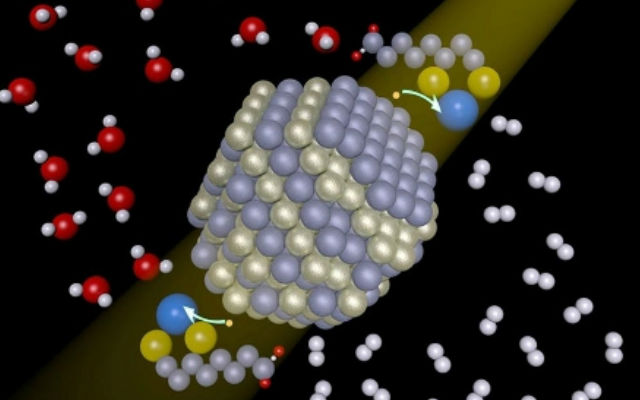
The new study, the results of which were reported only two weeks ago by authoritative scientific publications, was aimed precisely at developing ways to “collect” sunlight. Researchers at the University of Rochester in New York have created tiny particles of cadmium and selenium that break down electrons when exposed to sunlight. Scientists also needed a catalyst for these electrons to turn into hydrogen ions, then combined into the required hydrogen.

The researchers filled special containers with water, adding cadmium and selenium nanoparticles (along with substances for dissolving these nanoparticles in water), a nickel catalyst and some others ingredients. When light hit nanocrystals, this entire system came to life, starting to produce hydrogen. However, she did not even think of stopping herself! It was necessary to wait for the ray-absorbing part of this system to cease to be active; only then would the entire system cease to be active.
Hydrogen fuel will be obtained through the rational use of solar energy
One of the researchers, a certain Todd Krauss, said that the “mixture” continued to be active after two weeks of work. Scientists stopped it because they just lost the patience to wait! During normal photosynthesis, hydrogen, which receives electrons from fissile water, releases oxygen atoms. In this case, the goal was not to break down water molecules, especially since another component was used to make water “work” — ascorbic acid.

The experiments in question have allowed scientists to identify some of the problems that could hinder their efforts to organize the process of artificial photosynthesis. According to another project participant, chemist Hemamala Karunadasa, the resulting composition is “long-lasting” and compatible with water. The chemical components used can be used effectively more than once. It seems that scientists have really managed to develop the very desirable principle that will allow humanity to soon begin using solar energy more efficiently.