
 Unbelievable facts
In a world with a wide variety of animal species, there are species that may appear to be the same for a while, when they are actually very different when studied properly.
Sometimes these animals come from the same family.
Here's a list of 10 pairs of animals you might mistake for each other.
Let's take a look at them!
Read also: Unusual animals you didn't know about
1.
Rabbit and hare: how they differ
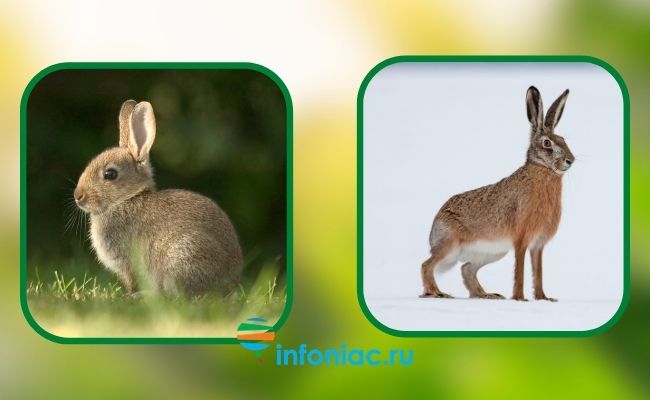
Despite the fact that rabbits and hares belong to the same family – Leporidae – and have an almost similar appearance. However, there are significant differences.
Hares are larger than rabbits. Their ears and legs are much larger than those of a rabbit the same age.
Rabbits prefer to stay underground in burrows, while hares live above ground, where they can run up to 80 km/h.
Rabbits love to have people around, but hares do not want to be petted and prefer wildlife. In winter, hares shed their brownish coat and replace it with a white coat for camouflage. Rabbits can't do the same trick.
2.
A crow and a raven: differences

Although they belong to the same family — Corvidae — they are actually different.
John Marzlaff, a researcher on crows, found that these birds can remember people's faces and actions.
The main distinguishing feature of a crow and a crow is size. A raven is heavier, larger, sometimes four times larger than a crow.
If you see a large group of flying birds, you can be sure that they are a flock of crows because crows prefer to travel in pairs.
During the flight of these birds, you can see that the crow's tail is diamond-shaped, and the crow's tail looks like a fan.
Read also: Now you've seen everything: what bald animals look like
3.
Lizard and salamander

These distant dinosaur relatives look like brothers, but they're not so close.
Lizards are reptiles and salamanders are amphibians.
In addition, lizards have five toes on their feet, while salamanders have one fewer toes. Salamanders spend a lot of time swimming, which means they are wet and cold. On the other hand, lizards are dry with rough skin.
While moving, lizards tend to crawl and jump, and salamanders run fairly smoothly and faster. Salamanders don't have claws or ears, and lizards love to show off them.
Salamanders, unlike lizards, go through metamorphosis (like frogs) – their body systems quickly become adults.
4.
Alpaca and llama
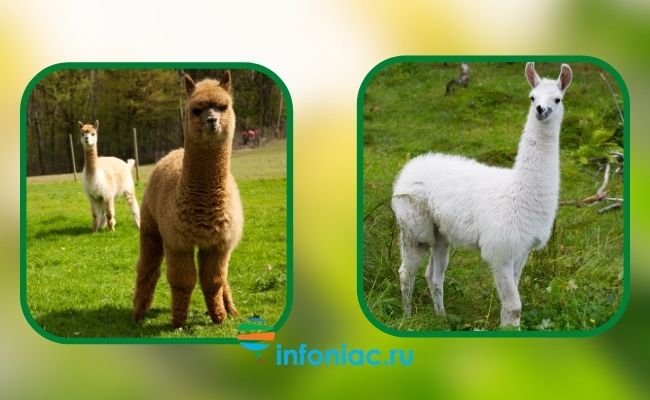
Belonging to the same Camelidae family, both species are widely found and used in Bolivia and Peru.
They serve different human purposes due to their distinct physical properties. Alpacas are used for wool production, while llamas are used for transportation.
The llama is 120 cm tall and weighs 113 kg. Alpaca can grow up to 90 cm and weigh 65 kg. Thus, the llama's higher body mass index makes it an excellent means of transportation.
Llamas have longer snouts and ears than alpacas. In addition, unlike timid and malleable alpacas, llamas often spit, kick, freeze, or lie down in response to abuse or overload.
Read also: The most amazing large animals that live on the islands
5.
Jaguar and leopard

The international scientific name for the leopard is Panthera pardus, and the jaguar is Panthera onca. You can find jaguars in Central and South America, and leopards in Africa and parts of Asia.
Jaguars have strong jaws, very strong teeth, and an incredibly strong bite force among all big cats. Leopards, on the other hand, are comparatively smaller in size.
Jaguars are masters of swimming. They feed on aquatic predators like caiman and anaconda. Meanwhile, leopards are more fond of climbing.
If we compare the spots on the skin, the jaguar has more spots than the leopard, and you can also see a small speck inside their spots.
Another feature that might amaze you is that leopards are the smallest of big cats. While jaguars are the largest in their realm in Central and South America.
6.
Crocodile and alligator: how they differ
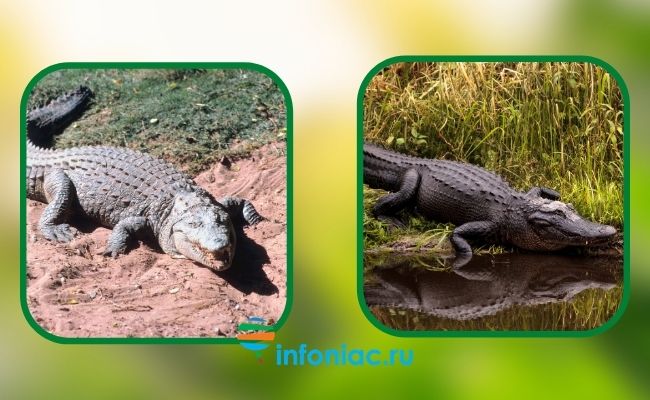
Crocodiles have a sharp and V-shaped snout, while alligators have dull and rounded snouts.
Alligators have more teeth. When both species have their mouths closed, you will not see their teeth, but crocodile has fangs on its lower jaw.
Crocodiles are also more aggressive than alligators. They can attack any animal at any time, but alligators only attack when they are very hungry or if provoked.
Alligators live in fresh water, and crocodiles can live in both fresh water and salt water because they have highly functional salt glands.
Crocodiles can live up to 100 years, while alligators can live 30 to 50 years.
7.
Sea lions and seals

Sea lions boast longer fins. They can also use flippers to walk on land, but seals can't do that. Seals, however, are better swimmers.
Sea lions also make louder noises than seals. Sea lions are also more sociable than seals.
Seals spend more time underwater than sea lions, but the latter are more artistic and playful
Another difference is that sea lions have earbuds that rotate to prevent water from entering their ears when diving.
8.
Seagull and albatross

Although both seagulls and albatrosses are seabirds, there are a few distinct differences between them that can be easily noticed.
Albatrosses have a long wingspan, reaching 3.3 meters, while gulls have significantly smaller wingspans. As a result, with the exception of washbasins (the seagull family), none of the gulls dare to fly far from land.
Meanwhile, albatrosses are among the most efficient vertebrate travelers, as they can travel thousands of kilometers with minimal energy. The presence of tendons in the shoulder allows them to “fix” their long wings when they are fully open.
Albatrosses are known to feed on marine animals and are carnivores in nature. But seagulls are omnivores. They live close to land, and their diet ranges from sea creatures to seeds, fruits, and even earthworms.
9.
The wolf and the coyote
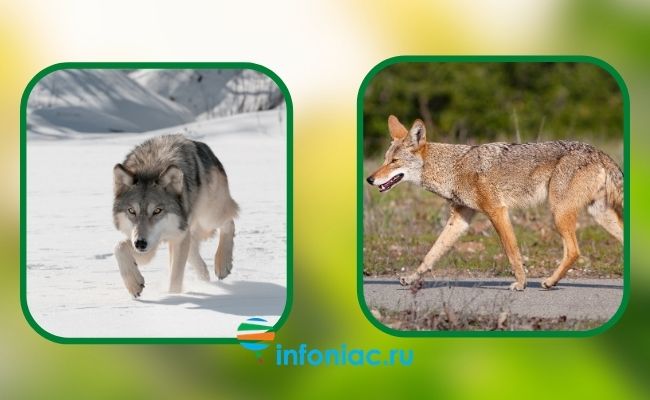
Wolves and coyotes belong to the same family, Canidae. There are certain physical features between them that can be used to distinguish an adult wolf from a coyote.
The coyote's snout is narrower and more pointed with a short nose pad. An adult wolf has a broad face with a large nose pad.
Coyotes are usually smaller and range in length from 100 to 140 cm. Wolves, on the other hand, can grow up to 2 meters in length. Due to its larger size, an adult wolf weighs between 30 and 70 kg, while an adult coyote can weigh up to 22 kg.
Coyotes have pointed ears and have a higher voice. Wolves, on the other hand, have short, rounded ears and a low voice. Also, wolves are more aggressive than coyotes.
10.
Frog and toad: differences
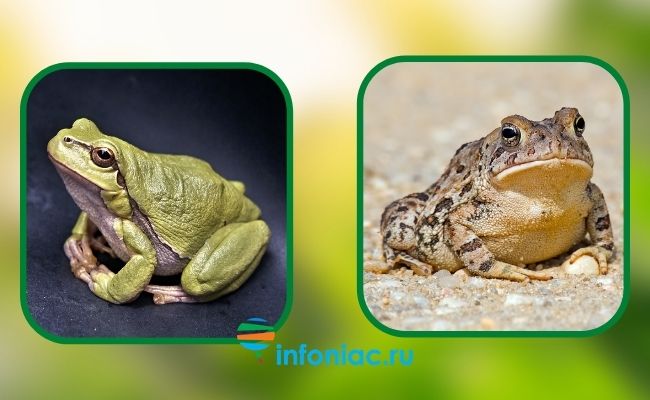
Toads are larger in size than frogs. Toad skin is wrinkled and pimpled, while frogs have smooth skin.
Toads live on land, and frogs live in water (although they sometimes go to land, they spend very little time on land).
Toads have shorter legs and mostly crawl, rarely using short jumps to move. Frogs boast powerful legs for high jumps.
Toads love to hunt down insects crawling on the ground and therefore often look down. Frogs, on the other hand, feed on flying insects and often look up.
It is also worth noting that frogs, unlike toads, have teeth.