
 Events
The man, known in scientific communities as M1, died a slow and painful death, and experts were able to prove that he died precisely from cancer, which, as it turned out, existed in ancient times.
Prostate cancer, one of the most common types of malignant tumors today, also developed among the ancient Egyptians, according to data obtained during the radiological examination of the mummy, which is about 2,250 years old.
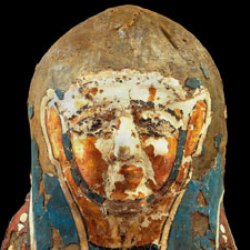
Held at the National Museum of Archaeology in Lisbon and cataloged as M1, the unnamed Ptolemaic mummy features a painted mask and an artfully decorated shroud. “The fact that a male mummy is indicated by pronounced sexual characteristics, including a mummified penis,” says radiologist Carlos Prates.
The man, 160 cm tall, was 50-60 years old when he died a slow and painful death. The researchers scanned the mummy with a powerful multilingual tomography detector that was specifically designed to produce very high-quality images.
Digital X-rays showed that M1 was buried cross-armed (this is a common posture for Ptolemaic mummies, although only kings and their families were buried this way in the New Kingdom) and suffered from lumbar sacral osteoarthritis, which was probably related to scoliosis that developed in the lumbar spine.
Several post-mortem fractures, most likely caused by improper transport to Europe, injured the body. However, this was not all they found. Experts have identified a round and dense tumor, between 0.03 and 0.59 inches in size, in the pelvis and lumbar spine. “The lesions to some of the bones were very similar to metastatic prostate cancer,” they wrote.
As it turned out, prostate carcinomas usually affect the bones of the pelvis, lumbar spine, upper arms and legs, and ribs. Prates and his colleagues also considered other variants of diseases, but after correlating all the data, analyzing the distribution of lesions, their shape and density, they came to the conclusion that they are dealing with prostate cancer.
“This is the first known case of prostate cancer in ancient Egypt and the second oldest case in history,” says Prates. Prostate cancer was first detected in 2007 when examining the skeleton of a 2,700-year-old Scythian king who died at the age of 40-50 in the steppes of Southern Siberia, in Russia.
“This study shows that cancer did exist in ancient times, and probably in ancient Egypt. The main reason that so few examples of it have been found is the short life expectancy and the very low prevalence of carcinogens,” says Egyptologist Paula Veiga ).
In addition, high-resolution CT scanners, which can detect even tiny tumors (0.03-0.07 inches in diameter), have only been available since 2005. Therefore, it can be assumed that earlier studies may have missed a number of cases.
“This technology has significantly improved our ability to interpret data. Radiology and its latest developments, such as high-resolution tomographs, are a phenomenal tool that is irreplaceable in many areas of art and archaeology,” he concluded Prates.