 Unbelievable facts
Space can be much more amazing than we think if we arm ourselves with the right equipment. Modern telescopes, cameras and spacecraft take photos that change our understanding of space processes.
1. Cornucopia galaxy cluster
At first glance, this photo looks like a bluish spiral galaxy, but it's actually much farther away than most of the objects that hit the telescopic lens cameras.
Galaxies are not at all scattered in the universe in random order as it might seem. They are attracted by gravity to form groups and clusters.
The galaxy cluster you see in this photo is known as SDSS J0333+0651. Such clusters help scientists understand what the farthest (and therefore earliest) regions of the universe were like.
Read also: Solar eclipse on July 13, 2018 and what to expect for your zodiac sign
Regions where new stars are forming are usually not very large. They extend over a maximum distance of several hundred light years, which is very short by cosmic standards. Therefore, it is not so easy for telescopes to capture them, even for those with super sensitive cameras.
Astronomers are going to the trick. They're looking for galaxy clusters whose gravitational influence is so strong that it distorts the space-time around them. This distortion works like a lens, amplifying the light of galaxies (and places where new stars are forming) that are much farther away from this cluster, as well as forming elongated arches similar to the one you can see in the upper left corner of the image.
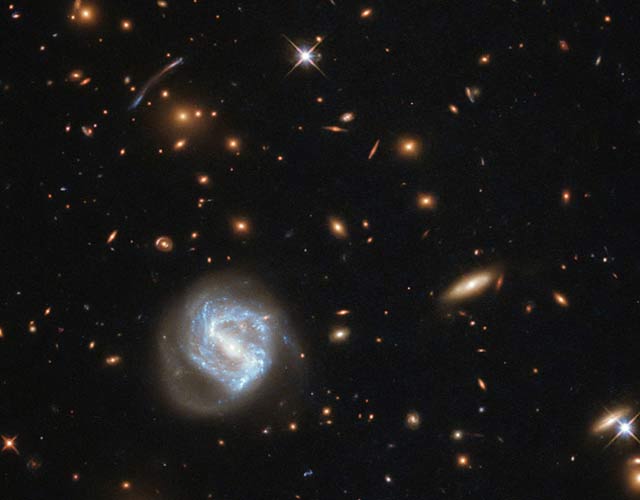
Photo: ESA/Hubble & NASA
2. Jet stream on Jupiter
This stream on Jupiter's surface was captured by the Juno spacecraft. The current is called “Jet N2", it has a lighter shade and extends from the upper left to the lower right edge of the photo. The photo was taken on May 23, 2018, when Juno was already close to Jupiter for the 13th time. At the time when the photo was taken, the device was at a distance of 5659 km
from the upper surface of the clouds.
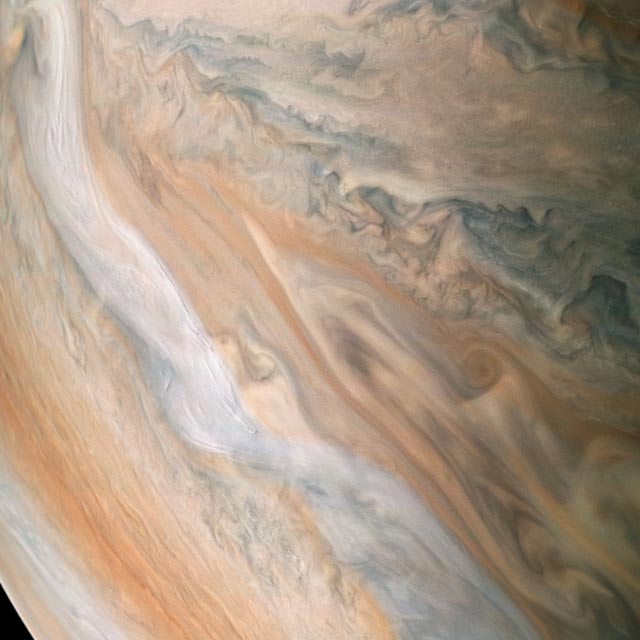
Photo: NASA/JPL-Caltech/Swri/MSSS/Gerald Eichstäd/Seán Doran
View from space: photo
3. Who said you were tired of working at the office?
“Space was our office yesterday,” said International Space Station astronaut Ricky Arnold after a difficult day in outer space setting up cameras on the orbital platform.
Arnold and station captain Drew Fustel completed their sixth spacewalk this year, which lasted 6 hours and 49 minutes. Astronauts have installed new high-definition cameras that will better monitor the approach and docking of the Dragon spacecraft, which is due to arrive on June 29, 2018.
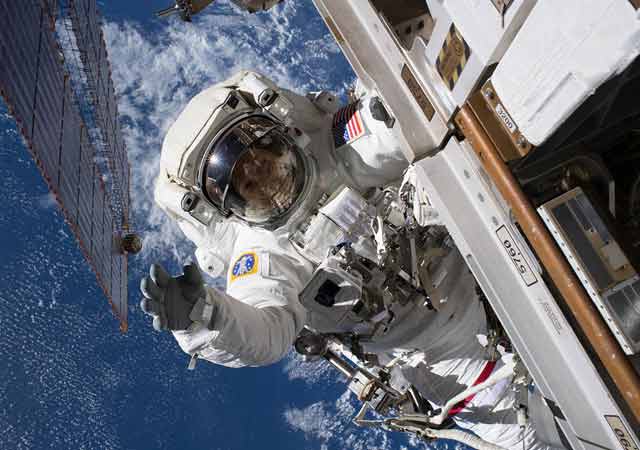
Photo: NASA
Beautiful photos of space
4. Dragon spacecraft launch
At 5:42am on June 29, 2018, a Falcon 9 rocket was launched from an airfield in Florida, lifting the SpaceX Dragon spacecraft. The Dragon has several tons of equipment, various supplies and supplies that will help researchers conduct dozens of studies aboard the ISS.
NASA astronauts working on the ISS are using a special Canadarm2 robot that will help catch the Dragon when it arrives at the station on July 2, 2018.
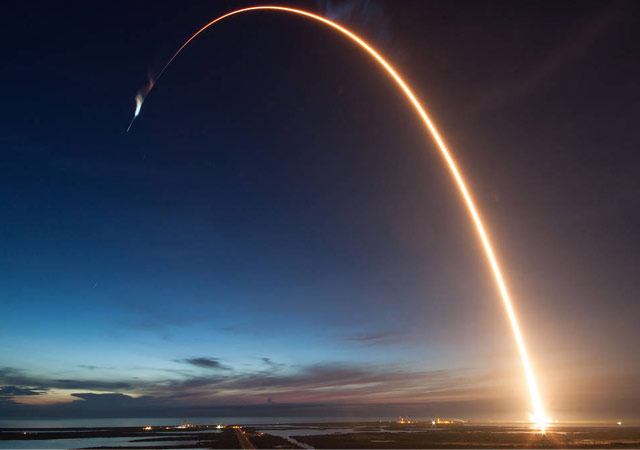
Photo: SpaceX
5. A rover under the light of the Milky Way on planet Earth
ARADS rover during test work in Chile's Atacama Desert. To the right is a beautiful view of our Milky Way galaxy, and to the left is a moonrise.
This rover is designed to study traces of life on Mars and other planets or satellites of planets in the Solar System. It is run by scientists and technicians who are physically based in California.
Read also: The most interesting and mysterious photos of space
The rover has the ability to move across the surface, take soil samples and send them for research to its own mini-laboratory on board in search of traces of living creatures.
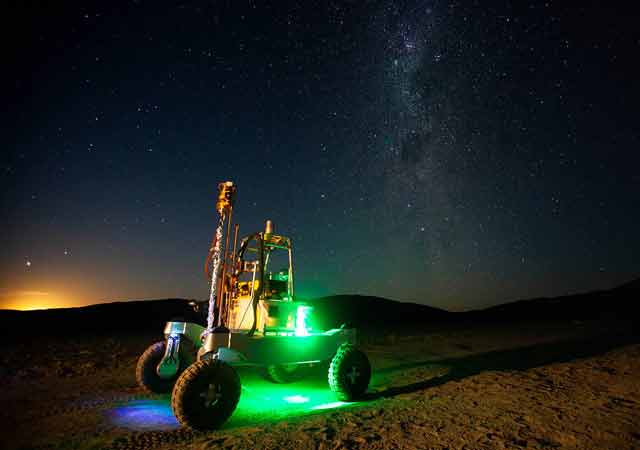
Photo: NASA/Campoalto/Victor Robles
6. He whistled
The Martian reconnaissance satellite took a photo of a relatively new (about 10 years old) impact crater, whose diameter is only 5 meters. The meteoroid hit the surface of the Red Planet and exploded, leaving behind a road about 1 kilometer long.
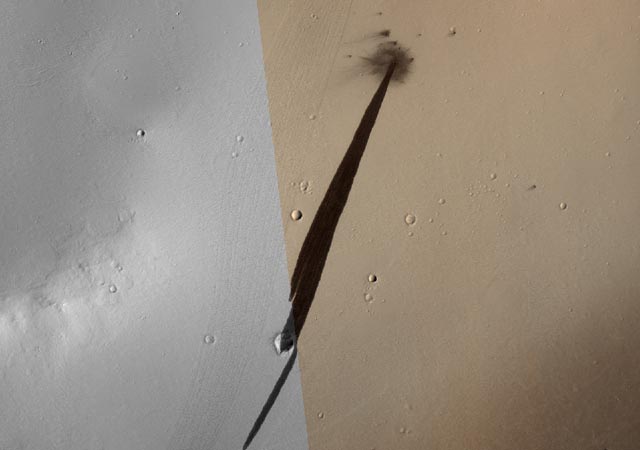
Photo: NASA/JPL-Caltech/Univ. of Arizona
7. New Moon over Newfoundland
The International Space Station team captured this stunning sight — the full moon — on April 30, 2018, as the station was flying over Canada's coast.
At that moment, the station was at a distance of 354 km
from Earth, completing another orbit around the planet. The station makes a full revolution around the Earth in 92 minutes. The station's speed is 27,700 km per hour, and astronauts manage to meet about 15-16 sunrises and sunsets in a day.
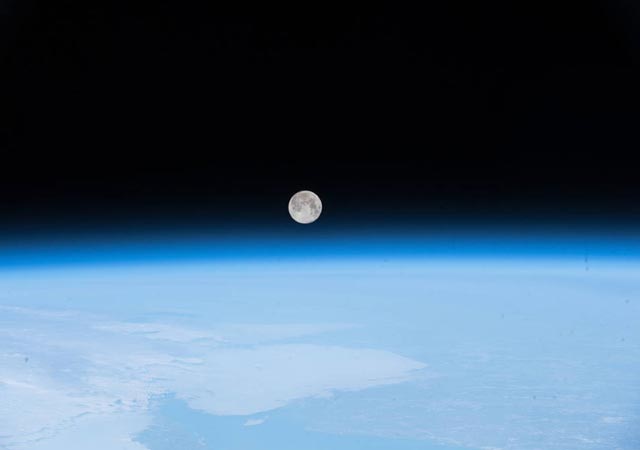
Photo: NASA
8. Ganymede: a satellite like no other
Somewhere far away in the solar system, where our Earth looks like a pale blue dot in a dark sky, NASA's Galileo spacecraft has been orbiting Jupiter for 8 years.
During the mission, the spacecraft helped make numerous discoveries related to Jupiter and the gas giant's moons. In particular, it was found that the magnetic environment around the moon Ganymede
differs from the magnetic field of Jupiter itself. The Galileo mission was certified in 2003, but scientists are still using the data obtained during it, revealing all the new secrets of the distant planet and its moon.
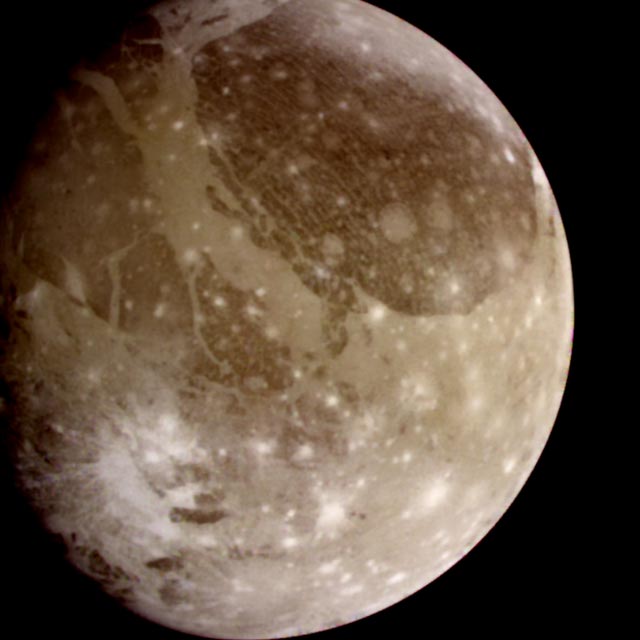
Photo by NASA/JPL
Just space: photo
9. The Hubble telescope was able to capture a camouflaged spiral galaxy
The spiral galaxy NGC 1032 is located about a hundred million light-years away from us in the constellation Cetus. This photo does not show that the galaxy is spiral-shaped because all its contents, including stars, dust and gas, are captured from the side.
This photo proves that spiral galaxies are shaped like a flat disk that looks like an elongated line from the side. Well, this angle at least makes it possible to understand the thickness of galactic disks, although it is impossible to see the galaxy's spiral arms in all their glory.
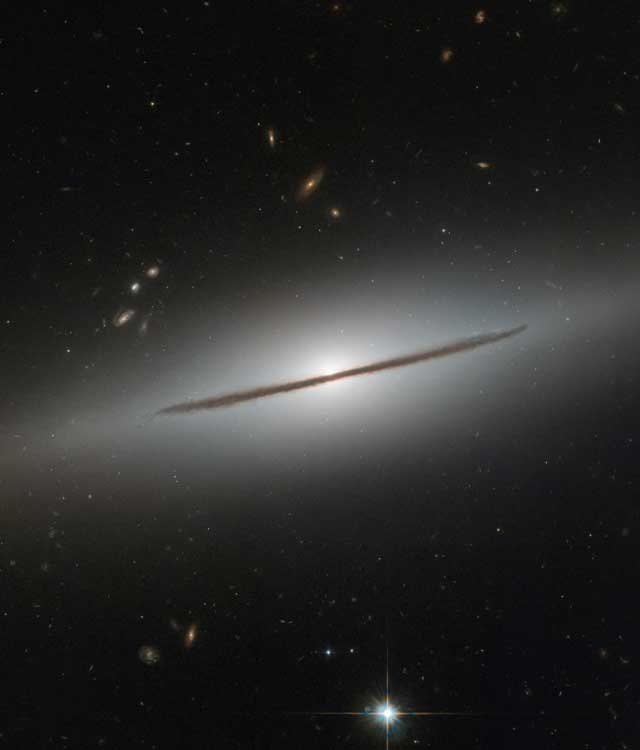
Photo: ESA/Hubble & NASA
10. Coming back home
This image captured the landing of the Soyuz MS-07 spacecraft crew, consisting of Anton Shkaplerov, Scott Tingle and Norishige Kanai, near Zhezkazgan, Kazakhstan on June 3, 2018. The astronauts worked on the ISS for 168 days, or almost six months.
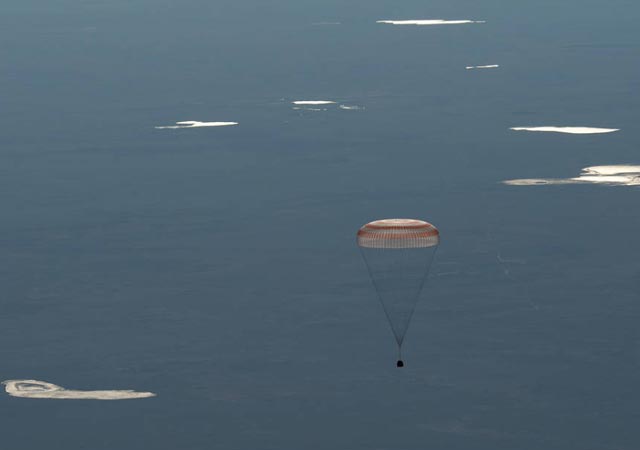
Photo: NASA/Bill Ingalls
Real photos of space
11. Space fireworks
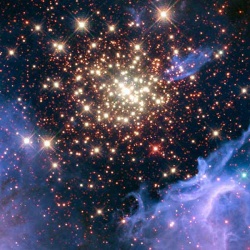
This bright cluster of stars resembles fireworks. Around it, you can see clouds of interstellar gas and dust, with the help of which new stars are formed. The NGC 3603 nebula is located about 20,000 light-years away in the Carina constellation and contains several clusters of large hot stars.
Most of the stars in this cluster were born almost simultaneously, but they are quite different in size, temperature, mass and color. The life of stars is determined by its mass, so the stars of this cluster are now at different stages of their lives, which makes it possible to study the life cycle of stars in detail.
NGC 3603 contains some of the most massive stars we know. These huge giant stars do not live long and die relatively young, burning their hydrogen fuel very quickly, before ending their lives in a spectacular supernova explosion.
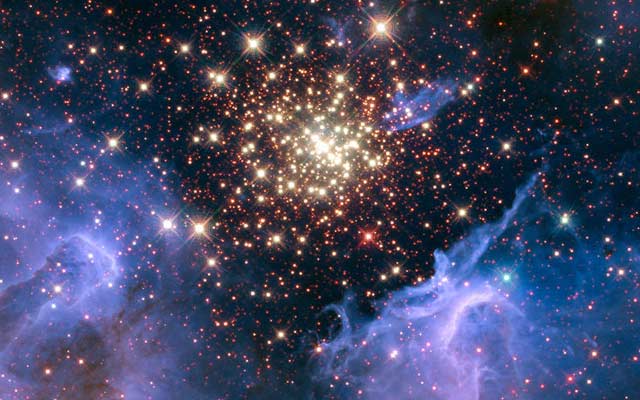
Photo: NASA, ESA
12. The mysterious Laguna Nebula
At the center of the photographed Laguna Nebula, you can see a massive young star that is 200,000 times brighter than our Sun. This star emits strong ultraviolet radiation and hurricane-like stellar winds, creating fantastic cosmic landscapes of waves, voids and mountains from gas and dust.
The Laguna Nebula is about 5,200 light years away and can be seen even with the naked eye as a muddy speck in the northern latitudes of the Northern Hemisphere.
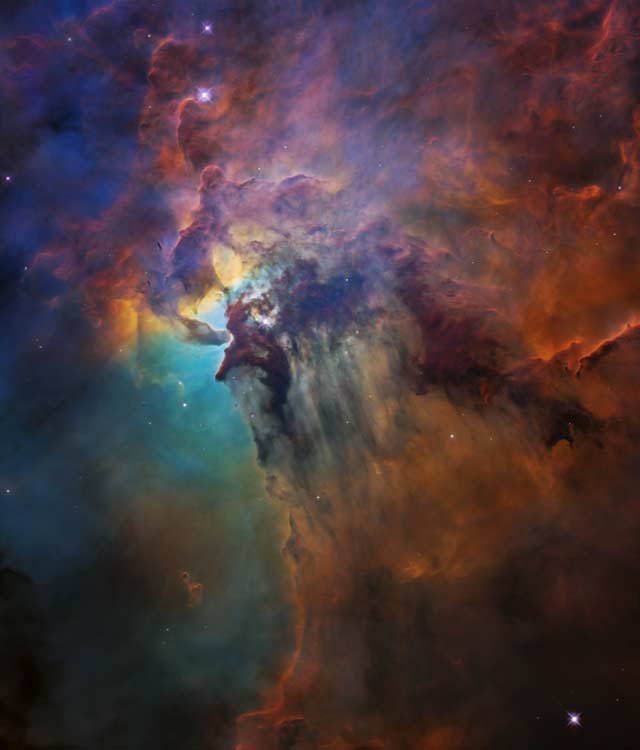
Photo: NASA, ESA, and STSci