
Walking around Barcelona, you can see many amazing buildings: a palace completely decorated with floral patterns, a huge cathedral that looks like a sand castle, and even a house made of bones and skulls. We tell you which architectural monuments definitely deserve the attention of travelers.
The cathedral
The main temple of Barcelona attracts the eye with its stunning Neo-Gothic architecture. The facade of the cathedral was created in the XIX-XX centuries, but the building itself is much older: it was built in the middle of the XV century. The work lasted 150 years! A lot has been preserved since then: a choir with a colonnade and a wooden pulpit, colorful stained glass windows, as well as stones and columns on which scenes from the Old and New Testaments are carved.
Basilica of Santa Maria del Pi
The church was built in the XIV century and during its history could have been destroyed more than once — during the War of the Spanish Succession (1701-1714) and the Civil War (1930s). Santa Maria del Pi has undergone several restorations and has stood the test of time. Today it is one of the main temples of Barcelona with unique features. For example, the facade of the Gothic basilica is decorated with the largest rosette window in Catalonia. And inside you can see an ancient statue of the Mother of God with Christ in her arms, which in the XVI century was accidentally found in … the trunk of a nearby pine tree! The monument was discovered by an ordinary fisherman who decided to cut down a tree to build a boat. A weekend fair is held in Piazza del Pi in front of the temple every two weeks. You can admire the Gothic architecture of the basilica and at the same time buy handicrafts.
Baglio’s House
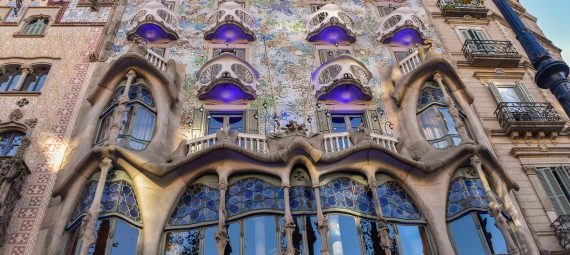
One of Antonio Gaudi’s masterpieces. The famous architect created this house in the early 20th century for the textile magnate Josep Baglio y Casanovas. There is not a single straight line inside and outside the building! This is a traditional Gaudi technique — the Spaniard has always been inspired in his work by the natural forms of nature. The Baglio House is also often called the “House of Bones” because the columns on its facade resemble bones and the balconies resemble skulls. And the undulating ceramic roof resembles the scales of a dragon. Hence the assumption that Gaudi used architecture to depict the legend of St. George, the patron saint of Barcelona, who slaughtered a dragon in battle. According to this theory, the tower with a cross on the roof is the hilt of a sword piercing a fire—breathing monster, and the columns are bones, and the balconies are skulls — the remains of victims eaten by the monster.
The Palace of Catalan Music
This concert venue is considered the pearl of Catalan Art Nouveau. Architect Luis Domenech y Montaner turned the Palace of Catalan Music into a kind of luxurious greenhouse in the very center of Barcelona: many floral patterns and floral motifs were used in the design of the building. The unusual architectural monument with an abundance of mosaics, stucco and stained glass windows was built for only three years: from 1905 to 1908. The main concert hall, surrounded by man—made flowers and palm trees, has a rather unusual detail – it is surrounded on all sides by large windows. Thanks to them, natural light becomes part of the “natural” interior of the Palace. There is even a window in the ceiling: with a concave center in the form of the sun. In addition, the main hall is decorated with sculptures symbolizing music. Among them, for example, busts of famous composers — Ludwig van Beethoven and Anselmo Clave. As well as the figures of valkyries, referring to the opera of the same name by Richard Wagner.
Sagrada Familia (Cathedral of Sagrada Familia)
This is the most important work of Antonio Gaudi, known far beyond Barcelona. The Catalan worked on the Sagrada Familia Cathedral for 42 years until his death, but never finished it. The Sagrada Familia, the first stone of which was laid in 1882, is still under construction! The reason is not only the complexity of the project: construction from the first day was carried out exclusively on public donations. When Gaudi was alive, he had to independently ask the residents of Barcelona for funds to continue the work. The unique building is planned to be completed by 2026, but you can still admire its architecture and interiors today. Externally, the cathedral looks like a bizarre sand castle. Of its 18 towers, three have not yet been completed, including the central spire with a height of more than 170 meters. The exterior of the building is decorated with many sculptures. The townspeople acted as models for them: for example, an alcoholic church watchman became the prototype of Judas, and Gaudi made Pontius Pilate a local shepherd. Inside the Sagrada Familia looks like a bizarre forest. The arches of the cathedral in the form of tree crowns are supported by branched columns-trunks. The entire interior is also flooded with light and bright colors thanks to the colorful stained glass windows. Gaudi’s best creation simultaneously became his last resting place. The remains of the architect rest right here, in the chapel of the Virgin Carmen.
Sao Paulo Hospital
Since the middle of the XV century, there has been a hospital on this site. It was not just a hospital, but an innovative scientific center, within the walls of which research was carried out and medicine developed. For this reason, the Spanish kings often gave the hospital interesting powers. Up to the point that its employees could inherit the property of deceased patients who had not left a will! By the 20th century, the old Gothic-style hospital buildings had fallen into disrepair. In 1930, a new hospital in Sao Paulo was built according to the project of Luis Domenech y Montaner (the author of the Palace of Catalan Music). As a result, it became one of the central monuments of Barcelona in the Art Nouveau style — with elegant domes, sculptures and bright stained glass windows. The architect laid out beautiful gardens on the territory of the hospital, and connected all the buildings with underground passages. In 2009, the hospital moved to a modern building, and the renovated Sao Paulo complex was occupied by a scientific and cultural center. There are also several museum spaces here. For example, in the San Salvador Pavilion, visitors get acquainted with the history of medicine in Barcelona, and the San Rafael pavilion is a preserved fragment of a hospital with a historical interior of the early 20th century.
“Spanish Village”
This unique place appeared on Montjuic Mountain, among other things, thanks to the World Exhibition. A walk through the complex can be compared to a trip all over Spain, because there are exact replicas of 117 buildings from different regions of the country — from medieval Gothic monuments of La Mancha to cozy whitewashed houses from the villages of Andalusia. There are even buildings whose originals have long been lost. For example, an old residential building of the XVI century from the city of Murcia, demolished in 1933. Folk festivals are also being reconstructed in the “Spanish Village”. Right up to the tomato battle of La Tomatina, which takes place annually in the main square of the village of Bunyol in the province of Valencia — on this day (the last Wednesday of August), everyone really throws tomatoes at each other! And it’s also worth going to master classes from craftsmen who will teach you how to paint stained glass windows, work with genuine leather and even create jewelry from silver.