
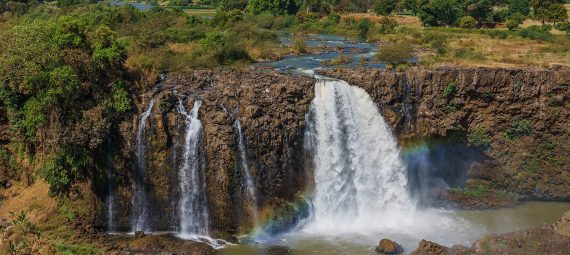
The mighty Nile, the main waterway of the African continent, is fed by many large tributaries — among them the Blue Nile, which irrigates the lands of Ethiopia for 800 km. It originates in Lake Tana and after 30 km downstream forms majestic cascades — waterfalls of the Blue Nile, also known as Tis-Ysat or Tis-Abbay by the name of the nearest village. It is the largest waterfall in Ethiopia and the second largest in Africa after the Zambian Victoria.
At various times, the natural attraction was visited by many famous personalities, including the traveler James Bruce and Queen Elizabeth II.
What to see
A winding path leads to the waterfalls of the Blue Nile, passing through small gorges and making its way through the Ethiopian jungle. The ascent will take about 30 minutes with a local guide — it’s easy to get lost here alone, because there are no signs for tourists. The Blue Nile can be heard from afar: the cascades have not yet appeared to the eye, and the noise of the rushing water already indicates the power of the water flow. The height of the waterfalls reaches 45 m, and the width is up to 400 m, depending on the season; during periods of drought, the flow weakens and the walls of the gorge are exposed.
In the 60s of the last century, the authorities built two hydroelectric power stations upstream of the river, and the waterfalls have become much shallower — but even now they look truly impressive.
The cascades of the Blue Nile, despite the catchy name, are not blue at all, but rather yellow-brown — this color is characteristic of the entire Nile basin, but the stream falling from a great height seems snow-white. Tis-Issat in translation from Amharic (the official language of Ethiopia) means “steaming water”: indeed, a cloud of spray rising from the stormy waters creates the illusion of a smoke screen. Thanks to the bright sun, rainbows often appear here.
Not far from the waterfalls there is an old stone bridge built by Portuguese adventurers in 1626.
The jungle around the gorge is full of colorful birds and enterprising monkeys, and myriads of insects buzz in the air. The waterfalls are relatively quiet — local kids and souvenir vendors prefer to wait for tourists closer to the village. Some brave travelers even spend the night in a tent in the immediate vicinity of a stormy stream, but because of the agile local fauna, it is better not to do this without the support of local guides.