
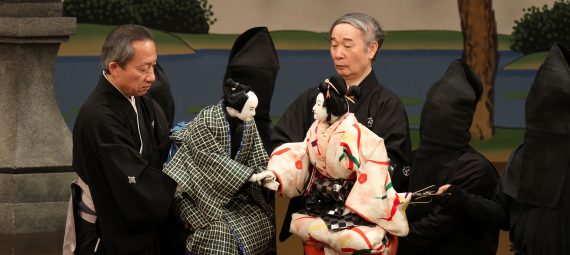
Bunraku in Osaka is the largest puppet theater in Japan, it is not just considered the keeper of the long—standing traditions of the land of the rising sun, but is also famous for its considerable contribution to the cultural life of the city today. Its history began back in 1872, and the theater acquired its name on behalf of the organizer and director of the first performances of Uemura Bunrakuken (1737-1810).
So, what is a puppet theater in Japan? As many centuries ago, its action is multifaceted and diverse. In a nutshell, this is a combination of a puppet show with a folk tale of dzeruri to the musical accompaniment of shamisen, and the first mention of such a sophisticated pastime dates back to the late 16th — early 17th centuries. Moreover, initially the performances were given in the ancient capital of Kyoto not in halls, but in open areas of the bed of the drying Kamo River. Only in the 17th century the puppeteers went to the newly founded capital of Edo (now Tokyo), from where in 1657 finally moved to Osaka and Kyoto. It was then that puppet theaters began to acquire their own “houses”, the device of which has survived to this day without significant changes.
Bunraku is a combination of a puppet show with a folk tale of dzeruri to the musical accompaniment of shamisen, and the first mention of such a sophisticated pastime dates back to the late 16th — early 17th centuries.
It is worth saying a few words about the dolls themselves — these are not the usual small Parsley and bears, these are huge, well-thought-out and exceptionally elegant dolls of half human height (or even more). Each of them is controlled by up to three operators, the most experienced “leads” the head, eyes, eyelids, mouth and eyebrows, as well as the right hand, the second is responsible for the left hand, well, the latter, as a rule, gets the legs. In order not to distract the audience from the action, the operators are dressed in black robes and only the most famous puppeteers are allowed to show their faces.
The skill with which the operators control their wards and the amazing facial expressions of these animated dolls completely distract the audience from the puppeteers in a few minutes — the whole hall, with bated breath, is focused on the plot and the unfolding action. The surreal image of the revived huge dolls is complemented by the voice of the singer-storyteller gidayu, as well as the rhythmic sounds of three-string shamisen and drums. It is noteworthy that gidayu speaks on behalf of all dolls — men, women, and children, changing only intonation and timbre.