
 Ecology
Some dinosaurs were indeed huge in size, but they were not too fat and well-fed as they are commonly portrayed.
A recent study used a new technique to calculate the weight and size of dinosaurs and other prehistoric animals. This study will forever change the appearance of many museum exhibits, as well as change the way many of our contemporaries think of what extinct creatures of the distant past actually looked like. The study was published in the latest issue of Biology Letters.
“We are now able to restore the appearance of many animals,” says study leader William Sellers from the University of Manchester, Department of Biological Sciences. “We now have numbers that help determine how much flesh should be added to the bones to understand what the animal really looked like.”
Sellers and his team of scientists used lasers to measure the minimum amount of skin it takes to cover skeletons in modern large animals, including white reindeer bears, giraffes and elephants. In the course of their work, scientists noticed that these animals had almost exactly 21 percent more body weight than with a minimum amount of bones covered with skin.
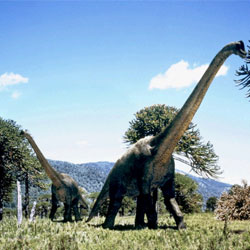
The new formula was applied to the skeleton of the giant Brachiosaurid, whose skeleton is now in the Humboldt Museum in Berlin. According to previous estimates, this creature weighed about 80 tons, but according to the new formula, it weighed only 23 tons. This, of course, is also quite an impressive figure, but it is much lower than previously estimated.
“23 tons is small enough for a creature this size, but we tend to argue that all dinosaurs were much thinner and slimmer than expected,” Stellers said, adding that the weight of dinosaurs and other ancient animals have been constantly revised since the 1960s, and each time it is getting smaller and smaller.
The new assessment provides a better understanding of biology. Scientists believe that a lower weight is more suitable for creatures like dinosaurs.
High-tech scanners, fast computers and other devices were not available when scientists first began assessing the weight of these giants. Until recently, researchers used fairly primitive methods to estimate the weight of dinosaurs.
“One common method is to take an animal sculpture and place it in water, as Archimedes did, to measure its volume,” says Sellers. “By calculating the volume, you multiply it by density, the result is weight.”
The main problem is the reconstruction of the sculpture. It takes a very long time to create it, and the resulting sculpture does not accurately reflect real facts, so the researchers decided to try a completely new method.
In addition to the fact that the new data is more accurate, the new method makes it possible to obtain results much faster. The only limitation in this case is that it is necessary to have a complete skeleton sample that must be fully assembled.