
 Politics
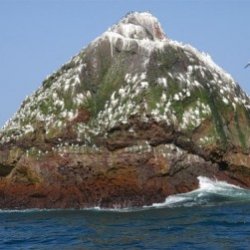
The fight for the small Rockall Rock is currently unfolding in the North Atlantic. The rights to it were claimed by: the United Kingdom, Ireland, Iceland and Denmark. It is unlikely that the 570-square-meter site would be of such interest if it were not for the oil underneath. Now the UN will decide who will be the lucky owner of the “golden stone”.
Rockall is located above the waters of the once extinct volcano. There was never fresh water there, which means that the area was not habitable. The only inhabitants of the island are guillemots, northern cormorants and other birds that stop on the island for a break during long flights. Some birds even build their nests on the rock. At the same time, there are plenty of fish and shellfish in the surrounding waters. Seafood ownership is another reason to fight for this region.
Rockall is mentioned in medieval Irish folklore. There it represents the mythical “Rocabarra” stone that should appear before the end of the world. As for the scientific description of the rock, information about it first appears in 1703, however, there is a reference to the existence of an Irish legend about “Rocabarra”.
As the centuries passed, Rockall developed a reputation for being a deadly place. For example, in 1686, a fishing boat ran aground in its vicinity. In 1812, the research vessel Leonidas sank near it, and 12 years later, the brigantine Elena Dundee sank. In 1904, the ship Norway crashed near Rockall on its way to New York. At that time, 635 people died, and 150 were saved.
Therefore, no one was in a hurry to formalize sovereignty over the ill-fated rock. Moreover, hardly anyone at that time could compete with England, the mistress of the seas, especially considering that the place is located not far from British shores. However, the British themselves did not seek to do this either until officials arrived on the island in 1955 and installed the British flag and navigation beacons.
However, since then, the British have not taken much care of this place and have not even registered their rights to it with the UN. They decided to “secure” their sovereignty in a strange way. In 1975, two Marines arrived on the island for just a few hours to take a couple of pictures.
Greenpeace activists were the first to challenge British sovereignty over the island. Three environmentalists settled on the island for 42 days to protest against a British oil exploration operation that took place there. Representatives declared the island the new global Waveland, meaning anyone could become its citizen. The political circus, however, did not last long.
Rockall would remain formally either British or nobody if scientists hadn't started exploring the shelf around the rock to see if there was oil there or not. Black gold has been found and, according to British experts, it can significantly replenish the treasury of the United Kingdom (by 100 billion pounds). Apparently, gas fields have also been discovered there. After this discovery, other countries also fussed.
Ireland, Iceland and Denmark have decided to challenge British rights to the territory. The Icelandic and Irish governments have submitted applications to the relevant UN Commission. The UK is following suit. Denmark has also joined the race. It is expected that an official decision will be announced in 2014.
Each side has its own arguments. The UK claims that the closest territory to Rockall is its Hart Island, located on Scotland's northwest coast. It is 300 kilometers from Rockall, and the Irish, Icelandic and Faroe Islands, which belong to Denmark, are much further away. The British say that the rock is an island, so all the waters surrounding Rockall are the exclusive economic zone of the UK.
Unlike its neighbor, Ireland is trying to prove that Rockall is not an island at all, but a rock. According to international law, there can be no territorial waters around the rock. This means that the rock must belong to the country it is closest to. The Irish claim that it is them, and Hart Island, formally linked to Scotland, should not be taken into account.
Denmark has the weakest position in this dispute. The main part of the state is located very far from the cliff, and Denmark “clings” to Rockall only through the Faroe Islands, located north of the cliff. The Danes claim that the Faroe Islands have an underwater micro-continent, so they can claim not only the shelf near their islands, but also the Rockall shelf.
Iceland, for its part, has little interest in owning a rock. Northerners are fighting for the delimitation of the underwater shelf near it, since they can only claim a part. Icelanders started working on submitting documents to the UN back in 2001. In addition, they were the ones who initiated negotiations on the controversial issue, and therefore, perhaps, the UN will appreciate their goodwill.
Negotiations have been going on for five years, but no compromise has been reached. Denmark, Iceland and Ireland discuss this issue from time to time, but without the UK's participation. The situation is unlikely to escalate into a war, however, no one wants to share oil and seafood, so Rockall has the potential to become a new arena for an international dispute that is unlikely to be resolved without the participation of the UN.