
 Useful tips
Coffee is undoubtedly one of the most popular soft drinks on our planet, and many people become addicted to it at a fairly young age.
A logical question inevitably arises: how does the consumption of large amounts of coffee and its various variations affect how much a person weighs? How many calories does a typical cup of ground coffee have? And soluble?
Finally, how do various additives, such as milk or sugar, affect coffee's caloric content? Now you will find answers to all these questions.
Read also: The world of coffee: everything you wanted to know about coffee and more
Content:
Caloric content of ground coffee
How many calories does instant coffee have
How many calories in a cup of coffee
How many calories does sugar coffee have
How many calories in coffee with milk
How many calories in a spoonful of coffee
Caloric content of ground coffee
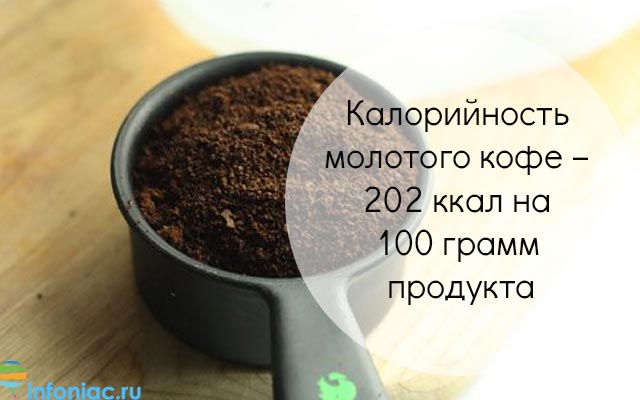
Coffee contains very few calories, so this drink in its pure form is not one of those that add extra pounds. This can be proved using banal mathematics. And we'll start with ground coffee. But first we need the following information: one teaspoon of ground coffee contains about 4 grams (this is if you add coffee without a slide) or 5-6 grams of the product (if you scoop up a spoonful of coffee with a slide).
Next, in order not to be unfounded, we recommend picking up a package of natural ground coffee. Read carefully the nutritional information that is usually on the packaging or on the additional sticker placed on a pack of coffee.
Caloric content of one spoonful of ground coffee
From this information it is clear that the caloric content of ground coffee is 202 kilocalories per 100 grams of product. Thus, one spoonful of ground coffee without a slide contains about 8 kilocalories, and a spoonful of ground coffee with a slide contains about 12 kilocalories.
Read also: What happens to your body if you drink coffee on an empty stomach every day

Many sources even call coffee a calorie-free product. Formally speaking, this is not entirely true, as we have just seen firsthand. A hundred grams of dry roasted coffee beans contain slightly more calories — about 223 kilocalories. By the way, the nutritional value of unroasted coffee beans is about the same.
How many calories does coffee have without milk
How many calories does instant coffee have
Anyone who is at least a little familiar with the process that results in instant coffee beans can easily understand why the nutritional value of coffee is energy instant coffee, in principle, cannot be higher than the nutritional value of ground coffee.
Read also: How to make coffee in Turkey
Indeed, if you study the range of instant coffee on store shelves, you can see that the caloric content of the product varies slightly from manufacturer to manufacturer. And you won't be very wrong if you give the average nutritional value of this product — about 94 kilocalories per 100 grams of instant coffee.
To calculate the calorie content of one spoonful of instant coffee, you need to know that a teaspoon contains about 2.5 grams of this product (this is if you type it without a slide) or up to 4 grams instant coffee (if you scoop it up).

Caloric content of one spoonful of instant coffee
Again, we use elementary mathematics to calculate that the energy value of one spoonful of instant coffee without a slide is about 2.5 kilocalories or even less. The calorie content of a spoonful of instant coffee with a slide is slightly higher – 3.5 kilocalories.
The reality is that coffee is a very complex product that includes many chemical substances (at least two thousand) that form not only its taste and aroma, but also its nutritional energy value. And the composition of these substances undergoes significant changes during the processing that coffee beans are subjected to.
Ultimately, the energy value of coffee without sugar, milk and other additives consists of the content of minerals such as fats, proteins, carbohydrates, iron, calcium, potassium, phosphorus, and also from a range of vitamin and enzyme kits, including B vitamins, tocopherol and many others.
How many calories does sugar-free coffee have
How many calories in a cup of coffee
So now we know that a teaspoon of pure ground coffee contains about 8-12 kilocalories, while a teaspoon of instant coffee contains about 2.5-3.5 kilocalories of product. Does the number of calories change when the product is finally prepared, that is, when preparing a coffee drink?

The answer is unequivocal — if it changes, it is only to a lesser extent. And these changes are extremely minor.
How many calories does one cup of ground coffee contain?
It's very simple — the answer depends on the type of coffee drink. Take, for example, espresso, usually made from freshly ground coffee. Classic espresso is 7-10 grams of product per about 30 grams of water. Thus, an espresso cup without milk or sugar will add 14 to 20 kilocalories to your body.
Fans of double espresso (doppio), which is essentially the same espresso with only twice the amount of water and coffee (that is, about 60 grams of water per 14-20 grams of coffee), drink with one a portion of the drink without additives is from 28 to 40 kilocalories.
Americano is a coffee drink for those who don't like the very concentrated coffee flavor. Essentially, Americano is a highly diluted espresso or double espresso. Moreover, according to the classics of cooking, it can be diluted in almost half a liter of water. Thus, the caloric content of one cup of classic Americano ground coffee is the same 14-20 kilocalories.

How many calories does one cup of instant coffee contain?
The nutritional energy value of one cup of coffee made from instant coffee is extremely negligible, although it also directly depends on its strength. Coffee is usually diluted in one hundred grams of water. We added one spoonful of coffee — we consumed about two kilocalories; two spoons — 4 kilocalories.
It is well known that the recommended daily calorie intake for women is 2,000 kilocalories and for men 2,500 kilocalories. Of course, these are average data, since this norm depends on age, body weight, type of activity, health status, climate and many other factors. Conclusion: then a couple of cups of coffee without additives a day does not pose any danger in terms of the risk of gaining excess weight.
Caloric content of coffee with sugar
How many calories does coffee with sugar have
Not everyone likes the bitter taste of pure ground or instant coffee, so they drink it with additives. The most popular additive is, without a doubt, granulated sugar.
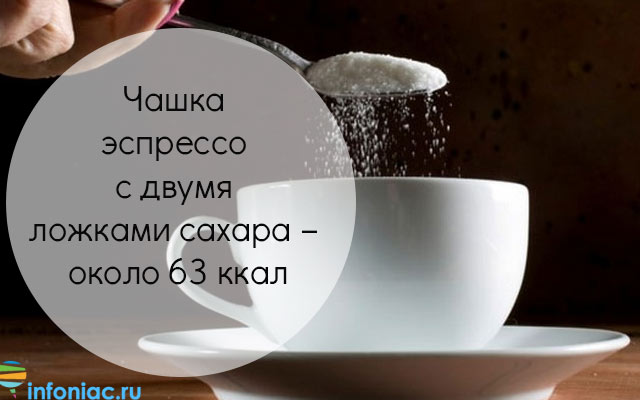
Before you estimate how many kilocalories one teaspoon of sugar adds to a coffee drink, you should remember how many grams of granulated sugar fits in such a spoonful. And the data is as follows: a teaspoon of sugar without a slide is about 5 grams, and with a slide it is 7 grams.
How many calories in a spoonful of sugar
The caloric content of granulated sugar is 387 kilocalories per 100 grams of product; therefore, 1 teaspoon of sugar without a slide
contains about 19 kilocalories; the amount of kilocalories in tea a spoonful of granulated sugar with a slide – about 27 kilocalories.
For clarity, one cup of espresso has an average of 63 kilocalories — for one cup, that's not much. But if you consume two or even three servings a day, you will already gain 189 kilocalories. And if you add milk or cream, even more. How much more?
How many calories does a latte have
How many calories does coffee with milk have

The addition of milk or cream only gives the coffee drink its characteristic softness of taste. However, the milk in coffee is usually extra calories. How much exactly depends on the fat content of the milk. For example, 100 grams of milk with a fat content of 1 percent contain 42 kilocalories; a product with a fat content of 2.5 percent already contains 54 kilocalories.
How many calories does one serving of milk added to coffee have?
The answer to this question directly depends on how much milk you add to your coffee. If it's a couple of teaspoons (one such spoonful is 5 grams of milk), then you add literally 5 kilocalories of nutritional value to the finished drink.
In other words, a cup of drink (for example, espresso) with two teaspoons of milk contains approximately 22 kilocalories. Add two tablespoons of sugar to it – you get a total of about 68 kilocalories. A cup of instant coffee without sugar and with milk in about the same proportion — about 10 kilocalories; with sugar — 56 kilocalories.

By the way, why exactly two spoons? We took as a basis the standard packaging of portioned coffee cream — usually it is packed in 10 grams. The caloric content of such cream is much higher – 10% cream contains 118 kilocalories per 100 grams of product.
Caloric content of coffee
Caloric content of cinnamon coffee
Cinnamon, which is usually added to the drink in the amount of half a teaspoon (about 3 grams), gives a special spice to coffee. Given the nutritional value of cinnamon (247 kilocalories per 100 grams of product), it can be estimated that a serving of cinnamon increases the caloric value of one cup of coffee by about 7.5 kilocalories.
Such a coffee drink as latte, which is, in fact, espresso coffee with milk, has gained great popularity. Most often, latte is prepared in such a way that there is twice as much milk in the finished drink as coffee.
Read also: Coffee turk: which Turku to choose
A 2.5 percent serving of sugar-free latte with milk will add approximately 50 kilocalories to your diet. A couple of spoons of sugar – and now 100 kilocalories. Just a little bit of cinnamon — almost 110 kilocalories. Three cups of this drink a day, drunk by an average woman or girl, is almost 20 percent of her daily calorie intake!