
Long-distance travel is always accompanied by a sleep disorder, which can be a serious test for the body.
An adult is ready to endure temporary difficulties with sleep, but with a child everything is more difficult. In a new place, the baby is applied to the pillow in the daytime, and at night, on the contrary, can not sleep. Parents’ attempts to adjust the regime are often met with whims and protests.
I will tell you how to help your child cope with jetlag and how long to prepare for the flight so that everything goes as easily as possible.
What is jetlag
Jetlag is a sleep disorder that occurs after quickly crossing several time zones. The body needs time to adjust the internal biological clock to a new cycle of day and night. In addition to sleep problems, gradual adaptation may be accompanied by headaches, gastrointestinal disorders, excessive irritability or, conversely, lethargy.
The duration of symptoms directly depends on the number of time zones crossed and on the direction of flight:
- A time difference of more than four hours is considered significant. The difference of up to two hours will not be significant and does not require preliminary preparation.
- A flight from west to east will be a heavier load than a flight from east to west. Adapting to the new time zone in this case takes longer.
How do children tolerate the change of time zones
Infants under one year old cope with jetlag easier than older children. The internal biological clock of a newborn baby is not synchronized with the environment and works in its own mode. The formation of circadian rhythms in babies, as a rule, is observed by four months, and their stable design — by ten months.
That is, for a child younger than four months, there is no difference between day and night, he will hardly notice the time zone change. A child of 4-10 months will also endure jetlag much easier than an adult.
Children older than one year are most vulnerable to jet lag syndrome due to the immaturity of the body’s adaptive mechanisms, which are fully formed only by adolescence. Therefore, it is better to start preparing the child for a regime change in advance.
When and how to shift the child’s regime before a long flight
As a rule, two or three days are enough for an adult to prepare for a regime change beforehand. But children should gradually shift the time of falling asleep and getting up earlier.
The period for which preparation begins depends on the time difference. For example, if it is more than seven hours, it will take at least two weeks, and if it is four hours, a week may be enough. A lot depends on how quickly the child gets used to the new regime — just in case it is better to take time with a margin.
Flight to the west. Let’s say the time difference between two cities is eight hours. That is, in one it is already the height of the day, and in the other it is only morning.
In this case, our biological clock is “ahead” of the time at the destination, and they need to try to “slow down”. Therefore, it is worth going to bed and getting up 20 minutes later than usual, adding another 15-20 minutes to this time every day.
After the first night of laying, shifted 20 minutes later, the baby is likely to wake up at the usual time, but with a slight lack of sleep. It is not necessary to compensate for this lack of sleep with too long daytime sleep, and then after two or three nights the child will wake up in the morning a little later than usual.
But it happens that the baby stubbornly continues to get up in the morning at the same time, his usual time. Most often, this is typical for children under one and a half years old. Then this technique may not work so quickly or it may not work at all.
Flight to the east. Here our biological clock will have to “catch up” with the time at the destination. For example, the time difference between cities is nine hours: when it’s the height of the day in one, it’s already deep night in the other.
In this case, it is worth going to bed and getting up 20 minutes earlier than usual, taking 15-20 minutes from the usual time of laying and lifting every day.
The first couple of evenings, the child is likely to fall asleep at the usual time. But since the rise will be earlier in the morning, approximately on the third evening, lack of sleep will make itself felt, and the child will fall asleep a little earlier than usual.
In both cases, the following should be considered:
- The daily sleep rate and the distribution of sleep between day and night remain the same. That is, daytime sleep shifts after the time of evening bedtime and morning wake-up, but the total sleep time does not change.
- If the child is excitable, you need to focus on his reaction. Perhaps it would be better to shift the mode not by 20, but by 10 minutes.
- Children over a year old can tolerate a shift of the regime for 30-60 minutes well. This can help to adapt faster and get closer to the time in a new place.
It will not be possible to completely rebuild the mode in advance if the time zone difference is large. But even a partial approximation of the regime to the new time greatly facilitates adaptation.
In addition, a complete restructuring of the regime can even complicate the situation, because after returning home, the child needs to return to the previous time of sleep and wakefulness.
If the family is in a new place for more than a month, there will be time to prepare for the return flight and shift the regime in the other direction. And if the travel period is shorter, you will have to change the mode at home.
How else can I help my child when changing time zones
Choose a suitable flight time for the child. For long flights, many parents prefer night flights so that the child can sleep on the way. But not all children can fall asleep in unusual conditions. Then the night of the flight and the next day in the new time zone will be a difficult test for both the child and the parents.
Therefore, it is worth focusing on the needs of the baby. If he does not sleep well on trips, it may be better, on the contrary, to take a daytime or morning flight arriving in the evening so that he can go to bed after arrival.
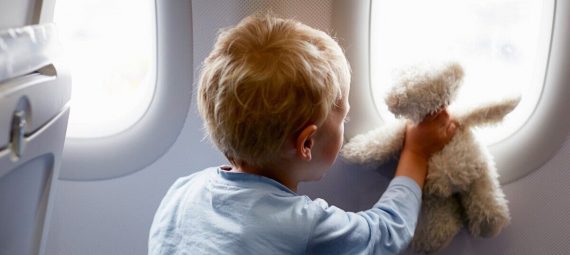
Take a piece of the house with you. Children, as a rule, are conservative, stability is important to them. The usual ritual before going to bed makes it much easier to fall asleep, so it’s worth taking your favorite blanket and toy on a trip.
Immediately start living in accordance with the local light day. While it is light, it is better to spend as much time outside as possible, turn on bright lights indoors.
In the evening, you need to go to bed, even if you don’t want to, try to calm the child down, not engage in active games. In the morning it is important to wake him up at the right time if he does not wake up himself.
Do not allow too long daytime dreams. To do this, you can create conditions for waking up the baby: open the curtains, make the usual everyday noise. Otherwise, the child will compensate for lack of sleep due to daytime sleep, and the evening laying will be delayed again for a long time.
Monitor the nutrition. Feeding also sets the usual rhythm of the day. It is better to eat at the same hours as at home, but according to local time. The same applies to other familiar rituals.