
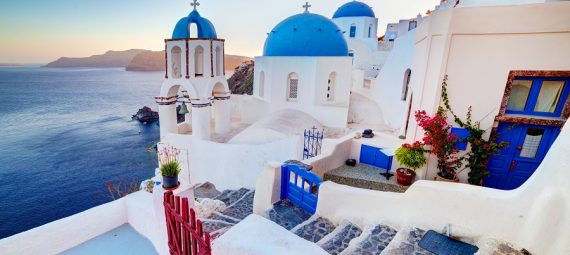
The fabulous beauty of the Santorini archipelago is perhaps one of the most beautiful places in all of Greece. According to legend, the five islands of the archipelago are the remnants of the former greatness of Atlantis, which went under water. Now hundreds of thousands of tourists come to sunbathe on the volcanic beaches of the islands and admire the snow-white houses clinging to the rocks.
Santorini consists of 5 islands, the largest of which is Fira (or Tira). It is his images that are printed on all advertising brochures dedicated to Greece. The two volcanic islands of Palea-Kameni and Nea-Kameni are a popular place for excursions.
Santorini is a place where you should definitely come at least once. Snow-white walls of houses, blue domes of churches, of which there are about as many days a year and colorful beaches will turn your vacation into a real fairy tale.
Climate and weather of Santorini
The climate in Santorini is Mediterranean, with dry summers and warm winters. The swimming season starts in May and ends in September. The best time to relax is the summer months, as well as the end of spring and the beginning of autumn.
Santorini Beaches
The beaches of Santorini are a full—fledged attraction. The islands were formed due to a volcanic eruption that occurred 3,500 years ago. The “legacy” of the ancient catastrophe left amazing beaches with colorful sand. There are areas with black sand (just like in Tenerife), there are areas with red sand (like the dunes in Mui Ne), and there are snow—white and golden beaches, which are a pleasure to relax on.
There are few beaches on the island — only 15, but each of them is unique and beautiful. The depth is serious almost everywhere, the water is cool, transparent, with turquoise, green and even black tint — depending on the sand or pebbles at the bottom.
Perivolos is the longest and most popular beach on Fira Island. Umbrellas and sun beds are placed on 3 kilometers of black sand, the owners of numerous taverns and restaurants are waiting for guests on the embankment. As almost everywhere in Santorini, the depth starts quickly, so families with children should be careful and make sure that the kids splash near the shore. In the evenings, discos are held on the beach of Perivolos and Perissa. There is a water park near Perissa Beach, and you can wait out the midday heat by arranging an excursion to the Museum of Minerals and Fossils.
Red Beach attracts not only bathers, but also people with cameras. Red pebbles and red rocks, turquoise water — an amazing combination. If red is not your favorite color, you can choose a White beach — it is strewn with snow—white pebbles. One problem is that you can only get to it by boat, although this is also an advantage — there will definitely not be a crowd of people.
Kamari Beach is the widest on the island. There is a well-developed infrastructure here, there are enough sun beds and umbrellas for everyone. The beach was awarded a Blue Flag for the purity of the water. Tired of lying on the sand, you can go to the archaeological reserve of Fira to admire the sea view.
The depth of the sea in Santorini is decent everywhere, but for families with children and insecure bathers there is a beautiful Monolithos beach, where the entrance to the water is gentle and you can safely let the heirs go swimming. The sand on the beach is dark, sun beds and umbrellas are available, you can have a snack in taverns nearby.
For vivid impressions, you can go to the beaches of the islands of Palea-Kameni and Nea-Kameni — by the way, their names are quite telling, meaning “burnt”. Tourists are brought to the crater of an ancient volcano, where you can swim in thermal springs.
Santorini Attractions
Santorini is a symphony of three colors: blue, white and ochre. According to Greek traditions, white symbolizes faith and justice; blue — the sky; yellow-brown, ochre — the power of nature and the power of the volcano.
There are almost as many churches in Santorini as there are 352 days a year. The most beautiful and famous is Ayiu Mina, perched on a rock. The chiming of bells can be heard from all corners of Fira Island in the mornings and evenings.
You can get acquainted with the past of the volcanic islands in the Archaeological Museum and the Museum of the city. The eruption of the volcano has greatly reshaped the local history: for example, there are even their own “Pompeii” — on Cape Akrotiri there are ruins of a city buried under a layer of ash. The medieval history of the archipelago can be touched on the ruins of the Venetian castle in Imerovigli. By the way, this is one of the best places to watch the sunset.
The most popular excursion is to the volcanic islands of Palea—Kameni and Nea-Kameni. 3,500 years ago, the local volcano exploded, and the echoes of the eruption can still be heard: the last activity was observed only 65 years ago. An underwater volcano boils water — there are therapeutic thermal springs here, and the soil itself is very hot. The tour includes the road to the island by boat, climbing to the crater, bathing in healing springs.
Orthodox holidays in Santorini are celebrated on a large scale. During the tourist season, you can get to the Assumption of the Virgin (August 15), the Transfiguration of the Lord (August 6). In addition, each church has its own patron, whose day the islanders also celebrate with large festivities and church services.
Santorini hosts a jazz festival in July and a volcano festival in August. Eyewitnesses say that this is an incredible sight, arguing with an abundance of pyrotechnics with the Chinese new year.
Santorini Cuisine
Due to its volcanic origin, the soil on the islands of Santorini allows you to grow amazing varieties of familiar vegetables and fruits.
Residents are very proud of their white eggplants — they taste sweet, they are fried in oil with thyme and served with seafood, for example, fresh octopus baked on coals.
The traditional Greek salad, “horiatiki salad”, in Santorini also has a special taste. Special little cherry tomatoes of the Santorini variety grow here — they are added to the salad and tomatokeftedes — vegetable meatballs are prepared. Cucumbers in Santorini are also not simple — the variety is called “katsuni”. And although feta cheese is traditionally added to the salad ferrets, you can ask to add chloro cheese — a special goat cheese with a creamy structure.
The signature dish in Santorini will definitely contain fava — a special variety of peas. It is especially good with pork, eggplant and tomatoes. You can also try it as a separate dish — the inhabitants of the island have ensured that their precious fava is recognized as a gastronomic treasure at the state level.
The wines in Santorini are also special — asirtiko grapes are grown here, from which an excellent Vinsanto wine is made, which has a citrus, fig or coffee shade. Dry white “Asirtiko” or fortified white “Nikhteri” will be excellent aperitifs before a meal in Greek traditions.