
 Science have appeared
NASA scientists have released new photos of Pluto taken by New Horizons 15 minutes after it approached the dwarf planet in July 2015.
The pictures show views of majestic ice mountains, wide plains and low fog. Surprisingly, Pluto is very similar to Earth in many ways, and processes similar to the water cycle take place here.
Photos of Pluto 2015

The view of Pluto at sunset on July 14, 2015 shows rocky mountains reaching 3.4 km in height and smooth icy plains.
The mountains were named Norgay Montes and Hillary Montes after climbers Edmund Hillary and Tenzing Norgay, who first climbed Mount Everest.
“This photo makes you feel like you're on Pluto exploring the area,” said Dr Alan Stern, a researcher at the New Horizons project.

The new images will help provide new information about Pluto's atmosphere, mountains, glaciers and valleys.
For example, an image taken from a distance of 17,000 km helps to see the haze above Pluto's surface.

The setting Sun illuminates haze or mist, through which the shadows of many hills and mountains cut through.
New Horizons: New Pluto Photos
Scientists say the latest photos suggest the presence of a hydrological cycle on Pluto, but with “softer” and “exotic” ice, including nitrogen instead of water.
Low fog also indicates regular weather changes, just as it happens on Earth.
Read also: New Horizons: 10 interesting facts about the first mission to Pluto

Pluto's “Heart”: The Sputnik Plain is the name for the smooth, light-bulb-shaped region on the left.
The panorama also showed glaciers flowing back into the plain from the icy area. Similar streams can be seen at the edges of polar ice caps in Greenland and Antarctica.
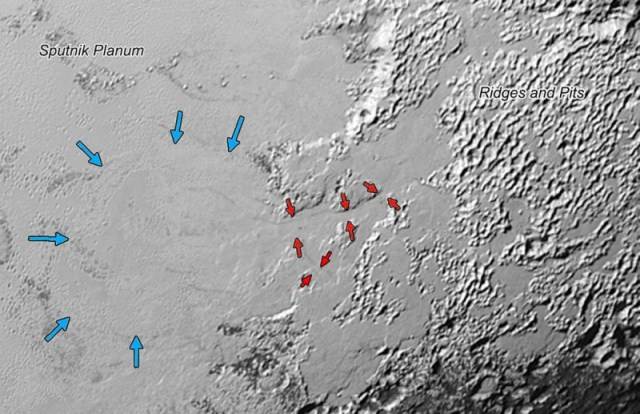
The ice on the mountainous part on the right flows from the mountains to the Sputnik plain through the valleys, as indicated by the red arrows. The ice flow is highlighted by blue arrows.
This came as a surprise to scientists who weren't expecting to find frozen liquid or frozen nitrogen in the harsh conditions of the outer solar system.
This can be compared to the hydrological cycle on Earth, where water evaporates from the oceans, falls as snow, and returns to the oceans through glacial currents.
New Horizons is an interplanetary spacecraft launched to study Pluto and other areas of our solar system. On July 14, 2015, at 11:49 a.m. UTC, it flew 12,500 km away above Pluto's surface, becoming the first to come close to this dwarf planet.