
 Culture
Concern about money can be compared to losing 13 points on an IQ test, one full sleep, or chronic alcoholism, scientists say.
People who have to spend their mental energy paying bills and cutting expenses are harder on complex but more important tasks, including educating and managing their own by time.
Researchers believe this explains why poor people are more likely to make mistakes or make decisions that exacerbate their financial difficulties.
Study author Anandi Mani, from the University of Warwick in the UK, also thinks that a little help or a nudge at the right time will help low-income people escape the trap poverty.
The problem of poverty

In the first study, researchers approached 400 passers-by at a shopping mall in New Jersey and asked them to think about solving a financial problem.
Volunteers were offered an “easy” scenario, in which car costs reached about $150, and a “difficult” option, when repairs cost more than $1,500. In addition, participants took IQ tests and completed attention tasks.
The rich man's body is full of arsenic, and the poor man's body is full of plastic
In the second study, a team of scientists conducted the same tests on 464 sugarcane farmers before the harvest, when their incomes are aground, and after the harvest, when incomes rise.
As it turned out, in both cases, poor people had the hardest time coping with the “difficult” scenario. At the same time, their intelligence coefficient fell by an average of 13 points when they thought about serious financial costs.
“This is the difference in IQ between a normal adult and a chronic alcoholic,” Mani explained. “When it comes to age, it's like a 45-year-old compared to a 60-year-old. When it comes to sleep, it's like losing one full sleep.”
However, scientists clarified that the study does not mean that poor people have worse intelligence, but that problems with money impair our cognitive abilities.
Poverty line
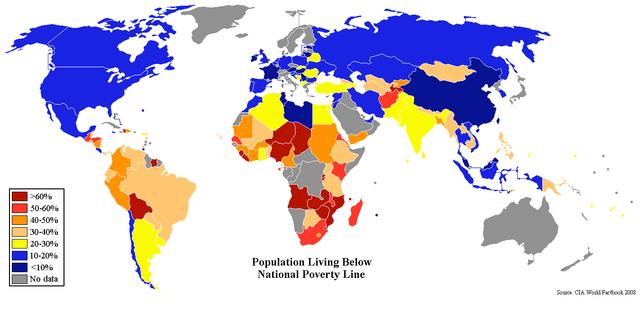
The world map shows the percentage of the population that lives below the national poverty line.
According to the Institute of Sociology of the Russian Academy of Sciences, almost a quarter of the Russian population lives below the poverty line. Currently, the subsistence minimum is the minimum level of income required to ensure a standard of living is 6,705 rubles per month.
Residents of Russia consider poor people with an average income of 8,848 rubles a month. And although it is officially believed that 15 percent of people are below the poverty line, in fact this figure reaches 23 percent.
In addition, experts identify several groups of poor people:
The “income poor” are those whose income per family member is below the subsistence minimum
The poor “in deprivation” are those who experience material difficulties due to deprivation
Chronically poor — who have been in poverty for more than five years