
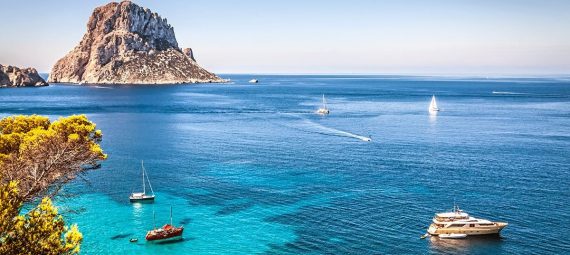
The authorities of the Balearic Archipelago in Spain have developed an innovative strategy that solves the problem of overturism and contributes to the sustainable development of the region. This experience can be an example for other congested tourist locations.
The Balearic Archipelago in Spain is one of the most visited places in Europe. Ibiza and Majorca were chosen by party–goers, Formentera and Menorca are adherents of beach chill. Last year, about 16.5 million tourists visited the Balearic Islands – about the same as before the pandemic in 2019. According to the local government, this is the ceiling. Even on the super-popular Canary Islands, only 14.5 million arrived.
The problem of overturism has become so serious that the authorities decided to experiment with restrictive measures. Its goal is to create a balanced closed–loop economy that not only serves the interests of visitors, but also protects local residents, nature and culture. They plan to spend $ 61.5 million on this.
Tourist tax
Following another popular region, Catalonia, the Balearic Islands have introduced a tourist tax. The cost of an overnight stay in rental housing is added € 1-4 per person. These fees are used to restore cultural and natural attractions. For example, to preserve the unique algae that give the sea an emerald-turquoise color.
Restrictions on short-term rental housing
Last year, the islands imposed a ban on the construction of new hotels and other accommodation facilities for tourists. It will be valid at least until 2026. In the capital of Mallorca, Palma, since 2018, it is forbidden to rent short-term housing to tourists in apartment buildings, because rent growth has begun to displace local residents from the city. However, judging by the number of ads on Airbnb, not all homeowners are deterred by this.
Cleaner air, less noise
The island of Formentera, which can be reached by ferry from Ibiza, has restricted access to transport in high season since 2019. From mid-June to mid-September, guests must apply in advance to drive a car or motorcycle. If it is approved, you will have to pay a daily tax of € 3 (minimum 15) from a car and € 1.5 (minimum 7.5) from a motorcycle. An exception was made for electric vehicles, and hybrids are given a 50% discount. A similar scheme is being considered in Menorca – it can start working in the summer of 2023.
The Balearic Islands National Park, rich in birds, Parc Nacional Maritim-Terrestre de l’arxipèlag de Cabrera in Majorca, has also introduced restrictions for visitors in high season. You need to book tickets in advance, 200-300 people are allowed to pass a day, and only to a certain part of the park.
The charms of the low season
A more even distribution of tourists throughout the year reduces the burden on the environment and infrastructure, so the authorities are trying to interest guests not only in beach holidays. Vueling Airlines has launched a year–round flight from London to Menorca, some hotels on the islands have stopped closing during the low season.
The mild climate from October to April is ideal for cycling and hiking. Hotels equip bicycle storage areas and repair shops. There are plans to build 100 km of bike paths in Palma. Hikers are lured by scenic hiking trails, such as GR221 in Majorca. It runs along the Sierra de Tramuntana mountain range, a UNESCO World Heritage Site.
No rampant
In the party districts of Ibiza and Majorca, tour operators and bars are prohibited from promoting “happy hours”, party boats and free drinks. Hotels have introduced an all-inclusive limit on the amount of alcohol. The behavior of tourists began to be monitored more closely: violators of peace and order face considerable fines.
Without plastic
Since 2021, disposable plastic has been banned in the Balearic Islands: bags, dishes, cutlery, straws, coffee capsules, cotton swabs, disposable razors, lighters. Water bottles have a limited turnover – they are either recycled by local companies or used for refilling. Hotel rooms are equipped with refillable bottles for toiletries instead of miniature disposable ones.
Other measures aimed at the sustainable development of the Balearic Islands include the use of solar energy, saving and purification of water, replacement of paper media with digital, priority of local products over imported ones.
“Sustainable development and a closed-loop economy are at the heart of the Balearic Islands’ tourism strategy. It is very important to preserve the natural environment and cultural heritage of our islands so that residents and future visitors can enjoy them for many years,” says Iago Negeruela, Minister of Tourism of the Balearic Islands.