
 Incredible facts
Are you tired of what is happening on Earth right now? It will take 110 people to start a new civilization on Mars, scientists say.
Professor Jean-Marc Salotti from the National Polytechnic Institute of Bordeaux in France made calculations using a mathematical model to find out how many people are needed for creating a society that will produce resources and goods necessary for life.
The good news is that it doesn't take many people to start a new life in space, namely 110 Earthlings.
Read also: How long does it take to fly to Mars
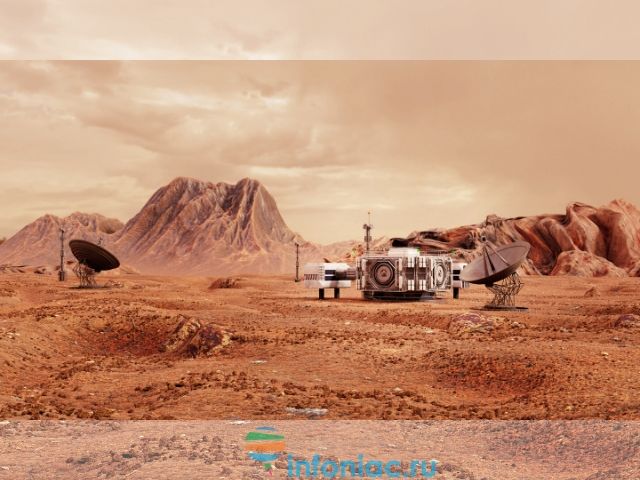
In his work, the scientist explained that a small settlement would live under a dome filled with oxygen. Inside this facility, it will be necessary to establish its own agricultural production, which is necessary to support life on the Red Planet.
All the results of his work have been published in the journal Scientific Reports.
The probability of surviving on Mars
© Getty Images Pro
Professor Salotti explained that the first thing he needed to do was to solve the problem of being able to survive on another planet and be self-sufficient.
These factors are key for future space expeditions and for all humankind. In his mathematical model, he determined the minimum number of inhabitants on another planet, using Mars as an example.
The scientist suggested that in order to survive on Mars, the main issues that need to be addressed would be settlement formation and design problems. He came to the conclusion that the minimum number of settlers on Mars should be at least 110 people.
He also noted that the success of the mission will largely depend on how well people can work together, as well as share resources and time.
Their survival will depend on the colony's access to natural resources. In addition, it should be noted that working hours will be limited.
In the study, the professor also simulated possible situations when settlers could lose support from Earth for various reasons, such as war.
It also provided for circumstances in which resources might be scarce or if settlers suddenly declared an independent Martian Republic.
© Photo Images
The factors that Professor Salotti considered include the number of settlers, the main engineering solution for agriculture, adequate living conditions, industry and livelihoods, and allocation and organization of resources.
Professor Salotti stressed that this issue is now mostly theoretical, but will have significant consequences for the future of humanity.
Life on Earth may be threatened by some catastrophic event, and it may happen that the only way to survive is to fly to Mars or another planet.
Some companies, including Elon Musk's SpaceX, have presented samples of rockets that will be able to fly people long distances to Mars.
But a lot comes down to the limited number of people the rocket can carry. This will inevitably lead to the need to calculate the minimum number of people who can survive on the Red Planet and create sufficient resources and tools for self-sufficiency.