
 Ecology
Research by Duke University (a private research university in Durham, North Carolina, USA) is based on a study of temperature records over 1,000 years.
These records were compared with the most terrible scenarios of the IPCC (Intergovernmental Panel on Climate Change). It was the IPCC that did not properly take into account data from centuries-old records.
It has been established that natural climate variability can both slow down and accelerate the rate of global warming.
Is global warming a myth or reality?
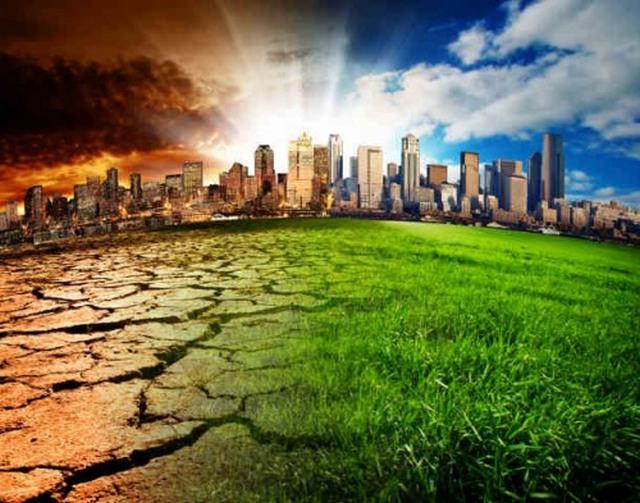
Global warming isn't happening as fast as expected, according to a new study based on 1,000 years of records of temperature changes.
As a result of research by Duke University, it is stated that the natural variability of temperature on Earth within even 10 years can constantly change.
It is also added to the above conclusion that the “climatic fluctuations” that are taking place on our planet may be warming it much faster than expected.
Read also: Global warming is the story of one hoax
The IPCC's projected temperature change from 2081 to 2100 is depicted in the following figure.
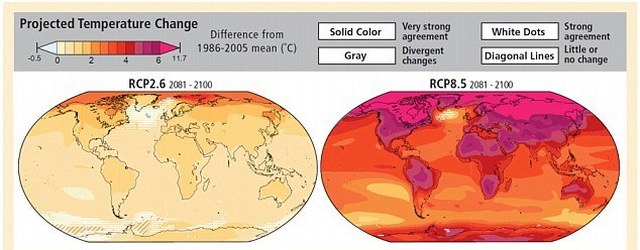
However, researchers from Durham argue that this model of future climate may be wrong.
Patrick Brown, PhD in climate science at Duke University, said: “Based on our analysis, the average level of warming is likely to be happening now.” But this condition may also change.
This study emphasizes that climate variability is mainly caused by interactions between the ocean and the atmosphere, as well as other natural factors.
In addition, it is noted that “climate fluctuations” can slow down or accelerate the rate of warming within decades. Climate change also increases or compensates for the effects of high concentrations of greenhouse gases.
If this is misexplained, reliable climate models are distorted and short-term temperature trends are misinterpreted.
“We would certainly see global warming at a much higher rate if the concentration of greenhouse gases in the atmosphere increased without any natural protection or without a natural process variability,” said Wenhong Li, an assistant professor of climate studies at Duke University who conducted the study with Brown.
A group of researchers has scrupulously studied all climate models, such as those used by the IPCC, taking into account the natural chaotic variability that can occur, including creating a global warming.
Scientists at Durham University have created a new statistical model of climate change based on reconstructed empirical records of surface temperatures over the past 1,000 years.

“Comparing our model with the IPCC model, we found that the international group's climate model is scientifically sound, but their long-term forecasts underestimate natural processes. Our model shows that natural processes can be quite influential to be “blamed” for global warming on Earth between 1975 and 2000, as well as between 2002 and 2013,” says Dr. Brown.
Statistically, it is unlikely that the 11-year warming we saw earlier this century could have occurred if the main factor causing it were human.
Read also: Global warming will continue for another thousand years
If we continue to study long-standing statistics, we can conclude that between 1993 and 2050, the planet with a duration of 11 years or more should warm with a 70% probability.

This coincides with what we're seeing. And there is no guarantee that this same rate of warming will remain stable in the coming years. The analysis by scientists at Duke University clearly shows that there is no reason to believe that the observed rates of warming will be constant. After all, this speed has always changed.