
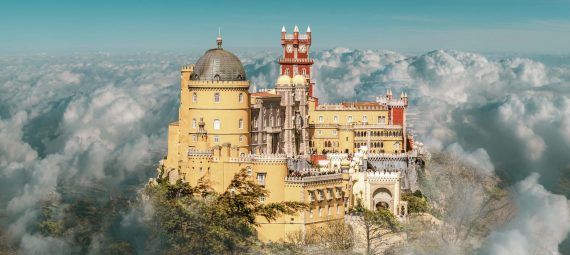
Pena Palace
The Pena National Palace, built in a romantic style, is perhaps the most striking landmark of Sintra. This recognizable castle cannot fail to catch the eye: it stands on a hill above the city and on a clear day is visible even from Lisbon.
The Moorish Castle of Sintra
This remarkable medieval castle on a hilltop above Sintra, recaptured by Christians from the Moors after the fall of Lisbon, became an important strategic point during the Reconquista. Today the castle is in ruins, but these ruins are in very good condition.
Cape Rock
Cape Roca is the perfect place to admire an amazingly beautiful sunset when the sun sets directly into the Atlantic Ocean, brightening the water surface in unimaginable tones and shades. The Portuguese poet Luis Camoens described this place as follows: “This is the place where the land ends and the sea begins.”
Montserrat Palace
This exotic palace-like villa served as a traditional summer vacation spot for the Portuguese court. Restored in 1858 for Sir Francis Cook, an English baronet, the villa owes its current design to the English architect James Knowles Jr.
The Capuchin Monastery in Sintra
The monastery was built by the son of the Portuguese military commander Juan de Castro. One day in the middle of the 16th century, Senor Juan was hunting, tired and decided to take a nap. He had a dream indicating that he should build a monastery on this place.
Sintra National Palace
The National Palace of Sintra, also known as the Palace of the City, is easy to recognize from afar: its snow-white structure is distinguished by two tall elongated and smooth twin cones. Many believe that this medieval royal palace has been preserved better than any other in Portugal.
Regaleira
The romantic name of the Quinta de Regaleira in Portuguese sounds like “Regaleira farm”. This paradise does not look like a farm at all, but its history is full of mysteries. The name of the estate was given by the wealthy Baroness Alain Regaleira in 1840.