
Imperial Palace in Tokyo
In the center of Tokyo, in the dense greenery of trees, the palace of the Emperor of Japan, surrounded by canals, moats and ancient walls, hides. The entire palace complex is spread over an area of almost 7.5 sq. km. Access to it is limited, but since 1968 its Eastern Park has been open to the public on certain days.
Nagoya Castle
The ancient Nagoya Castle was built in 1612 as the main residence of the famous Tokugawa Shogun rulers. Until 1871, it was considered the main political and administrative center of the principality of Ovari, the destinies of the best people of the country were decided here and history was made.
Ginza District in Tokyo
The name of one of the brightest noisy and cheerful districts of Tokyo is heard by many travelers — of course, this is Ginza. Translated from Japanese, “ginza” is a “coin”. Having been here at least once, it is easy to understand why the quarter got such a name.
Shinjuku
One of the most popular and lively areas of Tokyo is Shinjuku. Once a small town near a postal station, today in the daytime Shinjuku is teeming with black suits of disciplined office workers, and in the evening it burns with billions of lights, which literally ripples in the eyes of vacationers.
Kabuki-za Theater
Kabuki-za, located in the “heart” of Ginza, is the main Tokyo theater. This is not just one of the most unusual temples of Melpomene in the world, for the Japanese it is an object of national pride and reckless adoration. It’s hard to say what so catches an extremely smart nation: rich costumes or crazy makeup.
Arashiyama
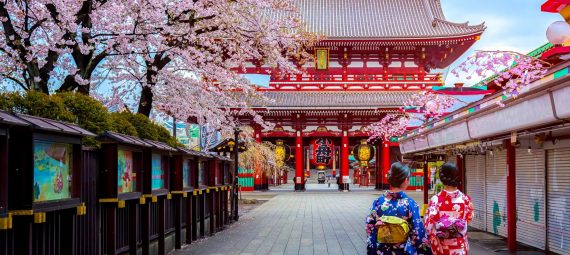
Mount Arashiyama on the outskirts of Kyoto has long been famous for the beauty of its landscapes, it was here in the 10th century that the traditions of admiring the blooming spring sakura and red autumn maples were born. These days, crowds of Japanese and tourists wander along the paths, but in summer there are few people here.
Tokyo Skytree Tower
It is no coincidence that the height of the Tokyo Skytree TV tower, the “Tokyo Sky Tree”, is 634 m: the Japanese wanted to emphasize the symbolism of this structure. The numbers 6-3-4 sound in old Japanese as “mu”-“sa”-“si” — in the 18th century, this was the name of the province where modern Tokyo now stands.
Kyoto Tower
This steel tower is the tallest building in Kyoto. Its observation deck is located at an altitude of 100 m, and together with the spire, the height of the tower reaches 131 m. The tower weighs 800 tons and is installed on the roof of a nine-storey building, which houses a 3-star hotel and several shops.
Toyota MegaWeb Exhibition Center
The main automobile museum of Japan, a fantastic amusement park and a showroom of the Toyota concern in one “bottle” – all this is the Toyota Mega Web, a place where all fans of really cool cars should visit.
The Shirakami Mountains
The protected mountains of Shirakami are a man—made masterpiece of Japanese nature. Surprisingly, not far from the super megapolis of Tokyo, the capital of the country, the “lands of the white god” have been preserved, where wild rocks are surrounded by dense beech, cedar, maple forests.