
The capital of the Czech Republic, Prague, is divided into districts numbered from 1 to 22, starting from the center. District 1 is the heart of the city with the most expensive hotels and iconic historical locations that are worth seeing in Prague first of all.
Prague Castle
Prague Castle is the largest castle complex, which was built in the IX century on the elevated left bank of the Vltava River and has since served as the residence of the Czech kings. It consists of many historical buildings, built mostly in the traditions of Romanesque and Gothic architecture, and in a later period – in the Baroque and classicism styles. At the front entrance of the castle, the guard of honor changes at noon, so this place has become one of Prague‘s favorite photo locations. The grandiose medieval Cathedral of St. Vitus is considered to be the center of the architectural ensemble. The complex also houses the Old Royal Palace of the XV century, the Theresian Palace, the Summer Palace of Queen Anne, many museums, galleries and gardens. Prague Castle is also the permanent residence of the President of the Czech Republic today, so it is considered the largest inhabited castle in the world (about 7 hectares). Entrance to the complex is free, but you need to pay for visiting individual facilities (you can buy tickets online here.
St. Vitus Cathedral
Where should Catholic believers and connoisseurs of sublime Gothic go in Prague? St. Vitus Cathedral, a majestic temple in Prague Castle, which has become one of the most important architectural monuments of the Czech Republic, began to be built in the 10th century and was completed in the 14th–16th centuries. It was originally built in the style of a Romanesque basilica, but after a while it was expanded and rebuilt in the Gothic style. The cathedral became a place of solemn liturgies (coronations, baptisms, weddings of members of ruling families), as well as the burial of Czech kings, bishops and cardinals. At the entrance to St. Vitus Cathedral, tourists are impressed by the ribbed vaults of the high central nave (33 m high) and the warm light of the stained glass windows. In the interior of the cathedral you can see the mosaic “The Last Judgment“, the chapels of St. Wenceslas and Schwarzenberg, as well as the chapel of St. Anezhka.
Old Town
Any travel guide to Prague will invariably take you to the Old Town (Stare Mesto) – a historical area on the right bank of the Vltava River, which is a real open—air museum. The area grew out of small settlements of the 8th century and became a key trading center between the west and east of Europe.The main sights of the Old Town:
– The Old Town Square is the most important square of the Royal Prague.
– Old Town Hall: the building with the famous astronomical clock.
– Charles Bridge: the most preserved medieval bridge in Europe.
– Powder Tower: built in the XV century, the “royal” route begins here.
– Josefov: a Jewish quarter with the oldest functioning synagogue in Europe and an ancient Jewish cemetery.
– Rudolfinum: an art house with two concert halls and an art gallery.
Charles Bridge
The capital of the Czech Republic is divided into two parts by the river, and the oldest Charles Bridge in the city connects the districts of Stare Mesto and Mala Strana. Built in the 14th century and named after King Charles IV, who built it, it has become one of the most popular places in Prague. The bridge is decorated with 30 Baroque statues, mostly depicting saints, and three towers, which nowadays resemble fairy-tale castles. In addition to tourists who like to take keepsake photos here, street musicians and artists can often be found on the bridge, creating a special atmosphere.
Old Town Square
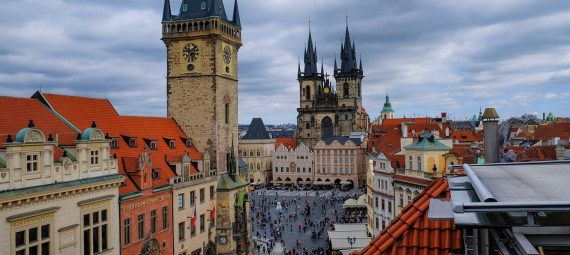
Beautiful places in Prague are often grouped around historically significant locations. Thus, the Old Town Square – the historical center of the ancient city – previously served for the organization of market trade and social events, and nowadays a large Christmas fair is held here. The architectural diversity of the square is impressive: Gothic, Baroque and Renaissance buildings have formed a harmonious ensemble. Among the main attractions are the Old Town Hall with its famous astronomical clock, as well as the Tyn Temple (an example of Gothic architecture) and the Church of St. Nicholas with a Baroque interior. In the center of the square stands a monument to the national hero Jan Gus.
Prague Astronomical Clock, or Orloy
What is unusual to see in Prague? The astronomical clock of Orloy is a famous landmark of the city on the Old Town Hall. Installed in 1410, they surprise the audience with their complex mechanics and symbolism, while the Eagle is the oldest working clock in the world. The astronomical dial shows the time, the position of the Sun and moon, the time of sunrise and sunset. And the calendar disk displays the months and zodiac signs. Statues of the apostles appear in the windows every hour from 9 to 23 o‘clock, and the moving figures of Death, Turk, Miser and Vanity symbolize different aspects of life. At the end of the performance, a rooster sings, symbolizing the beginning of a new day. The best excursions in Prague always include a tour of the famous clock at the very moment of the performance, do not miss the chance to see the ancient mechanism in action and you!
Tyn Temple
The Church of the Virgin Mary in front of the Tyn is not only the symbolic core of the Old Town Square, but also an architectural miracle that can often be seen in photographs of Prague. Its exquisite black towers, similar to each other but not identical, were built between the XIV and XVI centuries. Combining elements of Romanesque and Gothic styles, they tower over the city like guardians of time. Over its long history, the temple has become a testimony to turbulent historical events, and the interior of the temple combines Gothic traditions with later Baroque elements. The only Protestant, Tycho Brahe, the famous astronomer of the XVII century, was buried in this Catholic church (as a sign of respect for his merits).
The Jewish quarter of Josefov
Historical sites in Prague associated with the dramatic pages of its development are located in the Jewish quarter (the area between the Vltava River and the Old Town Square). Here are the remains of the Jewish ghetto, which has repeatedly survived pogroms, with its rich history and legends about the Golem. The name “Josefov“ comes from the name of Emperor Joseph II, whose reforms in 1850 improved the situation of Jews in Prague. At the turn of the XIX and XX centuries, part of the district was rebuilt, but many architectural monuments, synagogues and cemeteries have been preserved. During the Nazi occupation, the quarter became a hiding place for historical artifacts of Jewish culture. Josefov is a place that evokes a strong emotional response, according to tourists, it is one of the most mystical locations in Prague.
Wenceslas Square
The top attractions in Prague include Wenceslas Square, a wide boulevard with a length of 750 m, above which stands the monument to Prince Wenceslas and the National Museum. The square, known since the Middle Ages as a trading floor and horse market, was rebuilt in the 19th century and became the center of important political events and uprisings (including the Prague Spring of 1968). Today, Wenceslas Square is the center of modern Prague, the location of famous shops, banks, hotels and restaurants, festivals, holidays and social events are held here.
The National Museum
What to visit in Prague for lovers of history, natural sciences and art? Located in a monumental Neo–Renaissance building, the National Museum demonstrates various aspects of the development, culture and nature of the Czech Republic. Its extensive halls feature: historical collections (archaeological finds, coins, artifacts); collections on botany, zoology, mineralogy and paleontology; collections of paintings, sculptures and graphics; pantheon – gallery of busts of prominent Czech personalities.