
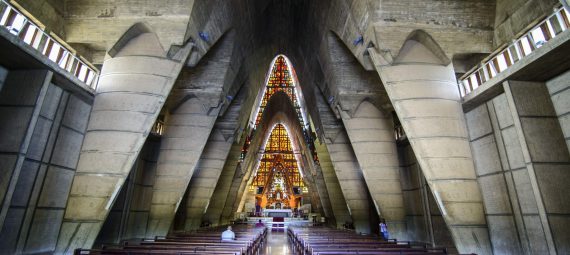
Cathedral of Nuestra Senhora de La Altagracia, Dominicana
What can lead a tourist to a city lost in the east of the Dominican Republic with a beautiful name Salvaleon de Higuey (translated from the language of the Taino Indians – “where the sun rises”)? The resort of Punta Cana with idyllic hotels and beaches stretches 50 km from here, and the picturesque streets of Higuey are always quiet and sparsely populated.
Well, or almost always: once a year, on January 21, on the day of the memory of the patron saint of the province, Madonna la Altagracia, it turns into one of the largest Catholic pilgrimage centers in the Caribbean.
And all because in 1971, the 80-meter cathedral of Nuestra Senhora de la Altagracia was built here for 3,000 parishioners, resembling rather the scenery for “Star Trek”. The massive concrete facade with a brick-red base and a blue figured lattice is crowned by an elongated arc of stone, forming a kind of needle’s eye, through which the Dominican sky looks through.
Inside there are spacious covered galleries, an atrium, a well—groomed garden and the revered icon “Our Lady of Altagracia”, the golden frame for which was personally granted by the Pope. All this is especially impressive at the end of the day: through the wall opposite the main entrance, entirely consisting of stained glass windows, the setting sun penetrates and illuminates the white walls, gently curving into the dome.
Notre Dame du Haut, France
The smooth fluidity of forms is also notable for Notre Dame du Haut, aka the Ronchamp Chapel, aka The Virgin Mary on High. She should be standing somewhere in Alberobello — she would look very harmonious among trulli, fabulous houses with cone roofs. But no, it was erected in France on the picturesque Vosges hill near Belfort, masterfully inscribed into a complex landscape.
The author of the project is the legendary Le Corbusier, who stood at the origins of functionalism and modernism. Far from religion, he had long doubted the proposal of the priest Marie-Alain Couturier, who had previously worked with Matisse and Chagall and wanted to create something grandiose. But when he arrived in Ronchamp, he agreed, demanding complete freedom of action.
Freedom is indeed evident in everything: the curved roof is a reference to the sink, which the architect—genius once found on a beach in Long Island and considered an ideal symbol of shelter and security. The chapel towers echo the early sketches of the then student who went to Adrian’s villa for inspiration, and are oriented along the trajectory of the Sun, because in pre-Christian times there was a temple in honor of the supreme luminary.
The interior is an air—filled space with a statue of the Virgin Mary and a stone altar, “hello” to the minimalism of the pre-Roman temples of Northern Europe. The rays penetrate through chaotic holes with stained glass windows in the south wall, the play of light and shadow changes shapes with proportions at almost every point of the chapel — it’s not for nothing that Notre Dame du Haut is considered the most significant iconic building of the 20th century from an artistic point of view.
Chapel of Light, USA
Elsworth Kelly, one of the brightest representatives of minimalism in the USA, color field painting and rigid contours (hard edge style), also experimented with light and color. True, he embodied his fantasies mainly in canvases, sculptures and lithographs, having designed a single building, and even then he did not find it during his lifetime. In 2015, shortly before his death, he came up with a white T-shaped structure decorated with small, geometrically arranged windows made of colored glass.
Kelly donated the project to the Blanton Museum of Art in Austin, but never lived to see it built. For the construction of an object with an area of more than 250 sq. m needed $ 23 million, which was collected over two years.
At first, a snow—white stone building, similar to a three-dimensional figure from “Tetris”, I want to go around from all sides: colorful windows fold into a square, then into a circle, then into the sun – I wonder what awaits inside. And there is only a totemic wooden sculpture, clean walls with black and white panels and the magic of multicolored glare, unpredictably lying on the surface.
Why is an art object called a chapel? The author himself claimed that this temple is not for religious rites, but for joy and contemplation. The concept is somewhat similar to the Rothko Chapel in Houston, where instead of icons there are paintings by the famous expressionist, and instead of services there are concerts of new age, meditation and yoga.
Votruba Temple, Austria
Vienna with its theaters, museums and palaces confidently ranks among the top most solemn European capitals. It is all the more unexpected to see a gray, gloomy pile of concrete blocks on the St. Georgenberg mountain, not far from the Vienna Forest. And it is even more unexpected to find out that this is the Roman Catholic church of the Holy Trinity, or the temple of Votruba – by the name of the architect.
152 cubes of different sizes ranging from 0.6 to 64 cubic meters. m and weighing from 2 to 140 tons seemed to be poured from above by someone’s hand into an awkward pile 15.5 m high. Fritz Votruba, an adept of Cubism and archaic, and Dr. Margaret Ottillinger, who started the project, wanted to prove that simplicity does not necessarily equal ugliness, and religion is boredom and triviality.
The Votruba Temple is a unique mix of sculpture and architecture, Art Nouveau and brutalism, not immediately appreciated by conservative Austrians. Today, masses gather up to 250 parishioners at a time: in a spacious bright hall with oblong windows — a sharp contrast with the “heavy” facade — it is pleasant to be and think about the eternal.
Transparent Church, Belgium
But the Transparent church in the town of Borglon (Limburg province, Belgium) is quite classic in shape: a rectangular base, a pointed dome, a cross at the top. But what on the one hand seems to be a monolith, on the other appears ephemeral, like a structure floating in the air, the walls are pierced by the sun’s rays, the laws of physics recede.
The church was created by young architects Peterjan Gijs and Arnout Van Waerenberg, participants of the Z-OUT project, designed to fill architecture with a new meaning and return interest to it, closely intertwining traditions with innovations.
The second name of the 10-meter church, in the guise of which Flemish notes sound, is “Reading between the lines”, and literally. The strings are 100 layers of steel plates 1.5 cm thick, and between them are thousands of jumpers that create transparent cavities. Sunlight streams through them, so that the building looks completely different depending on the viewing angle and time of day.
Another hidden meaning is unity with the stunning Flemish nature: the church does not just fit into the landscape, but becomes a part of it, a natural extension. Of course, there are no services inside, but art always encourages action: looking at the familiar from an unusual angle, next time someone will want to go to an ordinary Flanders church.