
Pyramids of Giza
The Pyramids of Egypt are a unique architectural monument that has remained for centuries thanks to mysterious builders who managed to create structures so durable that no natural disasters and destructive wars could completely destroy these ancient Egyptian necropolises. The mystery of the pyramids has not yet been solved: it is impossible to speak with certainty about the method of their construction, or about who acted as the main labor force. Now there are about 118 pyramids in Egypt, the most famous of them are the pyramid of Cheops and the pyramids of Djoser, Mikerin and Khafren located here on the Giza plateau. By the way, the pyramid of Cheops was the highest structure on the planet for 4,000 years, until its record was broken by the Eiffel Tower in 1889.
The Giants of Easter Island
Giant moai statues carved from stone are the main reason for tourist interest in Easter Island, lost at the edge of the world. There are about 900 statues on the island, most of them are located near the Rano Raraku volcano. Moai stand along the coast and look at the island. It is difficult to say what their mission is, but hundreds of books have been written about the history of their origin, films have been shot, and there is still no clue. Some believe that they were brought to the island by aliens, others are sure that such statues could only be made by giant people 3-4 meters tall. Another version is that these idols came to the island themselves, but later forgot how to walk and stayed here forever.
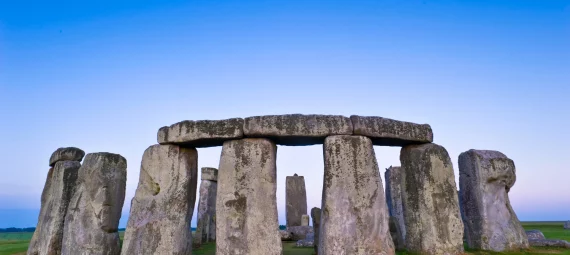
Stonehenge
Stonehenge is a mysterious stone megalithic structure on the Salisbury Plain, listed by UNESCO. The first researchers associated the construction of Stonehenge with the Druids. However, further excavations pushed back the time of Stonehenge’s creation to the New Stone and Bronze Ages — and now it is believed that the construction of the main moat and ramparts dates back to 3020-2910 BC. Legends associated the construction of Stonehenge with the name of the wizard Merlin. In the middle of the 17th century, the English architect Inigo Jones put forward a version that Stonehenge was built by the ancient Romans… and so there are many versions. But the exact interpretation of this mysterious structure has not been found so far. The fact remains that only exceptionally skilled builders could arrange the giant boulders so perfectly that they stood for 5,000 years.
The Great Wall of China
Perhaps there is not a single civilized person in the world who has not heard of the “eighth wonder of the world” — the Great Wall of China. It stretches from the Liaodong Bay northeast of Beijing through Northern China into the Gobi Desert. There are several opinions about its exact length, but what can be said for sure is that it stretches for a distance of more than two thousand kilometers, and if you take into account other ramparts extending from it, the total is all 6000-6500 km. According to the official version, the construction of the Great Wall began in the 220s BC by order of the ruler of Qin Shi Huang. The wall was built three times, over a period of 2,700 years, and approximately two million people died during its construction. However, some scientists still wonder whether the construction of this gigantic monument was possible in the conditions of Ancient China.
Angkor Wat
The Angkor Wat Temple, dedicated to the Hindu god Vishnu, is the largest religious building in the world. In total, there are about 200 monuments on the territory of more than 400 square kilometers — temples and pavilions, palaces, pyramids and mausoleums. The construction of Angkor dates back to the 10th-12th centuries, in those years it was one of the largest cities in the world, and its temples were known far beyond the Khmer Empire. In 1431, Siamese troops practically destroyed the city, forcing the inhabitants to leave it. Since then, Angkor and more than 100 palaces and temples left behind by the Siamese army have been hiding under the shadow of a lush tropical forest. Until the end of the 19th century, the French naturalist Anne Mouot published a number of works on Angkor. By the way, Rudyard Kipling wrote his “Jungle Book” about Mowgli after visiting Angkor.