
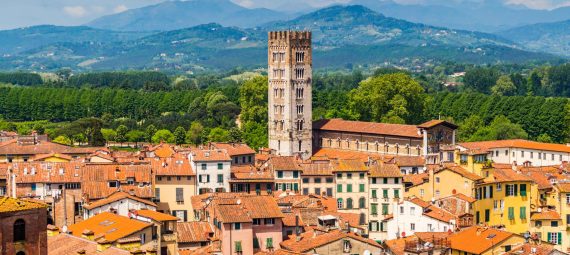
Basilica of San Frediano
This church on the square of the same name can be recognized by the characteristic shape of the facade and a huge painting that remembers its entire upper part. The church was first consecrated in honor of St. Vincent, a martyr from Zaragoza, and Bishop Fridianus of Lucca served there since the 6th century.
Guinigi Tower
Like many of the city’s attractions, the Guinigi Tower is related to a wealthy merchant family, the most influential family of Lucca in the 13th century. The medieval appearance of the Guinigi mansions between Via Sant’Andrea and Via Guinigi has survived to the present day, almost unchanged.
Cathedral of San Martino
The construction of the Cathedral in Lucca was begun in 1063 by Bishop Anselm (later Pope Alexander II). This Roman Catholic cathedral is an outstanding architectural masterpiece, although somewhat heterogeneous in appearance due to age and numerous improvements.
Palazzo Mansi National Museum
Like the National Museum of Villa Guinigi, this museum occupies an ancient rich mansion, where in the first half of the 20th century a part of the general collection of the National Museum of Lucca was moved from the Palazzo Pubblico. The beautiful Palazzo building serves as a reminder of the centuries-old history of the noble Mansi family.
The Botanical Garden of Lucca
The Lucca City Botanical Garden was founded in 1820 by Maria Luisa, Duchess of Parma, and today you can admire a lot of old trees, some of which are also of botanical interest.
The Ducal Palace in Lucca
The monumental Palazzo Ducale is located on the site of Fortezza Augusta, the former residence of Castruccio Castracani, whose palace was probably designed by Giotto himself. The palace complex occupied approximately 20% of the entire territory of Lucca until 1370, when it was destroyed.