
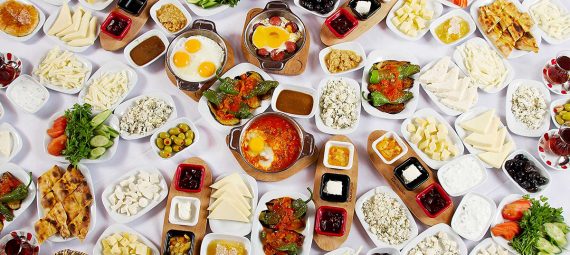
What is included in the Turkish breakfast?
Before we sort out the Turkish breakfast by components, we note that each region has its own specialties. For example, corn porridge is traditionally served on the Black Sea coast, various dishes with olives are served along the Aegean and Mediterranean coasts, and in the already mentioned Van region, breakfast invariably includes unique local cheeses. In a metropolis like Istanbul, you can find all the regional specialties at once.
Snacks. A variety of snacks, laid out on small plates, occupy the largest space of the table. Here you will find jams, marmalade, caramel, sesame paste tahini, butter, olives and olives. Among the snacks, there is often ajuka (acuka) – a spicy paste of tomatoes, peppers, nuts and spices, which should be eaten with bread. However, the most delicious dish on the table is kaymak (heavy cream) with honey. Kaymak should be spread on bread (simit bagel is ideal for this), and add honey on top. It’s really the food of the gods! In case you like kaymak, you can buy it in regular supermarkets.
Cheeses. A significant part of the table is occupied by a cheese board (peynir). Cheeses in Turkey are made from cow’s, sheep’s and goat’s milk. The most common breakfast options are similar to cheese beyaz peynir and ezine peyniri, yellow, reminiscent of cheddar kaşar peyniri, fibrous tel peyniri and the familiar pigtail cheese ögü peyniri. Crumbly goat cheese tulum peyniri is extremely popular, which, according to tradition, must be kept for 4-5 months in the skin of an animal. Among the specialties you can find cheese with the addition of red and black peppers sürk peyniri, smoked Adyghe cheese from the coast of the Marmara Sea çerkes peyniri and cheese with herbs from the Van – van otlu peyniri region. Among other things, they can also serve lor peyniri, which resembles our cottage cheese.
Smoked meat. Traditionally, the Turkish breakfast includes sujuk – dry beef sausages with spices and garlic. They are often added to scrambled eggs, but they can also be served cut into pieces with yogurt. If a separate board with smoked meats is placed on the table, then there will definitely be a dry basturma (pastirma) on it.
Eggs. No Turkish breakfast is complete without scrambled eggs. It can be fried without frills (yumurta), add sujuk to it (sucuklu yumurta) or cook a Turkish vegetable omelet menemen (menemen). Tomatoes, peppers and onions are put in the omelet, sometimes a little cheese is added. Often, when ordering breakfast on a plate (kahvaltı tabağı), designed for one person, scrambled eggs are replaced with simply boiled egg.
Vegetables, nuts, dried fruits. During the Turkish breakfast, a vegetable plate with tomatoes, cucumbers, carrots and hot peppers is always served on the table. In more expensive versions, there are, for example, avocados. But fruits, and desserts in general, are rarely included in Turkish breakfasts. The maximum can be added grapes, nuts or dried fruits to a cheese plate.
Junk. Despite the fact that corn porridge mıhlama is considered a typical dish for the Black Sea coast of Turkey, it is served in cafes and restaurants throughout the country. However, they are rarely included in the set menu and are more often offered to order separately. Mylama is made from corn flour and cheese. Therefore, it resembles fondue rather than porridge. They serve it hot with a mandatory ritual — to lift the spoon and show how stringy it is. The junk is insanely satisfying, so when ordering it for a big breakfast, think twice.
Bread. The bread basket for Turkish breakfast is also impressive. There can be simita bagels, pişi donuts, puff pies or börek puffs, thin pita bread with cheese and gozleme greens wrapped in it, ordinary freshly baked wheat bread ekmek or bazlama tortillas.
Drinks. And, of course, no Turkish breakfast is complete without tea. As a rule, tea in this case is served without restrictions: either in a thermos or a teapot, or by topping it up in your cup. As a rule, coffee is not included in the traditional Turkish breakfast, but it can be ordered after the meal.
Due to the fact that Turkish breakfast is so popular with both locals and tourists, it is offered at every turn in Istanbul. However, if you don’t know a place with a really decent breakfast, you can spend a significant amount on a plate of cheeses, smoked meats and snacks from a nearby supermarket.
The second difficulty with Turkish breakfast is that it is almost impossible to eat it. As a rule, you can feed two people with breakfast for one person, and four hungry people can barely overpower a set for two. In addition, in many establishments empty plates are considered a challenge and endlessly put snacks and bread. Therefore, when going to a Turkish breakfast, be prepared that most likely you will have to leave the food for disposal. By the way, this issue is constantly being raised in the local gastronomic environment. Therefore, some restaurants simply remove Turkish breakfast from the menu, others try to reduce portions to the minimum, others suggest ordering not a set breakfast, but its individual components.
The undoubted advantage of Turkish breakfast: in most cafes and restaurants it is served until 14:00, and in establishments specializing only in breakfast, it can be ordered throughout the day. However, the latter close already at 17:00-18:00.