
 Science
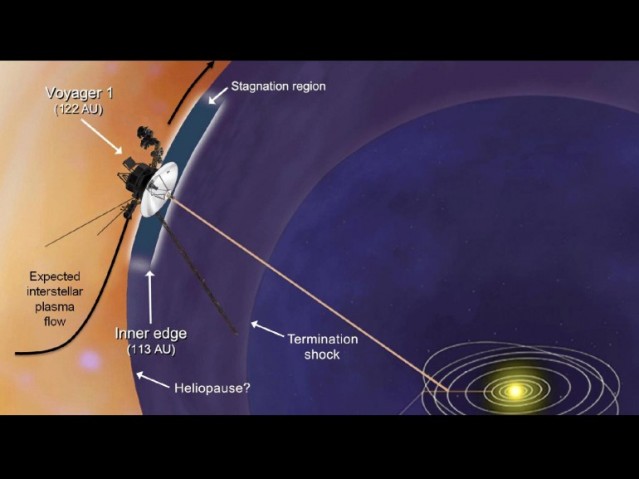
The Voyager 1 spacecraft, which was launched in 1977, has entered a new, previously unknown region of the Solar System. The region, called the “magnetic trail”, will be the last on the way to interstellar space.
Voyager 1 will be the first human-made object to leave the solar system.
The probe is now 18 billion km away from the Sun. At this distance, radio signals traveling at the speed of light reach our planet in 17 hours. (Light travels at 300,000 km per second)
“Although Voyager 1 is still inside the solar environment, you can already feel what it is like outside, as particles rush in and out on this “magnetic path”, said the presenter Voyager project scientist.
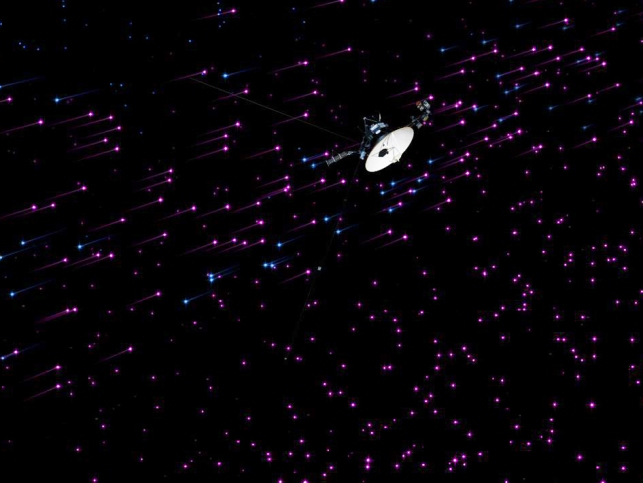
It may take a few more months to several years before the spacecraft reaches the boundary between the solar system and the rest of space.
A new region on the edge of the solar system was an unexpected discovery for scientists. Here, the lines of force of the Sun's magnetic field are connected to the magnetic field lines of interstellar space. This phenomenon allows high-energy particles from distant supernova explosions and other cosmic events to pass through, while less energetic solar particles remain.
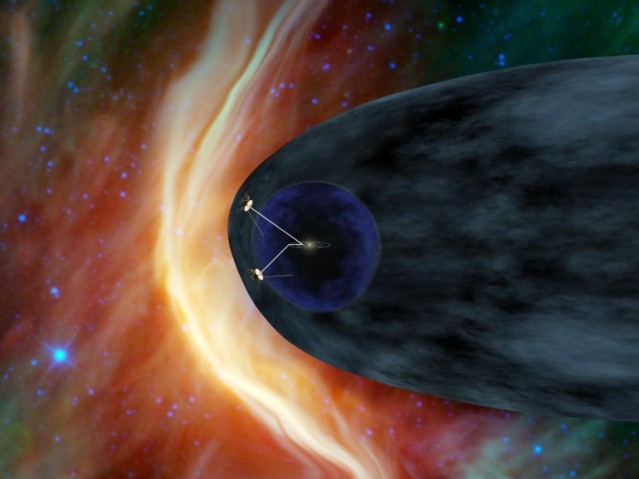
“It's like a highway that lets in and releases particles,” the scientists explained.
Voyager at the edge of the solar system
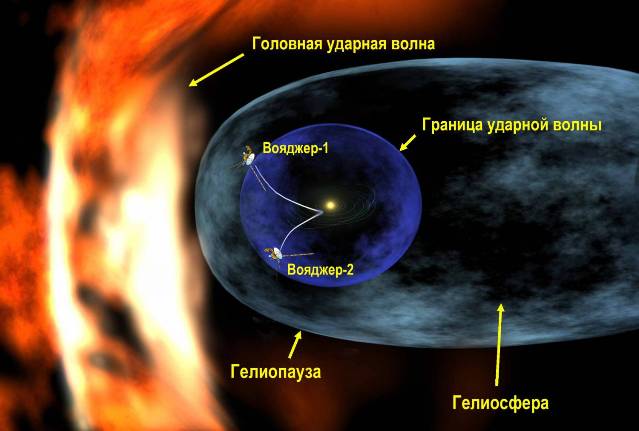
The Voyager project was launched 35 years ago with a mission to explore the distant planets of the Solar System. Although Voyager 2 was the first to be launched, it is closer to 15 billion km from the Sun. After both Voyagers transmitted images of Jupiter and Saturn, Voyager 2 went to Uranus and Neptune. So far, these are the only vehicles exploring these icy worlds.
At the same time, Voyager 1, using Saturn's gravity, went to the edge of the solar system.
Although the cameras on the devices have been off for a long time, they receive enough power to operate until about 2020.
The structure of the solar system
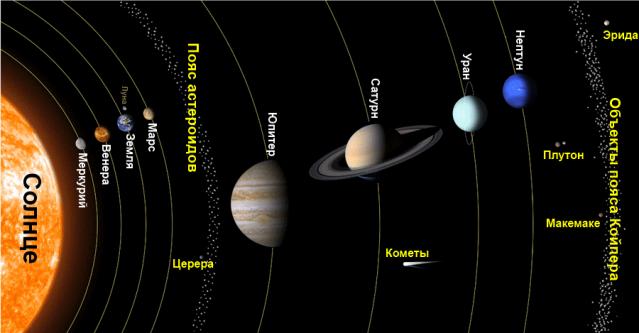
At the center of the solar system is the Sun. The closest planets to the Sun are Mercury, Venus, Earth, and Mars.
Behind them are four gas giant planets: Jupiter, Saturn, Uranus, and Neptune. Between the orbit of Mars and Jupiter is the asteroid belt, where the dwarf planet Ceres is located.
Beyond Neptune's orbit lies the Kuiper Belt, where the dwarf planet Pluto is located. And far beyond it are remote regions of the Solar System: the Oort cloud and the heliopause are the theoretical boundary of the Solar System.